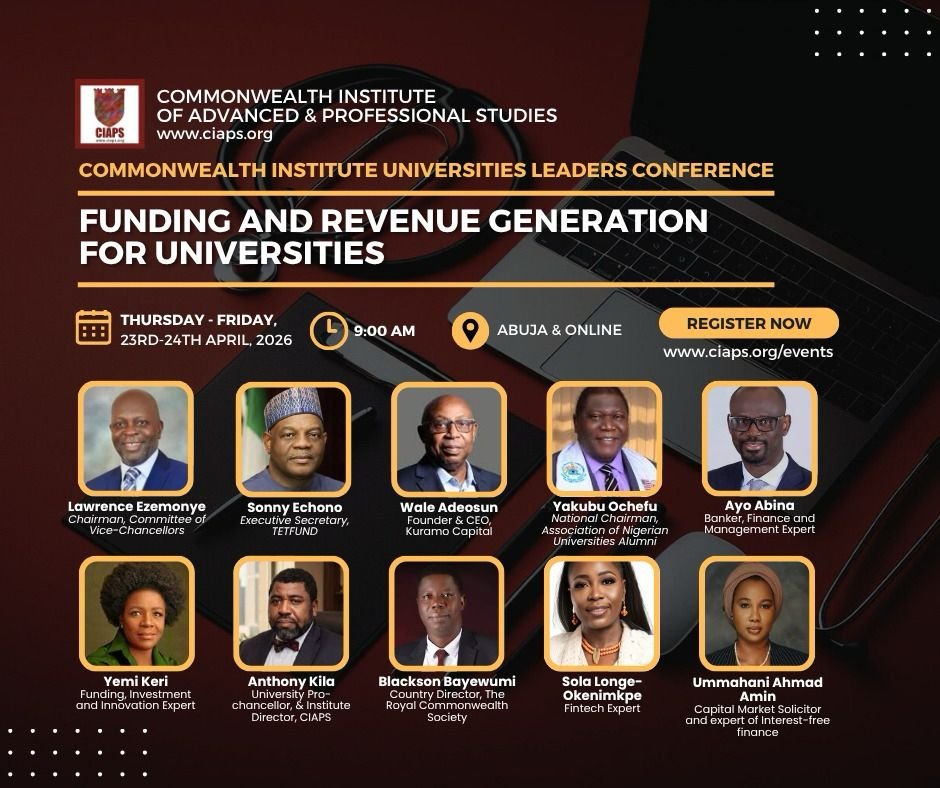
Senior university administrators, policymakers, and financial experts from across the Commonwealth are set to gather in Abuja later this month for a high-level conference aimed at addressing mounting financial pressures in the higher education sector, with a strong focus on sustainability and revenue diversification.
The two-day event, tagged the Commonwealth Institute Universities Leaders Conference, is scheduled to be held from April 23 to 24, 2026, in Nigeria’s capital. It comes at a time when universities across Africa and other Commonwealth countries are struggling with rising operational costs, tightening public funding, and increasing competition for students and research grants.
Organisers say the conference is deliberately structured as a solutions-driven platform, moving beyond theoretical discourse to provide actionable strategies that institutions can adopt to strengthen their financial resilience and long-term viability.
The central theme “Funding and Revenue Generation for Universities”, reflects growing concerns about the sustainability of higher education institutions operating in environments where government subventions are either declining or insufficient to meet expanding needs.
Participants are expected to include vice-chancellors, founders, registrars, bursars, governing council members, and development officers, alongside policymakers and investment professionals.
Key sessions at the conference will focus on practical pathways for unlocking new funding sources and strengthening institutional frameworks. Discussions will cover access to intervention funding, engagement with development finance institutions, and strategies for attracting private capital, donors, and international partners.
A major area of emphasis will be the need for universities to reduce reliance on tuition fees by developing alternative income streams. Stakeholders will examine opportunities in research commercialisation, executive education programmes, consultancy services, and structured alumni engagement as viable revenue channels..
The conference will also address governance as a critical enabler of financial sustainability. Strengthening institutional credibility, transparency, and accountability is expected to feature prominently in discussions, particularly in relation to attracting investment and building trust with stakeholders.
Among the confirmed speakers are prominent figures from academia, finance, and policy circles, including Sonny Echono, executive secretary of TETFund; Lawrence Ezemonye, chairman of the committee of vice-chancellors; Wale Adeosun, chief executive officer of Kuramo Capital; Ummahani Ahmad Amin, a capital market solicitor and expert in interest-free finance; and Yemi Keri, a funding and innovation specialist.
Others include Blackson Bayewumi, country director of the Commonwealth Society, and Sola Longe-Okenimkpe, a fintech expert and Commonwealth scholar. The sessions will be moderated by Anthony Kila, director of the Commonwealth Institute, who is expected to steer discussions toward practical outcomes and cross-sector collaboration.
A key highlight of the gathering will be the unveiling of the Commonwealth Collegium, a proposed alliance of universities designed to foster collaboration in research, funding, and academic exchange across member countries. The initiative is expected to enhance knowledge sharing and create new opportunities for joint funding and cross-border academic partnerships.
Speaking ahead of the event, Anthony Kila noted that the initiative reflects a growing recognition of the need for universities to collaborate internationally in order to remain competitive in an increasingly globalised education landscape.
Similarly, Prof. Yakubu Ochefu, an expert in economic history and development studies, described the conference as timely, particularly for institutions in emerging economies that must balance expansion with financial sustainability.
For many stakeholders, the Abuja conference represents more than a routine academic gathering. It is increasingly seen as a strategic platform for redefining how universities are funded, governed, and positioned within a rapidly evolving global knowledge economy.