Barely three months into 2026, fresh data from RationalFX indicates that job cuts across the global technology sector are continuing at a pace that could exceed last year’s totals, indicating that the industry’s reset is far from complete.
In its latest analysis, the firm reported that 45,363 technology workers have already been laid off worldwide since January, a figure that reflects the persistence of a downsizing cycle that began after the pandemic-era hiring surge. According to the report, if the current rate of redundancies is sustained, total layoffs in 2026 could surpass the 245,000 recorded in 2025.
The financial research firm noted that the ongoing wave of layoffs follows several years of post-pandemic adjustment, during which nearly one million jobs were eliminated globally. What initially emerged as a correction from aggressive expansion has developed into a more fundamental shift in how technology companies structure their operations.
The report highlighted that by 2025, factors such as automation, artificial intelligence integration, and stricter cost controls had become central to corporate restructuring strategies. Entire teams were either scaled down or eliminated, as firms increasingly adopted leaner operating models supported by AI-driven tools. RationalFX said these trends have carried into 2026 with little sign of easing.
A regional breakdown of the data shows that the United States accounts for the largest share of job cuts so far this year. According to RationalFX, 30,846 layoffs. The report identified major contributors to these reductions, including Amazon, Meta Platforms, and Block Inc..
In Australia, the report recorded 2,650 layoffs, largely concentrated within two companies. WiseTech Global accounted for the bulk of the cuts with 2,000 job losses, while Telstra reduced its workforce by 650 roles. RationalFX observed that although the overall number is smaller compared to the United States, the concentration of layoffs within a few firms underscores the depth of restructuring in specific markets.
Across Europe, RationalFX reported a moderate but notable level of job cuts, particularly in Sweden, the Netherlands, the United Kingdom, the Czech Republic, and Germany. The firm linked these reductions to ongoing structural adjustments in sectors such as telecommunications, semiconductors, and gaming. Companies including Ericsson and ASML were cited among those undertaking workforce reductions as part of broader efficiency measures.
In Asia, the report recorded 4,595 layoffs across several markets, with Israel, India, and Singapore accounting for the largest shares. RationalFX noted that the job cuts span a range of industries, including artificial intelligence startups, cybersecurity firms, e-commerce platforms, and electric mobility companies. A significant portion of these layoffs, the firm added, is tied to automation and AI adoption, particularly in Israel and Singapore.
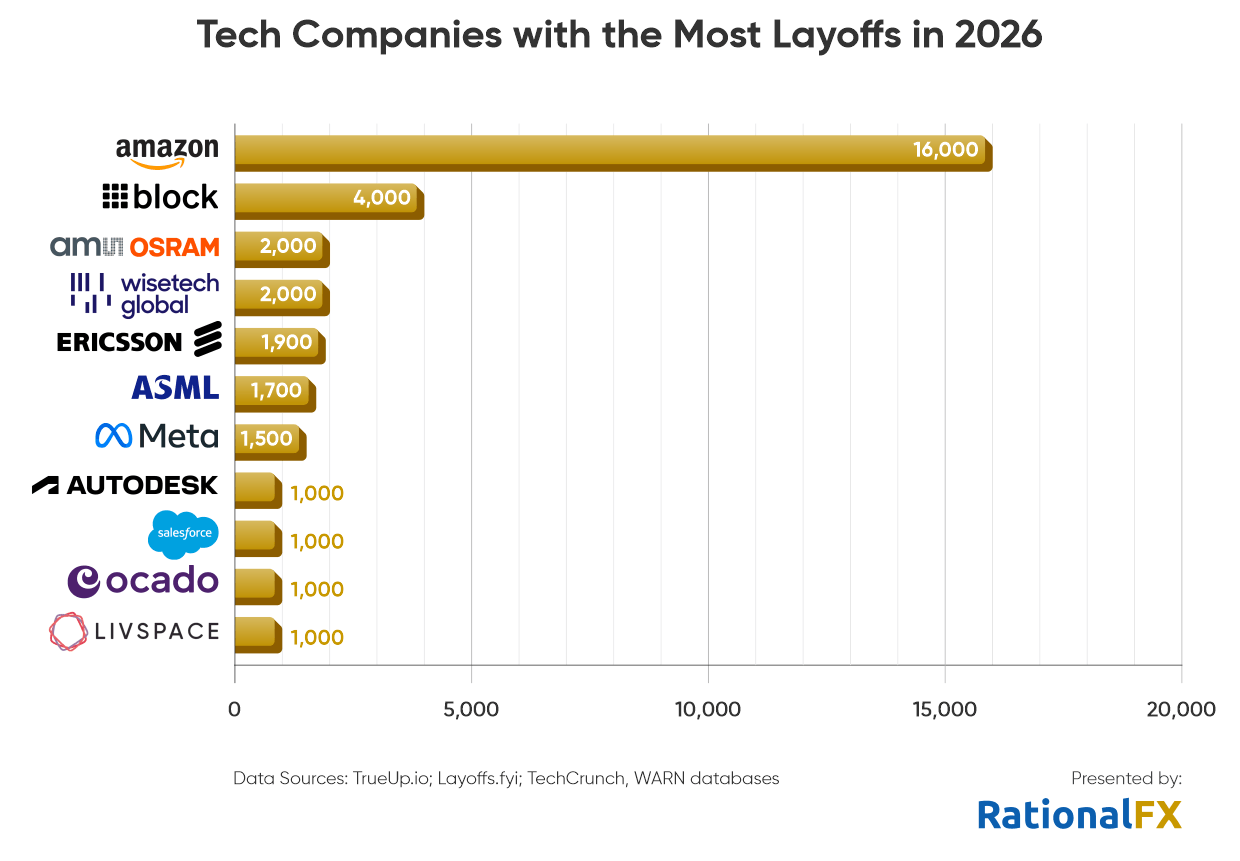
At the company level, RationalFX identified Amazon as the largest single contributor to layoffs in 2026 so far. The company has announced plans to cut 16,000 jobs this year, following nearly 20,000 layoffs in 2025. According to the report, Amazon attributed the move to efforts aimed at improving efficiency, streamlining reporting structures, and accelerating decision-making, even as it continues to post strong revenue growth and invest heavily in artificial intelligence and cloud infrastructure.
Similarly, Block Inc. is planning to reduce its workforce by 4,000 roles as part of a restructuring effort. RationalFX said the company is seeking to flatten management layers and eliminate overlapping positions while increasing investment in AI tools and Bitcoin-related products.
The report also pointed to planned job cuts at ams OSRAM, which intends to eliminate around 2,000 roles, as well as restructuring efforts at WiseTech Global. In Europe, Ericsson and ASML were highlighted for significant workforce reductions tied to cost-efficiency strategies.
For Meta Platforms, RationalFX reported that approximately 1,500 jobs have been cut within its Reality Labs division, representing about 10 percent of that unit’s workforce. The move reflects a shift in focus away from metaverse investments toward artificial intelligence, following sustained losses in the division.
A key theme running through the report is the growing role of artificial intelligence in shaping workforce decisions. RationalFX estimated that 9,238 of the layoffs recorded so far in 2026 are directly linked to AI adoption, automation, or related organisational restructuring. The firm said many companies are transitioning toward AI-assisted workflows, which require fewer employees to manage operations.
Among the companies cited in this context are eBay and Pinterest, both of which have reduced headcount while emphasising efficiency gains from automation. Additional reductions linked to similar trends were reported at Oracle and several smaller technology firms across different regions.
Geographically, RationalFX identified Seattle, San Francisco, and Menlo Park as the US cities most affected by layoffs, reflecting the concentration of major technology firms in those locations. Outside the United States, Sydney emerged as a key hotspot due to workforce reductions at WiseTech Global, while European hubs such as Stockholm and Veldhoven also recorded notable job losses.
Looking ahead, RationalFX cautioned that the pace of layoffs could accelerate further if current trends persist. The firm projected that total job cuts in 2026 could reach 264,730 by year-end, surpassing the previous year’s figures.
The report concluded that the technology sector is entering a phase defined by structural transformation rather than temporary adjustment. While companies continue to invest heavily in artificial intelligence and automation, RationalFX noted that these shifts are reshaping workforce requirements across the industry. It added that although some firms are exploring reskilling and redeployment strategies, the speed of technological change raises questions about whether new job creation can keep pace with ongoing displacement.