Business A.M
No Result
View All Result
Wednesday, March 4, 2026
  • Login
  • Home
  • Technology
  • Finance
  • Comments
  • Companies
  • Commodities
  • About Us
  • Contact Us
Subscribe
Business A.M
  • Home
  • Technology
  • Finance
  • Comments
  • Companies
  • Commodities
  • About Us
  • Contact Us
No Result
View All Result
Business A.M
No Result
View All Result
Home Frontpage

IMF issues warning on rising global debt, says high debts make govt. finances vulnerable to shocks

by Admin
April 18, 2018
in Frontpage
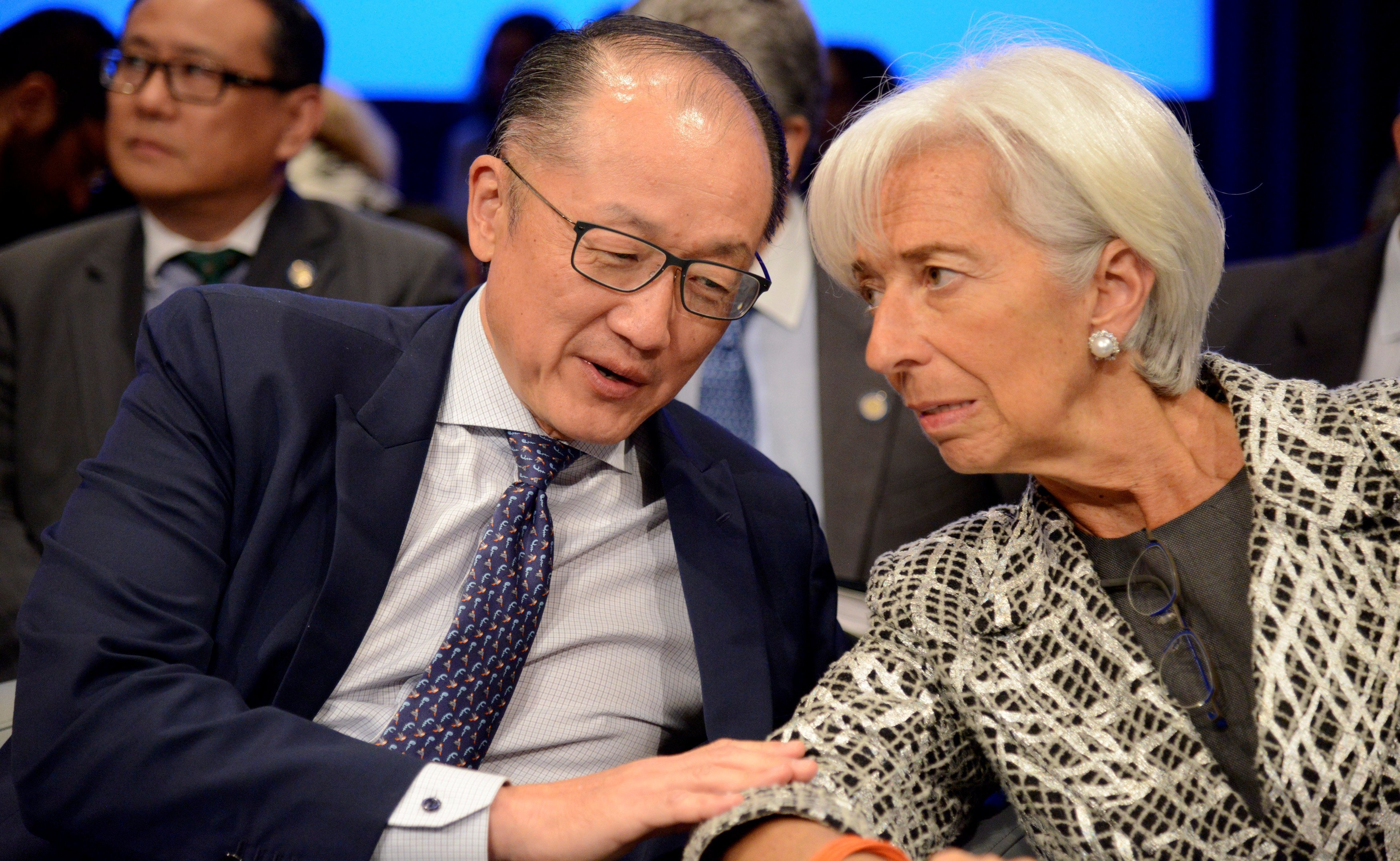
Jim Yong Kim, World Bank President and Christine Lagarde, IMF chief

The International Monetary Fund (IMF), concerned with the world’s rising debt profile, has urged governments to use the current strong economic growth to strengthen their finances, warning that high debt makes governments’ financing vulnerable to sudden changes in market sentiments.

“Countries should use the window of opportunity afforded by the economic upswing to strengthen the state of their fiscal affairs,” the IMF advised in its blog, the IMFBlog, Wednesday 18, 2018.

The IMF said global debt hit a new record high of $164 trillion in 2016, the equivalent of 225 percent of global GDP, and that both private and public debt have surged over the past decade.

“High debt makes government’s financing vulnerable to sudden changes in market sentiment. It also limits a government’s ability to provide support to the economy in the event of a downturn or a financial crisis,” it said, adding that the April 2018 Fiscal Monitor explores how countries can reduce government deficits and debt in a growth-friendly way.

Of the $164 trillion, 63 percent is nonfinancial private sector debt, and 37 percent is public sector debt, with advanced economies responsible for the most global debt, it said.

However, the fund pointed out that in the last ten years, emerging market economies have been responsible for most of the increase with China alone contributed 43 percent to the increase in global debt since 2007. In contrast, the contribution from low-income developing countries is barely noticeable.

High levels of sovereign debt could make it difficult for governments to refinance when their debt reaches maturity, especially if financing conditions tighten, the IMF said, warning that large debts also impede the ability of nations to increase spending if their economies fall into recession, and may cause a drag on growth.


Read also: EM managers urged to strengthen economic fundamentals against short-term risks to global financial stability


“Countries with elevated government debt are vulnerable to changing financing conditions, which could hinder their ability to borrow, and put the economy in jeopardy. Furthermore, historical experience shows that high debt and deficits in a country increase the depth and duration of a recession—such as in the aftermath of a financial crisis—because governments are unable to deploy sufficient fiscal support to the economy, as discussed in the October 2016 Fiscal Monitor,” it noted.

The IMF said countries should take decisive action to rebuild their fiscal buffers so they can increase spending during hard times. The fund urged the U.S., whose budget deficit is expected to surpass $1 trillion by 2020, to “recalibrate” its fiscal policy so government debt-to-GDP levels decline over the medium term.

On what should fiscal policy do, it said its forecasts indicate that debt-to-GDP ratios would come down over the next three to five years in most countries. But this hinges on countries delivering fully on their policy commitments. There is no room for complacency.

“In the April 2018 Fiscal Monitor, we urge policymakers to avoid fiscal policies that provide unnecessary stimulus when economic activity is already picking up. Instead, most advanced, emerging market, and low income developing countries should deliver on their fiscal plans, and put deficits and debt firmly on a downward path. They should also enact fiscal reforms that increase productivity and promote human and physical capital.

“It is imperative that low-income developing countries strengthen their tax capacity. This will allow them to service their debt. It will also allow them to finance spending priorities—such as health, education and public infrastructure—to attain the 2030 Sustainable Development Goals.

“No one can predict the ebb and flow of countries’ economies. Prudent and successful governments prepare in good times to face the storms looming on the horizon,” it posited.


Admin
Admin
Previous Post

Wema Bank to issue second tranche of N50bn bond in May to boost capital ratio

Next Post

Cocoa posts higher future prices, rising 5.5% above trading speculations

Next Post

Cocoa posts higher future prices, rising 5.5% above trading speculations

  • Trending
  • Comments
  • Latest
Igbobi alumni raise over N1bn in one week as private capital fills education gap

Igbobi alumni raise over N1bn in one week as private capital fills education gap

February 11, 2026

Glo, Dangote, Airtel, 7 others prequalified to bid for 9Mobile acquisition

November 20, 2017

How UNESCO got it wrong in Africa

May 30, 2017

CBN to issue N1.5bn loan for youth led agric expansion in Plateau

July 29, 2025

6 MLB teams that could use upgrades at the trade deadline

Top NFL Draft picks react to their Madden NFL 16 ratings

Paul Pierce said there was ‘no way’ he could play for Lakers

Arian Foster agrees to buy books for a fan after he asked on Twitter

Nigerian Exchange breaks N91trn mark as equities rally

NGX snaps rally as N101.9bn wipeout hits market cap

March 4, 2026
Oil market weighs softer U.S. demand against rising OPEC supply outlook

Oil rally pauses as U.S. jobs data offsets Hormuz war risk

March 4, 2026
Gas supply disruption to OML 18 cuts power supply across 9 Abia LGAs

Gas supply disruption to OML 18 cuts power supply across 9 Abia LGAs

March 4, 2026
PalmPay marks International Women’s Day 2026 with ‘Purple Woman 3.0’ tech masterclass

PalmPay marks International Women’s Day 2026 with ‘Purple Woman 3.0’ tech masterclass

March 3, 2026

Popular News

  • Igbobi alumni raise over N1bn in one week as private capital fills education gap

    Igbobi alumni raise over N1bn in one week as private capital fills education gap

    0 shares
    Share 0 Tweet 0
  • Glo, Dangote, Airtel, 7 others prequalified to bid for 9Mobile acquisition

    0 shares
    Share 0 Tweet 0
  • How UNESCO got it wrong in Africa

    0 shares
    Share 0 Tweet 0
  • CBN to issue N1.5bn loan for youth led agric expansion in Plateau

    0 shares
    Share 0 Tweet 0
  • Google, global partners roll out new standard for AI-powered payments

    0 shares
    Share 0 Tweet 0
Currently Playing

CNN on Nigeria Aviation

CNN on Nigeria Aviation

Business AM TV

Edeme Kelikume Interview With Business AM TV

Business AM TV

Business A M 2021 Mutual Funds Outlook And Award Promo Video

Business AM TV

Recent News

Nigerian Exchange breaks N91trn mark as equities rally

NGX snaps rally as N101.9bn wipeout hits market cap

March 4, 2026
Oil market weighs softer U.S. demand against rising OPEC supply outlook

Oil rally pauses as U.S. jobs data offsets Hormuz war risk

March 4, 2026

Categories

  • Frontpage
  • Analyst Insight
  • Business AM TV
  • Comments
  • Commodities
  • Finance
  • Markets
  • Technology
  • The Business Traveller & Hospitality
  • World Business & Economy

Site Navigation

  • Home
  • About Us
  • Contact Us
  • Privacy & Policy
Business A.M

BusinessAMLive (businessamlive.com) is a leading online business news and information platform focused on providing timely, insightful and comprehensive coverage of economic, financial, and business developments in Nigeria, Africa and around the world.

© 2026 Business A.M

Welcome Back!

Login to your account below

Forgotten Password?

Retrieve your password

Please enter your username or email address to reset your password.

Log In
No Result
View All Result
  • Home
  • Technology
  • Finance
  • Comments
  • Companies
  • Commodities
  • About Us
  • Contact Us

© 2026 Business A.M