The very foundations of globalisation appear to be under siege. The geoeconomic rivalry between the United States and China is intensifying. The ongoing conflict in Ukraine has ushered in the most perilous geopolitical dynamics since the end of World War II. The lingering effects of the coronavirus pandemic, chip wars and the disruption of global supply chains have led nations to adopt progressively protectionist and inward-looking industrial policies.
Amidst this backdrop, the world’s biggest economies find themselves more divided than ever. Just consider the recent G20 summit where leaders grappled to find common ground on pressing issues such as Ukraine and climate change.
Notably, China’s Xi Jinping missed the summit for the first time since taking power. Meanwhile, Xi and leaders of France, India, the United Kingdom and Russia decided not to attend the United Nations General Assembly (UNGA). While they all sent representatives, it means four of the five leaders of the permanent UN Security Council members were not present.These absences underscore the fraying threads of international unity.
At the same time, the BRICS (Brazil, Russia, India, China and South Africa) group is expanding. Collectively these major emerging economies already encompass a significant portion of the world’s population and economic power. The group’s recent decision to admit Saudi Arabia, Iran, Ethiopia, Egypt, Argentina and the United Arab Emirates signals its ambition to reshape the course of globalisation.
A major cooperation deficit
Back in 2008, political scientist Larry Diamond coined the term “democratic recession” to highlight the decline in democracies and resurgence of authoritarian regimes. Today, we find ourselves asking whether a similar trend is unfolding in the flows of trade, investment and knowledge. Are the principles of market economies under assault? Could we be experiencing a “globalisation recession” fuelled by the convergence of pandemic, geopolitics and climate risks?
The concept of globalisation should cover more than just the ever-expanding technological advances in transport and communications. It is also about decreasing obstacles to international trade and investment, increasing global supply chains and improving macroeconomic coordination among the world’s top economic players, especially those member countries of the G20.
Implicit within globalisation is the need for consensus. As economic exchanges grow, a sense of shared experience in the world fosters interdependence and interconnectedness. This not only forms the basis for productivity gains but also aids an expanded awareness of environmental sustainability, good governance and social inclusion.
However, these drivers of globalisation seem to have been in check for the past few years, particularly the globalisation of values. This relates to the idea prevalent in the 1990s that the principles of a market economy and representative democracy were the best parameters for organising societies worldwide.
Multilateralism is hurt by the globalisation recession. There is a major cooperation deficit in the world today, underlined by the absences at the G20 summit and the UNGA. Even the “BRICS Plus” expansion seems to suggest the rise of competing or conflicting forms of multilateralism.
Furthermore, we are confronted by various conflicts and tensions taking place on multiple fronts or “platforms”. These include issues like cybercrimes and terrorism, as well as widespread criticism of the Western world and its liberal political and economic systems. Instead of the “End of History”, we are witnessing the emergence of “multi-histories” – diverse and sometimes conflicting narratives, ideologies and worldviews.
In this context, we find the US grappling with uncertainty regarding its role in global affairs, as its policymakers weigh up the pros and cons of globalisation. As a result, the US seems more inclined to focus on domestic issues and less eager to assert itself as a leading global advocate for democracy and free markets.
Recent remarks by Jake Sullivan, the US National Security Advisor, indicate a shift towards a new economic doctrine characterised by protectionism and widespread subsidies across various sectors. Such a departure from globalisation in the US has far-reaching consequences, with Europe, Japan and China responding in kind.
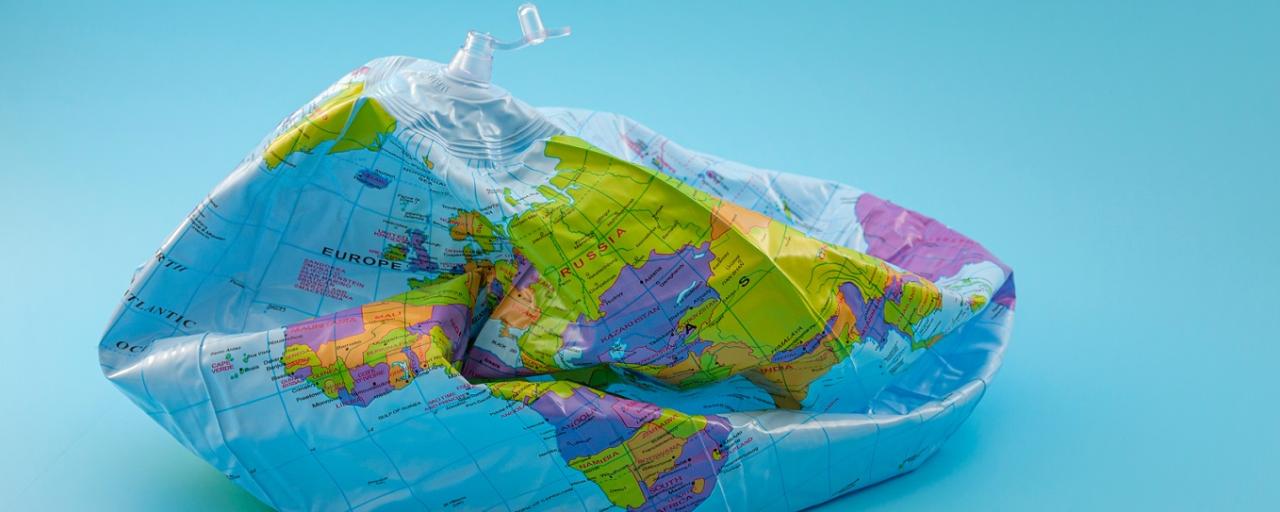
How long will the globalisation recession last?
Geoeconomically, the world is also experiencing a slowdown in regional integration and a strengthening of the nation-state as the leading player in global economic affairs. In this context, international relations (understood here as relations between nation-states) have regained prominence. While this doesn’t necessarily mean a return to extreme nationalism, it does suggest that nations are prioritising their individual interests and agendas. Additionally, some countries may be seeking to re-establish the traditional North-South divide.
With so much disconnect around the world, the question is: How long will this globalisation recession last? There are a few points to consider. The purchasing power and relative economic clout of various nations is changing. Based on World Bank data, the Group of Seven (G7) nations has a combined GDP, measured in purchasing power parity (PPP) terms, of approximately US$49 trillion. However, in the Emerging Seven (E7) economies of Brazil, China, India, Indonesia, Mexico, Saudi Arabia and Turkey – GDP at PPP is US$58 trillion.
Global value chains are being rerouted. Not only because of geopolitics and the consequential nearshoring and friendshoring of production, but also due to the growing influence of emerging economies. China, for example, has become one of the most important sources of foreign direct investment.
At a first glance, we might think the globalisation recession and a return to the old North-South economic hierarchy are here to stay. In reality, performance in the coming years will be judged less by what we once labelled either “advanced” or “emerging” economies and more by a country’s ability to respond competitively to the new chapter of globalisation that will undoubtedly be written.
The globalisation recession and the embrace of economic isolationism hurt all nations. While these trends could lead to stagnation in emerging economies, the same holds true for advanced economies that shelter behind protectionist barriers, fail to prioritise innovation and revel in costly, poorly-managed welfare states.
This next phase of globalisation is not likely to promote the deepening of cross-border interactions related to regional economic, political and legal integration. Regional entities will not take precedence over nations as the main actors in global affairs. This new phase will not bring about a far-reaching communion of different world views. Nor will it fall under a new global compact stitched together by the United Nations or the World Trade Organization.
The next chapter of globalisation will likely be more superficial than the idealised “End of History” world order envisioned after the Cold War. It will also be more selective, emerging as the result of plurilateral or bilateral trade and investment agreements.
Business-friendly ecosystems, well-established market rules and jointly developed sustainability and governance standards will collectively strengthen economic connections and drive prosperity. These should be the guiding lights as we navigate a path out of the globalisation recession and move towards a better future.