Onome Amuge
Lafarge Africa Plc, one of Nigeria’s leading building solutions companies, is turning attention to persons with disabilities (PWDs), a largely untapped segment of the country’s workforce. The company recently marked the International Day of Persons with Disabilities by hosting participants of its Disability-to-Ability (D2A) Programme, a vocational and entrepreneurial training initiative designed to equip PWDs with market-ready skills and pathways to self-reliance.
The D2A Programme, launched under the theme “Ability Reimagined,” seeks to train 100 participants across four skill sets including laptop and phone repairs, make-up and gele artistry, wig and braids making, and shoe and bag production. The initiative, implemented in collaboration with the Lagos State Employment Trust Fund (LSETF), the Lagos State Ministry of Youth and Social Development, the Lagos State Office for Disability Affairs (LASODA), and Tunde Onakoya, founder of Chess in Slums Africa, represents an intersection of corporate social responsibility, state-supported skills development, and inclusive economic growth.
The programme’s dual-hub design, operating from Ikeja in Lagos West and Ikorodu in Lagos East, ensures diverse geographic access for participants, reflecting Lafarge’s commitment to inclusivity. The approach highlights a growing trend among Nigerian corporations to embed social impact into core business strategies, particularly at a time when Environmental, Social, and Governance (ESG) considerations increasingly influence investor decisions.
Speaking at the event, Viola Graham-Douglas, Lafarge Africa’s director of communications, Public Affairs & Sustainable Development, described D2A as a reflection of Lafarge’s commitment to inclusivity, empowerment, and sustainable livelihoods. She emphasised that the initiative extends beyond technical training, offering participants mentorship, financial literacy, and entrepreneurship guidance coordinated by LSETF. “We don’t just produce building solutions; we build society, homes, and empower people to be the best they possibly can be,” she said.
The programme also dwelled on cultivating a pipeline of micro-entrepreneurs and professionals who can thrive in Nigeria’s informal economy, a sector that accounts for more than 60 per cent of national employment. By equipping PWDs with marketable skills, Lafarge is helping to address structural barriers that have historically kept disabled persons outside formal and informal labour markets.
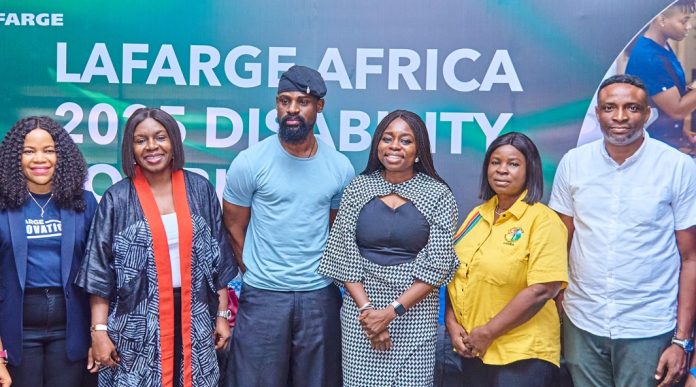
Tunde Onakoya, a Guinness World Record holder and advocate for youth and disability inclusion, drew on his personal journey to inspire participants. Despite physical challenges, Onakoya leveraged chess and education to travel internationally and create opportunities beyond conventional limitations. “Your skills are a blessing. Be diligent, believe in yourself, and use what you have to create value,” he told the trainees.
The presence of Lagos State officials underscored the public-private synergy driving the programme. Feyisayo Alayande, executive secretary of LSETF, led a speed mentoring session for participants, providing practical guidance on business management and entrepreneurial strategy. Meanwhile, the Lagos State Office for Disability Affairs (LASODA), represented by Adekola Oluwafunmilayo, director of monitoring and evaluation, highlighted the importance of collaborative responsibility. “Building an inclusive society does not rest with government alone. It requires compassion, consistent effort, and partnership from every stakeholder,” she said.
LASODA commended Lafarge and LSETF for providing starter toolkits and business registration support to graduates, interventions that facilitate immediate market participation and reduce entry barriers for PWD entrepreneurs.