Onome Amuge
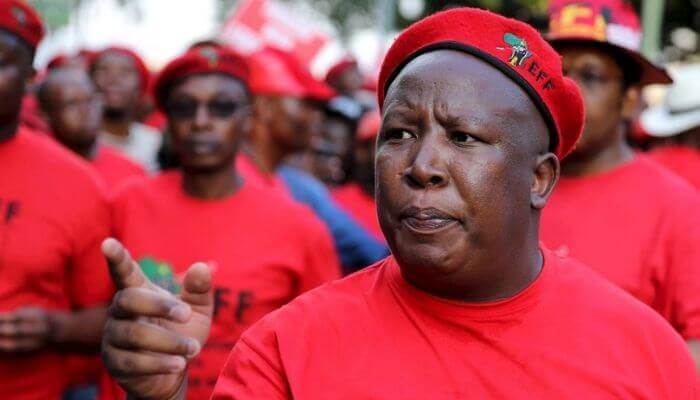
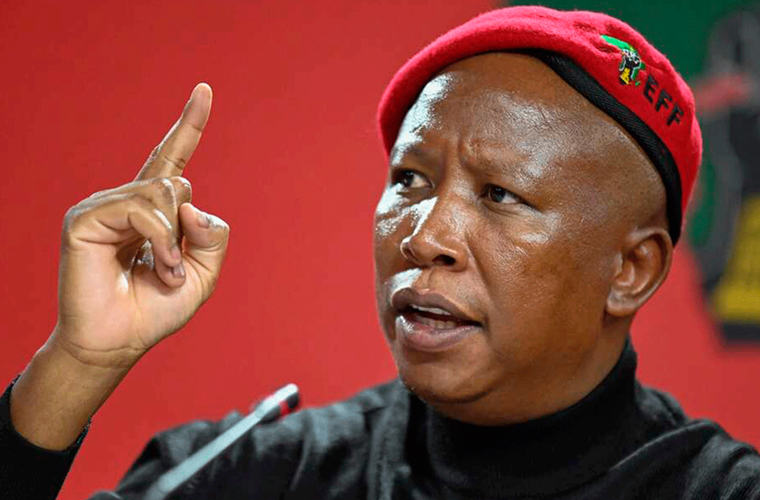
South African opposition leader Julius Malema has reignited the debate over continental unity, urging African nations to dismantle colonial borders and embrace a single government, currency, parliament and military command.
His remarks, delivered recently at the Nigerian Bar Association’s Annual General Conference in Enugu, Nigeria, have stirred both admiration and scepticism across the continent’s political and economic circles.
Malema, who leads South Africa’s radical Economic Freedom Fighters (EFF) party, argued that Africa’s fragmentation into 54 sovereign states is the biggest obstacle to realising its potential as an economic powerhouse. He said the continent’s vast mineral wealth, youthful population and strategic positioning give it a historic opportunity to assert itself in a shifting global order.
“We demand one Africa, we demand a borderless Africa, we demand an Africa with one president, one currency, one military command, with one parliament,” Malema declared before an audience of lawyers, policymakers and business leaders. “We know the currency of Africa will be much stronger against the American currency. Africans must refuse to be subjects of others. We must stand together as the world changes and show the world that Africa is one and equal to all nations,” he added.
Malema’s call echoes decades of pan-Africanist thought, from Kwame Nkrumah’s early advocacy of continental government to Muammar Gaddafi’s push in the early 2000s for a United States of Africa. Yet the political realities of national sovereignty, entrenched ruling elites and economic disparities have long blunted such ambitions.
Malema framed his appeal as a repudiation of colonial-era divisions, which he said continue to constrain African development. “The land belongs to Africans, and the minerals of Africa must be returned to Africans. We have the capacity to create industries and process our minerals here. We must never allow imperialist forces to divide us in order to take our wealth,” he said.
The EFF leader dismissed Western narratives of Africa as a dark continent,insisting instead that Africans have the ingenuity to build globally competitive industries. He was critical of external exploitation of raw materials, warning that unless Africans process and industrialise their resources, they will remain trapped in cycles of dependency.
Malema also cautioned against what he described as reckless borrowing from international lenders such as the World Bank and the IMF. “Our governments must protect Africa’s economic sovereignty. We cannot continue mortgaging our future to institutions that do not have our interests at heart,” he said.
One of the more pragmatic elements of Malema’s address was his call for visa-free travel across the continent, a policy that resonates with the African Union’s long-term goal of free movement of people. “No African should require a visa to visit another African country,” he argued, adding that dismantling barriers to mobility was crucial for deepening economic integration.
The African Continental Free Trade Area (AfCFTA), which formally began trading in 2021, was a central plank of his argument. Malema urged Nigeria and South Africa, the continent’s largest economies, to lead by example in pushing forward the agreement, which is designed to create the world’s largest single market by number of countries.
“Our salvation lies here, in Lagos and Johannesburg, in Abuja and Pretoria, in the hands of Africans who refuse to be divided,” he said, adding; “Nigeria and South Africa must provide leadership for Africa’s industrialisation and growth.”
Malema also underscored South Africa’s debt of gratitude to Nigeria for its support during the anti-apartheid struggle. Nigeria, which never had formal diplomatic relations with apartheid South Africa, was at the forefront of providing financial assistance, scholarships and political backing to the African National Congress during the 1970s and 1980s.
For Malema, who has built his political brand on fiery rhetoric and radical economic proposals, the call for a united Africa also serves a domestic purpose. With South Africa seen facing sluggish growth, stubborn unemployment and widening inequality, his message of continental solidarity is seen to resonate with younger audiences frustrated by structural economic challenges.
Malema’s intervention comes as global powers including the United States,Europe, China, India and Russia compete for influence in Africa. With the continent’s population expected to double by 2050 and its mineral resources increasingly critical to the global energy transition, Africa’s strategic importance is rising.
In this context, Malema argued, Africa’s disunity is its greatest vulnerability. “We must make sure that no single corner of Africa witnesses Africans killing each other. We must unite against the forces that seek to exploit us,” he said.