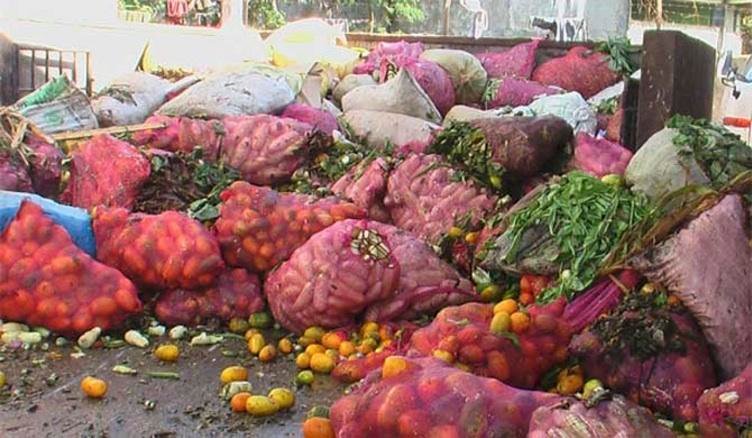
Nigeria forfeited between N3.5 trillion and N5 trillion in economic value in 2025 due to post-harvest losses, a worrisome development that highlights deep structural inefficiencies in the country’s agricultural value chain and threatens its food security, export competitiveness and macroeconomic stability.
The Organisation for Technology Advancement of Cold Chain in West Africa (OTACCWA) disclosed that the country lost an estimated 30 to 40 million metric tonnes of food within the year, largely across highly perishable categories such as tomatoes, vegetables, fruits, dairy, meat, fish and root crops.
Alexander Isong, President of OTACCWA, described the losses as a direct consequence of inadequate cold storage systems, weak aggregation networks and inefficient transportation infrastructure.
“In monetary terms, this translates to approximately N3.5 trillion to N5 trillion in economic losses,” Isong stated.
The implications stretch beyond agriculture. By the time food spoils, the economy has already deployed land, fertiliser, irrigation, labour and logistics capital. The production value exists — but never materialises as market revenue. Isong argued that inadequate cold chain infrastructure effectively wipes out GDP already embedded in harvested output.
Analysts increasingly argue that Nigeria’s agricultural challenge is no longer primarily about production volumes. Rather, it is about preservation, processing and distribution.
Isong emphasised that post-harvest loss must be understood as an infrastructure and economic systems failure rather than merely an agricultural issue. According to him, without certified, functional and scalable cold chain systems, Nigeria will continue to experience food inflation, depressed farmer income and diminished export credibility.
“The lack of adequate cold storage facilities remains the primary obstacle. Cold chain is an integral part of agriculture, and without sufficient investment, the sector’s growth and potential are severely limited,” he said.
Cold chain infrastructure includes refrigerated transport fleets, pack houses, modular cold rooms, temperature-controlled warehouses and integrated logistics platforms. In advanced agricultural economies, these systems function as the bridge between farm productivity and commercial profitability.
Countries such as the United States, China, Australia and New Zealand have significantly reduced post-harvest losses through technological integration across their value chains. In contrast, many developing countries, including Nigeria, still rely heavily on informal preservation systems.
In rural Nigeria, where a majority of food production originates, smallholder farmers often depend on open-air sun drying for cereals and legumes. Grains spread across roadsides and bare ground remain exposed to birds, rodents, insects and contamination from sand and debris.
A survey conducted by the Irucin Foundation revealed high post-harvest losses among farmers in Sanga Local Government Area of Kaduna State and Ushaffa in the Federal Capital Territory. Farmers there typically dry crops such as okra, melon and grains along roadsides and other exposed spaces.
The survey noted that pest intrusion and environmental exposure led to labour waste and income erosion for farmers.
Transportation compounds the problem. Poor road networks and long-distance haulage routes between northern production clusters and southern consumption hubs create delays that degrade perishable produce. Trucks carrying tomatoes, cucumbers, carrots and watermelons often spend days in transit under high temperatures without refrigeration.
By the time these goods arrive in major markets, spoilage reduces both quality and price. In many cases, traders must sell below cost or discard damaged stock entirely.
Yusuf Bello, a tomato trader in Lagos sourcing from Kano State, described the volatility inherent in the trade.
“The tomato business is profitable, but sometimes I sell below my purchase price because of spoilage during delayed transit,” he said.
Packaging practices also worsen deterioration. Raffia baskets and jute bags, widely used for tomatoes, mangoes, onions and bananas, lack ventilation and have abrasive interiors that bruise produce during transportation. Such physical damage accelerates spoilage and waste.
Export competitiveness under threat
The Nigerian Export Promotion Council (NEPC) has also raised concern over the implications of post-harvest inefficiencies for Nigeria’s non-oil export ambitions.
Speaking in Port Harcourt during a capacity-building programme themed “Best Processing and Handling Practices of Agro Produce for Export Competitiveness,” Ngozi Ibe, NEPC Regional Coordinator (South-South), cited global and regional loss statistics.
Quoting data from the Food and Agriculture Organization, she noted that 14 per cent of food produced globally is lost after harvest. In Nigeria and Sub-Saharan Africa, however, losses for perishable crops can reach up to 50 per cent, while grain losses average between 20 and 30 per cent.
“Export competitiveness is not only about producing more; it is about producing better and handling more effectively,” Ibe said.
She stressed that poor handling practices, inadequate preservation and substandard storage facilities undermine export volumes and result in rejection in international markets. Global trade standards have tightened, particularly under sanitary and phytosanitary frameworks championed by the World Trade Organization.
“Limited knowledge of export requirements often leads to rejection in international markets. The effort invested in planting and harvesting is sometimes undone by what happens after harvest,” she added.
Ofon Udofia, executive secretary of the Institute of Export Operations and Management Nigeria Limited, disclosed that about 30 per cent of Nigeria’s agro exports are rejected abroad. Sesame seed, he noted, reportedly records one of the highest rejection rates.
Participants at the programme received guidance on acceptable pesticide residue levels, moisture testing procedures and documentation standards required to meet global compliance benchmarks.
“Proper testing and documentation will significantly reduce export rejections. We must address knowledge gaps before discussing financing; knowledge is the major gap in the sector,” Udofia said.
He noted that agro exports remain a significant foreign exchange earner. Products such as fish bladder command prices as high as $3,000 per kilogramme, while palm kernel cake trades at around $300 per metric tonne in international markets.
Technology as a turning point
The Nigeria Stored Products Research Institute (NSPRI), under the Agricultural Research Council of Nigeria has introduced a range of technological interventions aimed at reducing losses.
Lateef Sanni, executive director of NSPRI, said the institute has developed Evaporative Coolant Systems for fresh fruits and vegetables, ventilated reusable plastic crates for packaging, ice fish boxes for handling fresh fish and hermetic steel drums for durable dried goods.
NSPRI, said it has also promoted crop conversion technologies, transforming wheat, yam, rice and beans into flour variants to extend shelf life and preserve economic value.
Sanni called for expanded adoption and commercialisation of these technologies, stressing that food sustainability and security depend on systemic behavioural and operational change across storage, processing and marketing practices.
Madu Inani, Zonal Coordinator at the Nigerian Stored Products Research Institute, added that incubation centres approved in collaboration with the National Agency for Food and Drug Administration and Control now support start-ups in meeting regulatory standards.
She urged exporters to form cooperatives to improve access to finance and enhance global competitiveness.