Joy Agwunobi
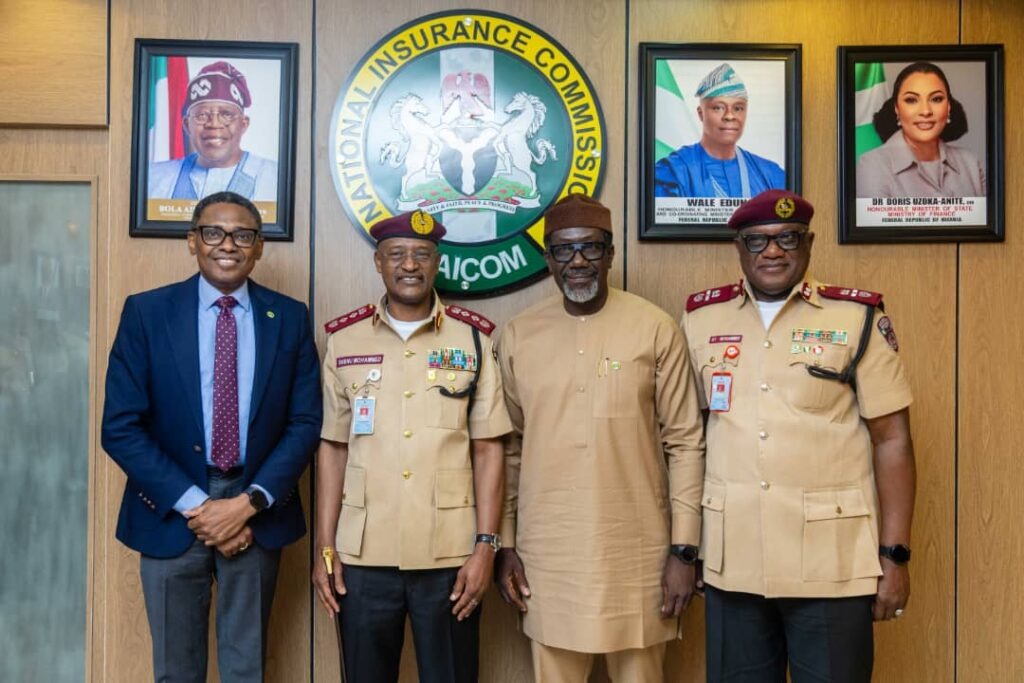
The National Insurance Commission (NAICOM) and the Federal Road Safety Corps (FRSC) have inaugurated a Joint Committee on the Enforcement of Compulsory Third-Party Motor Insurance, marking a new phase in Nigeria’s effort to strengthen compliance with motor insurance laws and enhance road safety across the country.
According to a statement issued by NAICOM, the inauguration ceremony, held at the Commission’s headquarters in Abuja, represents a major milestone in the implementation of the Nigerian Insurance Industry Reform Act (NIIRA) 2025. The initiative aims to ensure full enforcement of compulsory motor insurance, promote data-driven regulation, and guarantee prompt compensation for victims of road accidents.
Delivering his remarks at the event,Olusegun Ayo Omosehin, commissioner for Insurance, praised the FRSC for its collaboration in driving what he described as a “nationally significant initiative.” He noted that the joint effort between the two agencies would deliver tangible benefits to Nigerians, including effective enforcement of the law, seamless integration of vehicle registration and insurance databases, and stronger public awareness of insurance obligations.
“This collaboration will enable effective enforcement of compulsory Third-Party Motor Insurance, integration of insurance and vehicle registration databases, enhanced protection and compensation for road accident victims, and increased public education on insurance obligations and consumer rights,” Omosehin said.
He reaffirmed NAICOM’s commitment to continuous engagement and policy improvement, emphasising that the collaboration would not be a one-off event but an evolving framework for reform.
“We are open to regular feedback, ongoing evaluation, and the adoption of innovative ideas as we move forward. Fewer road accidents, more insured motorists, and stronger public confidence in insurance will be the key outcomes,” he added.
Also speaking at the event, Shehu Mohammed, Corps Marshal of the FRSC, lauded the partnership as a model for inter-agency cooperation aimed at improving national safety and compliance. He expressed confidence that the initiative would drastically reduce the number of uninsured vehicles on Nigerian roads while ensuring that accident victims receive timely financial and medical support.
“This partnership provides a framework for technology integration, data sharing, and on-field enforcement. By working together, we can improve road safety, ensure fair compensation, and promote trust in public institutions,” Mohammed stated.
He further emphasised that strong collaboration among government agencies remains vital to achieving Nigeria’s broader development and safety goals.
Presenting the Terms of Reference (ToR) for the newly inaugurated committee, Ekerete Ola Gam-Ikon, deputy commissioner for Insurance, outlined its key mandates, noting that the committee would be responsible for enforcing compulsory Third-Party Motor Insurance across the country, reducing the number of uninsured vehicles on Nigerian roads, and ensuring prompt compensation as well as medical assistance for accident victims.
He added that the committee would also focus on promoting public awareness about the benefits and obligations of motor insurance, enabling real-time verification of insurance status through digital integration, and supporting microinsurance schemes targeted at commercial drivers and passengers. Furthermore, it would work to strengthen emergency response coordination during the critical “golden hour” following road accidents, ensuring that victims receive timely care and intervention.
The Joint Committee, co-chaired by senior officials from both NAICOM and FRSC with NAICOM serving as the Secretariat,will oversee nationwide enforcement exercises, coordinate public sensitisation campaigns, and continuously assess policy outcomes to enhance compliance levels.
The partnership between NAICOM and FRSC is expected to play a transformative role in the country’s motor insurance landscape, closing long-standing compliance gaps and aligning Nigeria’s insurance enforcement framework with global best practices.