Nigeria’s music industry is consolidating its position on the global stage, with new data from Spotify showing that local artists are reaching unprecedented international audiences and generating billions of streams across the world.
The figures, drawn from Spotify’s annual Loud & Clear report, highlight how Nigerian music continues to evolve from a regional cultural force into a globally recognised export, driven by rising listener demand and expanding digital distribution.
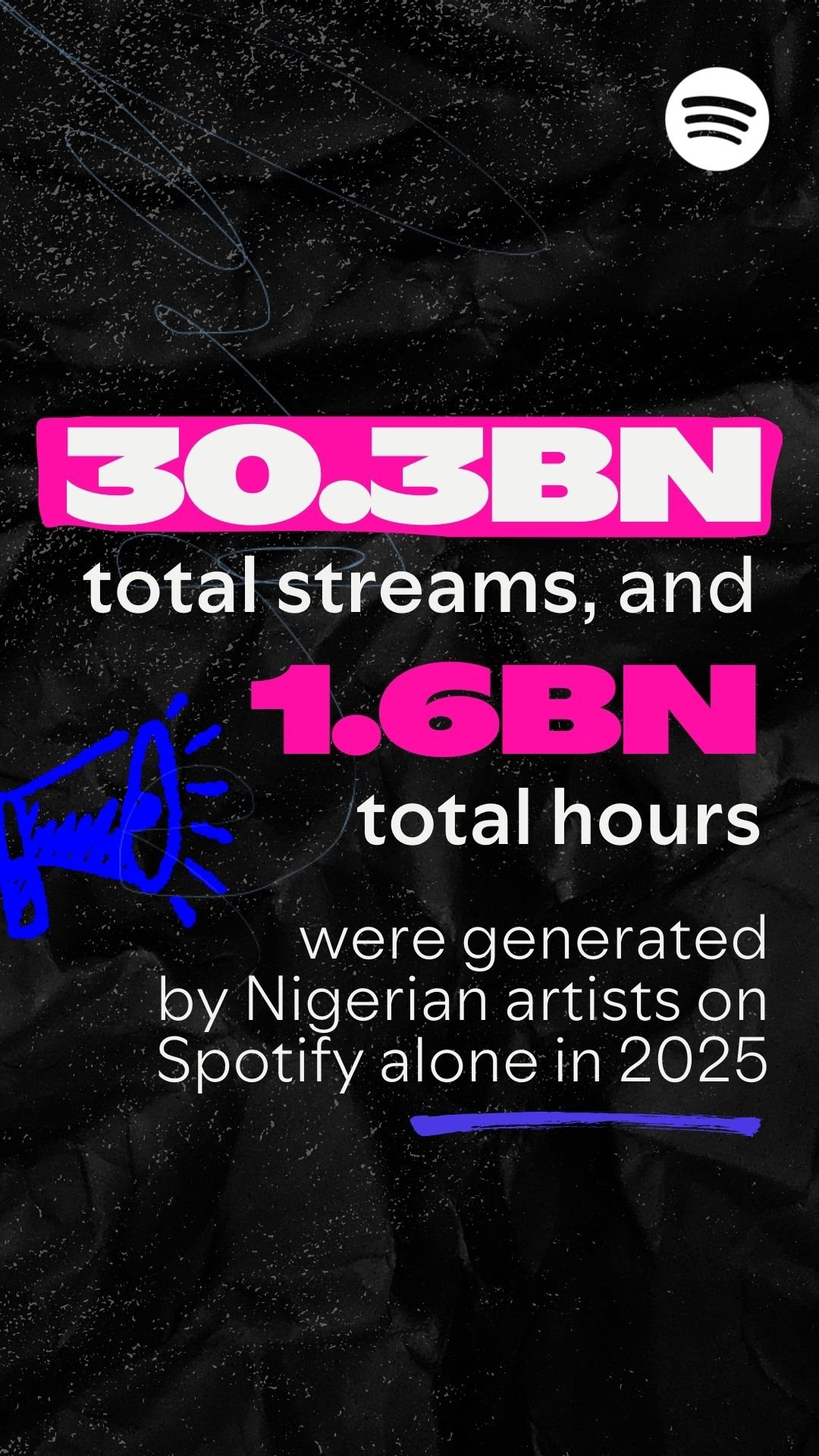
In 2025 alone, Nigerian artists recorded over 30.3 billion streams on the platform, alongside 1.6 billion hours of listening time. The scale of global discovery is equally striking, with first-time listeners engaging Nigerian music more than 1.3 billion times during the year, representing a 26 percent increase compared to 2024.
The data underscores how Nigerian sounds, long rooted in local rhythms and storytelling are now travelling across borders at speed, reaching new audiences far beyond the country’s shores. This global traction is further reflected in playlist activity, where Nigerian artists were featured in nearly 320 million user-generated playlists worldwide, reinforcing their growing influence within international listening habits.
Beyond reach, the financial implications of this expansion are becoming increasingly significant. The report noted that Nigerian artists generated over ₦60 billion in revenue from Spotify in 2025, marking a growth of more than 140 percent over the past two years. The earnings point to a maturing digital ecosystem where music is not only a cultural asset but also an emerging export category with real economic value.
At the domestic level, the industry continues to demonstrate strong foundations, with Nigerian artists accounting for more than 80 percent of tracks on Spotify Nigeria’s Daily Top 50 chart. Local consumption also surged by 170 percent year-on-year, suggesting that while Nigerian music is gaining global ground, its home audience remains deeply engaged.
However, the global rise is not limited to mainstream acts alone. Independent artists are playing an increasingly central role in driving this expansion. According to the report, around 58 percent of all royalties generated by Nigerian artists on Spotify in 2025 were earned by independent artists or labels, signalling a shift towards a more decentralised industry structure where creators have greater control over distribution and revenue.
Growth is also becoming more inclusive across segments. Local streams of Nigerian female artists rose by 55 percent year-on-year, while indie artists saw a 75 percent increase in local streams, reflecting a broader diversification of voices contributing to the country’s global music footprint.
Jocelyne Muhutu-Remy, managing director for Africa at Spotify, noted that Nigeria’s music story continues to be defined by creativity and cross-border appeal. She explained that the data reflects a market where artists are not only finding new audiences internationally but also building stronger connections with listeners at home.
Spotify’s editorial ecosystem has also played a supporting role in amplifying this growth. Nearly 2,000 Nigerian artists were added to editorial playlists in 2025, helping to boost visibility and drive discovery across different markets. In total, more than 60 million playlists featuring Nigerian artists were created on the platform during the year, including over 12 million within Nigeria.
At the same time, the listening landscape itself is becoming more diverse. While Afrobeats remains a dominant force, emerging genres such as alternative pop, drill, emo, anime-inspired sounds, and pop urbaine are gaining traction among listeners, signalling a shift in taste driven largely by younger audiences.
Taken together, the data points to an industry that is no longer confined by geography. Nigerian music is not only scaling globally in terms of streams and audience reach but is also reshaping perceptions of African sound in the global music economy.
As digital platforms continue to lower barriers to entry and expand access to international audiences, Nigerian artists appear increasingly positioned to sustain their global momentum—turning cultural influence into measurable economic and industry impact.