- Tinubu faces criticism over 15% inflation target, others
Onome Amuge
In layman’s term, the ‘Budget of Restoration’ proposed by President Bola Tinubu last week, if shared among 200million Nigerians ( estimated) will amount to N250,000/head per annum. In dollar terms, it will amount to about 160.
This amount will not pay four months minimum wage salary ( N70,000) as agreed by the Federal Government and the organised Labour Unions this year.
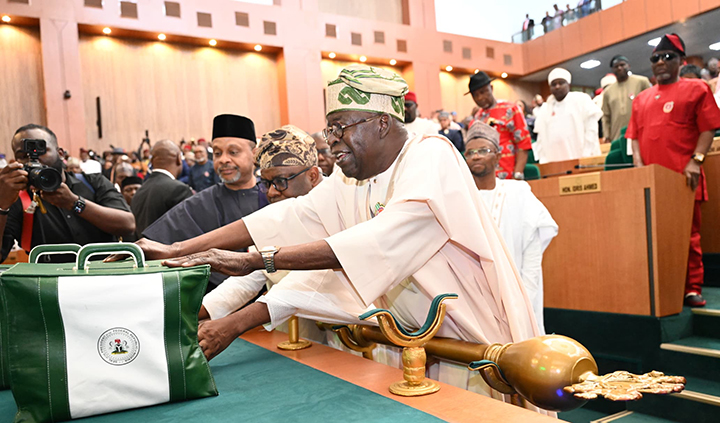
Tinubu presented a N49.7 trillion budget proposal for 2025 before the Nigerian National Assembly, with the ambitious target of reducing inflation from its current heights of 34.6 percent to 15 percent in the coming fiscal year.
The proposed budget tagged, “Budget of Restoration: Securing Peace, Rebuilding Prosperity”, prioritised funding to key sectors such as Defense and Security (N4.91 trillion), Infrastructure (N4.06 trillion), Health (N2.48 trillion), and Education (N3.52 trillion).
The proposed budget earmarked N16 trillion for capital expenditure, which will finance the development of infrastructure and other capital projects. Furthermore, N6 trillion was projected for human capital development.
The president also set a revenue target of N34.82 trillion to fund the 2025 budget, while government expenditure for the year was projected to reach N47.90 trillion, including an allocation of N15.81 trillion for debt servicing.
A budget deficit of N13.08 trillion, or 3.89 percent of GDP, was further projected for the year. This budget deficit, which represents the difference between government spending and revenue, is expected to be financed through borrowing.
Tinubu, in his address to the legislative arm of government, assured that the proposed budget would consolidate key economic policies aimed at restructuring the Nigerian economy, boosting human capital development, increasing trade and investment, bolstering oil and gas production, and kickstarting the manufacturing sector.
According to the president, the budget is designed to pave the way for a stronger and more competitive Nigerian economy, one that can weather the current challenges and emerge even stronger.
Tinubu expressed optimism that the rate of inflation would decline from the current rate of 34.6 percent to 15 percent by 2025. This expected drop in inflation is anticipated to be accompanied by an improvement in the exchange rate, with the naira projected to strengthen against the US dollar, moving from approximately N1,700 to N1,500, and a base crude oil production assumption of 2.06 million barrels per day (mbpd).
While the 2025 budget proposal represents a 80.73 percent increase compared to the proposed N27.50 trillion of 2024, there are concerns that the budget plan lacks a clear focus on key sectors that could boost local production, alleviate inflationary pressures, and bring some much-needed relief to Nigerians who are struggling with the high cost of living.
Drawing attention to the proposed budget’s minuscule per capita expenditure of just N250,000 per citizen in 2025, economist and business strategist Marcel Okeke voiced concerns over the feasibility of the proposed budget, highlighting the uncertainty surrounding whether the projected figures will be realised and, if achieved, whether the funds will be allocated as planned.
“Obviously there’ll be shortfall in revenue generation, leading to more deficits. Leading to more borrowing. Corruption and ‘leakages’ in the system won’t allow the budgetary expectations to be realised,” Okeke stated in a note to Business a.m.
Raising red flags on the viability of the budget projections, the sustainability consultant pinpointed several critical assumptions as highly unrealistic. Chief among these were the president’s assertion that the inflation rate would drop from 35 percent to 15 percent in just a few months.
Okeke also queried what factors would drive Nigeria’s crude oil production level from its current anemic 1.45 barrels per day (bpd) to a seemingly ambitious 2.06 bpd so swiftly. These concerns, according to the economist, cast doubt on the budget’s attainability.
Basil Abia, a policy analyst criticised President Tinubu’s 2025 budget proposal as being unrealistic, particularly in terms of its projections regarding inflation and crude oil production.
According to Abia, reducing inflation to 15 percent by the following year is an improbable feat given the fact that crude oil production levels are below the two-million-barrel-per-day threshold.
Basil, who presented his argument in a television programme, remarked, “The projections are not realistic and the most important thing I think Nigerians should understand is what are the assumptions driving those projections.
“Now, if you say you want to do 15 per cent headline inflation rate on aggregate for 2025, the core drivers, you have to be able to show us that you are going to realistically drop down those drivers, reduce their efficacy, and their frequency.”
Abia contended that it would be highly unlikely for Nigeria to achieve a headline inflation rate of 15 percent given that the current crude oil production levels hover around 1.5 million barrels per day, well below the two-million-barrel-per-day benchmark.
Bismarck Rewane, CEO of Financial Derivatives Company Limited (FDC), also raised doubts about the government’s inflation target of 15 percent for 2025, dismissing it as too optimistic.
Rewane, who analysed the N49.74 trillion federal government’s 2025 budget proposal in a presentation titled, “The Restoration Budget: Policies, Promises, and Aspirations, Lags and Impact”, projected that the consumer price index would hover around 25 percent in the coming year, considerably higher than the government’s target. While conceding that the Naira may appreciate and stabilize against the dollar at N1,550 in the parallel market by 2025, Rewane sounded a cautionary note on the government’s ability to rein in inflation.
“Some of the key assumptions underlying the 2025 budget are over optimistic. The inflation target of 15 per cent, down from the current level of 34.6 percent sounds far-fetched. The benchmark price of Brent leaves no headroom for market swings. Furthermore, the reference to $40 billion of gross external reserves could be misleading,” he stated.
According to the economist, a budget is more than just a name or label, and its actual impact on the economy hinges on its outcomes, not its presentation. He stated that the crucial components of economic management include the amount of spending, earnings, surplus or deficit, sources of funding, and economic objectives, all of which determine the effectiveness of a budget.
Rewane pointed to a number of key economic indicators, such as the decline in GDP per capita from $1,597.4 in 2023 to $910.7 in 2024 and a decrease in national debt per capita from $438.2 in 2023 to $418.7 in 2024. He also noted that foreign debt service per capita increased from $46.54 in 2023 to $47.65 in 2024, while external reserves per capita dropped from $175 in 2023 to $172 in 2024.
Despite the generally unfavourable trend of economic indicators, the CEO of Financial Derivatives Company Limited found a ray of optimism in the government’s exchange rate assumption of N1,500, arguing that this alignment with market realities contributes to both the budget’s feasibility and the overall economic confidence.
He concluded that 2025 might prove to be less challenging for Nigerians when compared to 2024, noting that with appropriate and well-considered policies, the Nigerian economy could potentially achieve a growth rate of six percent in the forthcoming year.
Meanwhile, in response to the skepticism surrounding the 15 percent inflation target outlined in President Tinubu’s budget proposal, Tanimu Yakubu,the director general of the Budget Office of the Federation, expressed confidence that the president possesses a well-defined plan of action to achieve this economic goal.
Yakubu defended the budget’s 15 percent inflation target by citing the anticipated impact of increased domestic refining of petroleum products on prices. He argued that, with refined fuel products becoming more readily available within the country, prices would decrease, contributing to a drop in the inflation rate.
Furthermore, Yakubu revealed that the government plans to step up its oversight of budgeted projects, including the possibility of engaging external consultants, in order to guarantee cost-effective implementation of the 2025 budget.
“We used to spend as high as one-third of our foreign exchange earnings to import refined products. With Dangote Refinery coming on stream and small local refineries adding to the supply, we think this will substantially reduce the pressure on the naira,” he said.
The director general of the Budget Office of the Federation, posited that a combination of factors, including increasing investor confidence in the Nigerian economy and a renewed focus on agriculture, would ultimately lead to a decrease in inflation.
Specifically, he noted that rising investment in agriculture would contribute to increased food production, thereby curtailing food inflation and mitigating its effect on the overall inflation rate.