Oil falls on weak US jobs data ahead of Opec+ meeting

Onome Amuge

Oil prices fell on Friday after a weaker-than-expected US jobs report raised concerns about energy demand, while expectations of further supply growth weighed ahead of a crucial Opec+ meeting this weekend.

Brent crude, the international benchmark, settled 2.2 per cent lower at $65.50 a barrel, while US marker West Texas Intermediate dropped 2.5 per cent to $61.87.

The declines followed reports that eight Opec+ members are considering raising output when producers gather on Sunday, potentially unwinding some of the cartel’s pledged production cuts. US government data showing a 2.4 million-barrel rise in crude inventories last week, against analyst expectations for a draw, added to market pressure.

“It’s kind of a perfect storm. It started falling with the Opec story. The jobs report was not helpful. That suggests the market is weakening,” said Phil Flynn, senior analyst with Price Futures Group. 

Nonfarm payrolls increased by just 22,000 last month, compared with forecasts for a 75,000 gain, according to the US Bureau of Labor Statistics. July’s increase was revised up to 79,000. Analysts warned the report could add pressure on the Federal Reserve to cut interest rates.

“The jobs report is a bad data point for the market,” said John Kilduff, partner at Again Capital.
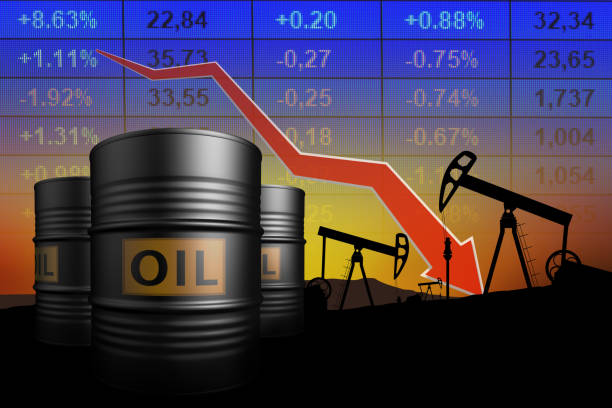
The collapse of the market and the stock exchange due to covid-19 coronavirus. Oil barrels, oil pumps and graphs.

Opec+, which together accounts for about half the world’s oil production, has already signalled plans to unwind an additional 1.65 million barrels per day of output cuts, equivalent to 1.6 per cent of global demand, more than a year ahead of schedule.

“If the eight Opec+ countries were to agree on another production increase, we believe this would place significant downward pressure on oil prices. After all, there is already a significant risk of a supply surplus,” analysts at Commerzbank said in a note. 

Geopolitical risks remain in play, however. The White House said on Thursday that President Donald Trump had urged European leaders to halt imports of Russian oil, even as Moscow seeks to deepen energy ties with Asia.

“There remains the risk that Western powers could ramp up sanctions against Russia in an attempt to compel President Putin to the negotiating table,” analysts at JPMorgan said.

Kilduff noted that the recent appearance of Vladimir Putin and Narendra Modi at a Beijing parade alongside Xi Jinping suggested Russian crude exports would remain in global markets, in defiance of US pressure.

Leave a Comment

Oil falls on weak US jobs data ahead of Opec+ meeting

Onome Amuge

Oil prices fell on Friday after a weaker-than-expected US jobs report raised concerns about energy demand, while expectations of further supply growth weighed ahead of a crucial Opec+ meeting this weekend.

Brent crude, the international benchmark, settled 2.2 per cent lower at $65.50 a barrel, while US marker West Texas Intermediate dropped 2.5 per cent to $61.87.

The declines followed reports that eight Opec+ members are considering raising output when producers gather on Sunday, potentially unwinding some of the cartel’s pledged production cuts. US government data showing a 2.4 million-barrel rise in crude inventories last week, against analyst expectations for a draw, added to market pressure.

“It’s kind of a perfect storm. It started falling with the Opec story. The jobs report was not helpful. That suggests the market is weakening,” said Phil Flynn, senior analyst with Price Futures Group. 

Nonfarm payrolls increased by just 22,000 last month, compared with forecasts for a 75,000 gain, according to the US Bureau of Labor Statistics. July’s increase was revised up to 79,000. Analysts warned the report could add pressure on the Federal Reserve to cut interest rates.

“The jobs report is a bad data point for the market,” said John Kilduff, partner at Again Capital.

The collapse of the market and the stock exchange due to covid-19 coronavirus. Oil barrels, oil pumps and graphs.

Opec+, which together accounts for about half the world’s oil production, has already signalled plans to unwind an additional 1.65 million barrels per day of output cuts, equivalent to 1.6 per cent of global demand, more than a year ahead of schedule.

“If the eight Opec+ countries were to agree on another production increase, we believe this would place significant downward pressure on oil prices. After all, there is already a significant risk of a supply surplus,” analysts at Commerzbank said in a note. 

Geopolitical risks remain in play, however. The White House said on Thursday that President Donald Trump had urged European leaders to halt imports of Russian oil, even as Moscow seeks to deepen energy ties with Asia.

“There remains the risk that Western powers could ramp up sanctions against Russia in an attempt to compel President Putin to the negotiating table,” analysts at JPMorgan said.

Kilduff noted that the recent appearance of Vladimir Putin and Narendra Modi at a Beijing parade alongside Xi Jinping suggested Russian crude exports would remain in global markets, in defiance of US pressure.

[quads id=1]

Get Copy

Leave a Comment