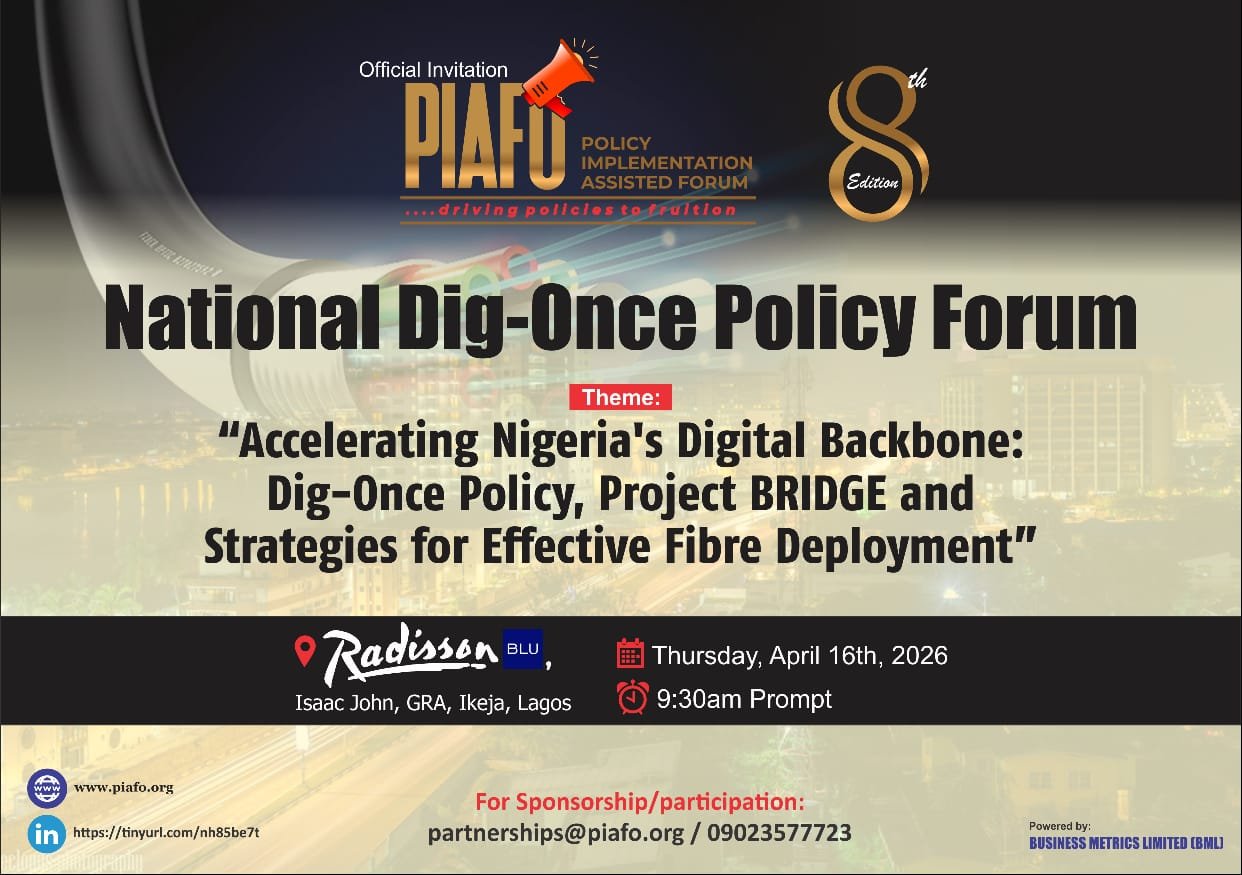
A renewed push to expand broadband infrastructure is bringing together key players in telecoms, infrastructure, and policy to rethink how fibre networks are deployed, with an ambitious target of 125,000 kilometres now in focus.
The National Dig-Once Policy Forum is expected to serve as the focal point for aligning stakeholders around a more coordinated and cost-effective deployment model.
The forum, organised by Business Metrics Limited under the 8th edition of the Policy Implementation Assisted Forum (PIAFo), will convene policymakers, regulators, telecom operators, and infrastructure providers in Lagos to address fragmented and inefficient fibre deployment, considered one of the most persistent bottlenecks in Nigeria’s digital transformation.
The urgency of the dialogue is underscored by the federal government’s ambitious $2 billion Project BRIDGE, which aims to expand Nigeria’s fibre backbone from 35,000km to 125,000km by 2030.
If successfully implemented, the initiative would represent one of the largest digital infrastructure expansions on the continent, significantly enhancing broadband penetration, digital inclusion, and economic competitiveness.
However, industry stakeholders caution that achieving this target will require more than capital investment. Structural reforms, particularly the adoption of a National Dig-Once Policy, are seen as critical to avoiding the inefficiencies that have historically slowed infrastructure rollout.
Data from the Nigerian Communications Commission (NCC) reveals the scale of the challenge. Telecom operators recorded more than 50,000 fibre cuts nationwide in 2024, with over 60 per cent attributed to road construction and rehabilitation activities.
These disruptions have imposed significant financial and operational costs on the sector, running into billions of naira in repair expenses, while also causing widespread network outages and service degradation.
In Lagos alone, operators spent more than N5 billion repairing damaged fibre infrastructure within the same period, underscoring the economic toll of uncoordinated civil works.
Industry analysts note that beyond direct repair costs, such disruptions undermine investor confidence, delay network upgrades, and ultimately slow Nigeria’s progress toward a fully digital economy.
The proposed Dig-Once Policy seeks to address these inefficiencies by mandating the installation of fibre ducts and conduits during the construction or rehabilitation of roads, railways, and other public infrastructure.
By embedding fibre deployment into broader infrastructure planning, the policy aims to eliminate repeated excavation, reduce costs, and ensure more coordinated development across federal, state, and local levels.
Stakeholders argue that without such a framework, Nigeria risks falling short of its broadband targets despite significant investments.
“Success in expanding Nigeria’s digital backbone will depend on how well we align infrastructure planning across all tiers of government,” industry experts say, pointing to global best practices where Dig-Once frameworks have significantly reduced deployment costs and accelerated rollout timelines.
The forum, themed “Accelerating Nigeria’s Digital Backbone: Dig Once Policy, Project BRIDGE and Strategies for Effective Fibre Deployment,” is slated for Thursday April 16, 2026 at Radisson Blu Hotel, Ikeja GRA, Lagos
Beyond fibre cuts, telecom operators continue to face a range of structural challenges, including high Right of Way (RoW) charges, regulatory fragmentation, and lack of coordination among public works agencies.
These issues have historically increased the cost of fibre deployment in Nigeria, making it one of the more expensive markets globally for broadband infrastructure expansion.
The absence of a unified national framework has also led to duplication of efforts, with multiple operators excavating the same routes at different times, further inflating costs and disrupting urban infrastructure.
The upcoming forum is expected to serve as a critical platform for bridging the gap between policy formulation and execution. Participants will include representatives from government ministries, regulatory agencies, telecom companies, infrastructure firms, and state governments.
Key objectives of the forum include aligning infrastructure planning across jurisdictions, strengthening collaboration between public and private sector players, and translating policy concepts into actionable implementation frameworks with clear timelines.
Organisers say the event will also build momentum for Project BRIDGE by fostering stakeholder buy-in and identifying practical pathways for scaling fibre deployment nationwide.
Speaking ahead of the event, Omobayo Azeez, team lead at Business Metrics Limited, said Nigeria is being denied access to robust connectivity it should derive from up to eight high-capacity undersea cable networks landed on its shores because of difficulties around terrestrial fibre infrastructure expansion.
“The Project BRIDGE initiative should excite everyone because of ambitious targets. But for those who understand the operating terrain, and why it took the industry over 20 years to achieve around 35,000km of fibre network that the country currently operates for broadband connectivity, the project calls for a major shift in execution approach with the adoption of a National Dig-Once Policy as the starting point.
“PIAFo, now in its 8th edition, is again serving as the viable platform for representatives from government ministries and agencies, senior telecom executives, infrastructure companies, data centre operators, equipment manufacturers, state governments, and industry associations to chart the way forward,” Azeez stated.
Nigeria’s ability to fully leverage its digital economy potential hinges on the strength and reach of its broadband infrastructure. With increasing reliance on digital services, from fintech and e-commerce to education and healthcare, the demand for reliable, high-speed connectivity continues to grow.
A robust fibre backbone is widely seen as the foundation for this transformation, enabling faster data transmission, improved service quality, and greater inclusion in the digital economy.
Industry observers believe that if effectively implemented, a Dig-Once Policy could significantly accelerate Nigeria’s broadband penetration, reduce infrastructure costs, and position the country as a leading digital hub in Africa.