SEC regulatory overhaul aims to restore stability after market volatility

Onome Amuge

The Securities and Exchange Commission (SEC) is spearheading a pivotal modernisation of the capital market, unveiling a series of reforms designed to boost efficiency, strengthen investor confidence, and accelerate digital transformation. Announced by Emomotimi Agama, the SEC director-general, during the second Capital Market Committee (CMC) meeting of 2025, the initiatives aim to reshape the investment landscape and bring the market closer in line with global best practices.

Central to the reforms is the shift toward shorter equity settlement cycles, moving the market from T+2 to T+1, with a long-term goal of reaching same-day, or T+0, settlements.

The recent shift from T+3 to T+2, implemented on November 28, marked a significant milestone, according to Agama. “Shorter settlement cycles enhance liquidity, reduce counterparty risk, and accelerate capital reinvestment,” he said, noting that the reform now applies across the Nigerian Exchange (NGX), NASD OTC Securities Exchange, and Lagos Commodities and Futures Exchange.

The SEC’s reform agenda comes against the backdrop of key developments in Nigeria’s macroeconomic and financial environment. Since the last CMC meeting in May, the country has seen its sovereign credit rating upgraded and was removed from the Financial Action Task Force (FATF) grey list. Combined with a moderation in inflation, headline rates fell to 16.05 percent year-on-year in October, the lowest since March 2025. These developments have boosted investor sentiment and created fertile ground for capital inflows.

The period between April and October witnessed significant capital-raising activity across equity, debt, and commercial paper markets. Notable issuances include the N500 billion Climate Funding Special Purpose Vehicle (SPV) and the N200 billion Elektron Finance bond, reflecting growing investor interest in infrastructure and sustainable finance. The commercial paper segment remained active, with over N753 billion issued across manufacturing, energy, and agriculture, underscoring sustained confidence in the market’s regulatory framework.

However, the market has not been without challenges. November saw the Nigerian Exchange experience its heaviest monthly decline on record, with market capitalisation falling by N6.54 trillion and the All-Share Index dropping nearly seven per cent. Analysts attributed the slump to profit-taking ahead of a proposed 30 per cent Capital Gains Tax, weakened sentiment in banking stocks, and global policy uncertainties. Despite the setback, Agama emphasised the market’s resilience, noting a modest recovery following government reassurances on fiscal and tax policy.

Beyond regulatory and operational reforms, the SEC is pursuing financial inclusion and investor education. One key initiative involves integrating capital market studies into the national secondary school curriculum, in collaboration with the Nigerian Educational Research and Development Council. At the tertiary level, partnerships such as the conference with Nnamdi Azikiwe University are designed to highlight opportunities for small and medium enterprises (SMEs) to leverage capital markets for growth.

Regionally, Nigeria continues to assert leadership in non-interest finance. The SEC recently engaged with a Bank of Ghana delegation to share regulatory frameworks for non-interest capital markets, highlighting Nigeria’s N1.4 trillion sovereign Sukuk issuances and the expansion of Islamic mutual funds. Plans are also underway for a Municipal Bond and Sukuk Summit in early 2026.

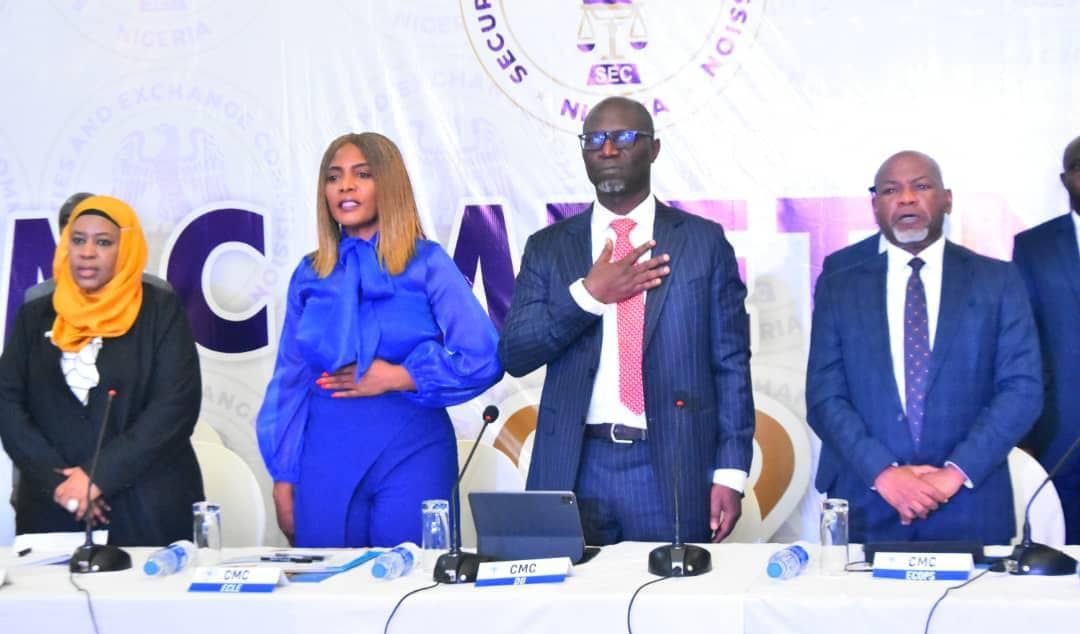
L-R: Samiya Hassan Usman, executive commissioner, corporate services, Securities and Exchange Commission (SEC); Frana Chukwuogor, executive commissioner, legal & enforcement, SEC; Emomotimi Agama, director general, SEC;and Bola Ajomale, executive commissioner (Operations), SEC; at  SEC CMC meeting in Lagos, recently

Commodities and derivatives market development

The SEC is advancing efforts to deepen Nigeria’s commodities and derivatives ecosystem. In collaboration with the Standards Organisation of Nigeria, the Commission is updating commodity standards, while insurance brokers are being mobilized to enhance risk mitigation. Engagements with the Ministry of Solid Minerals aim to unlock funding for mining companies, and the SEC is working with the Central Bank of Nigeria to secure liquidity status for warehouse receipts. Oversight of commodity exchanges, such as Gezawa and NCX, is being strengthened through inspections and financial reviews.

In the derivatives space, the SEC is collaborating with stakeholders to deploy a real-time surveillance system aimed at reinforcing market integrity. Updated rules on central counterparties, derivatives trading, online forex, and NG Clearing operations have been submitted to the Rules Committee. A draft systemic risk management framework is also being developed to bolster governance standards across regulated entities.

Technology-driven regulation

Digital transformation remains a cornerstone of the SEC’s agenda. The Digital Transformation Portal now allows operators to submit applications, upload documents, and track approvals online. A commercial paper issuance module has been launched, while automation of quarterly and annual returns is underway. These reforms are supported by significant IT infrastructure upgrades and strengthened cybersecurity measures.

The SEC’s Technology Adoption Survey conducted in May 2025 revealed that while tools like cloud computing and basic cybersecurity are increasingly in use, adoption of advanced technologies such as artificial intelligence (AI) and big data analytics remains below 10 percent. Nevertheless, more than 70 percent of firms surveyed indicated plans to adopt AI, blockchain, and regulatory technology within the next three years, citing cost, skills shortages, and legacy system integration as key challenges.

Agama emphasised that technological innovation must be coupled with ethical deployment. Protecting investor data, preventing market abuse, and maintaining operational resilience are vital to building trust—foundational elements for a thriving capital market.

To streamline compliance and reduce administrative burdens, the SEC announced the introduction of a Harmonized Corporate Governance Reporting Template for public companies. This unified template integrates SEC regulations, the Nigerian Code of Corporate Governance 2018, and the Business Facilitation Act 2022, eliminating duplication and simplifying reporting obligations.

Looking ahead, the renewal of registration for capital market operators will take place from January 1 to 31, 2026, with electronic receipt and processing of applications set to begin in the first quarter of 2026.

Agama concluded by reaffirming the SEC’s commitment to building a resilient, transparent, and innovation-driven capital market. “A strong capital market is not built in a day; it is shaped by vision, collaboration, and resilience,” he said.


Leave a Comment

SEC regulatory overhaul aims to restore stability after market volatility

Onome Amuge

The Securities and Exchange Commission (SEC) is spearheading a pivotal modernisation of the capital market, unveiling a series of reforms designed to boost efficiency, strengthen investor confidence, and accelerate digital transformation. Announced by Emomotimi Agama, the SEC director-general, during the second Capital Market Committee (CMC) meeting of 2025, the initiatives aim to reshape the investment landscape and bring the market closer in line with global best practices.

Central to the reforms is the shift toward shorter equity settlement cycles, moving the market from T+2 to T+1, with a long-term goal of reaching same-day, or T+0, settlements.

The recent shift from T+3 to T+2, implemented on November 28, marked a significant milestone, according to Agama. “Shorter settlement cycles enhance liquidity, reduce counterparty risk, and accelerate capital reinvestment,” he said, noting that the reform now applies across the Nigerian Exchange (NGX), NASD OTC Securities Exchange, and Lagos Commodities and Futures Exchange.

The SEC’s reform agenda comes against the backdrop of key developments in Nigeria’s macroeconomic and financial environment. Since the last CMC meeting in May, the country has seen its sovereign credit rating upgraded and was removed from the Financial Action Task Force (FATF) grey list. Combined with a moderation in inflation, headline rates fell to 16.05 percent year-on-year in October, the lowest since March 2025. These developments have boosted investor sentiment and created fertile ground for capital inflows.

The period between April and October witnessed significant capital-raising activity across equity, debt, and commercial paper markets. Notable issuances include the N500 billion Climate Funding Special Purpose Vehicle (SPV) and the N200 billion Elektron Finance bond, reflecting growing investor interest in infrastructure and sustainable finance. The commercial paper segment remained active, with over N753 billion issued across manufacturing, energy, and agriculture, underscoring sustained confidence in the market’s regulatory framework.

However, the market has not been without challenges. November saw the Nigerian Exchange experience its heaviest monthly decline on record, with market capitalisation falling by N6.54 trillion and the All-Share Index dropping nearly seven per cent. Analysts attributed the slump to profit-taking ahead of a proposed 30 per cent Capital Gains Tax, weakened sentiment in banking stocks, and global policy uncertainties. Despite the setback, Agama emphasised the market’s resilience, noting a modest recovery following government reassurances on fiscal and tax policy.

Beyond regulatory and operational reforms, the SEC is pursuing financial inclusion and investor education. One key initiative involves integrating capital market studies into the national secondary school curriculum, in collaboration with the Nigerian Educational Research and Development Council. At the tertiary level, partnerships such as the conference with Nnamdi Azikiwe University are designed to highlight opportunities for small and medium enterprises (SMEs) to leverage capital markets for growth.

Regionally, Nigeria continues to assert leadership in non-interest finance. The SEC recently engaged with a Bank of Ghana delegation to share regulatory frameworks for non-interest capital markets, highlighting Nigeria’s N1.4 trillion sovereign Sukuk issuances and the expansion of Islamic mutual funds. Plans are also underway for a Municipal Bond and Sukuk Summit in early 2026.

L-R: Samiya Hassan Usman, executive commissioner, corporate services, Securities and Exchange Commission (SEC); Frana Chukwuogor, executive commissioner, legal & enforcement, SEC; Emomotimi Agama, director general, SEC;and Bola Ajomale, executive commissioner (Operations), SEC; at  SEC CMC meeting in Lagos, recently

Commodities and derivatives market development

The SEC is advancing efforts to deepen Nigeria’s commodities and derivatives ecosystem. In collaboration with the Standards Organisation of Nigeria, the Commission is updating commodity standards, while insurance brokers are being mobilized to enhance risk mitigation. Engagements with the Ministry of Solid Minerals aim to unlock funding for mining companies, and the SEC is working with the Central Bank of Nigeria to secure liquidity status for warehouse receipts. Oversight of commodity exchanges, such as Gezawa and NCX, is being strengthened through inspections and financial reviews.

In the derivatives space, the SEC is collaborating with stakeholders to deploy a real-time surveillance system aimed at reinforcing market integrity. Updated rules on central counterparties, derivatives trading, online forex, and NG Clearing operations have been submitted to the Rules Committee. A draft systemic risk management framework is also being developed to bolster governance standards across regulated entities.

Technology-driven regulation

Digital transformation remains a cornerstone of the SEC’s agenda. The Digital Transformation Portal now allows operators to submit applications, upload documents, and track approvals online. A commercial paper issuance module has been launched, while automation of quarterly and annual returns is underway. These reforms are supported by significant IT infrastructure upgrades and strengthened cybersecurity measures.

The SEC’s Technology Adoption Survey conducted in May 2025 revealed that while tools like cloud computing and basic cybersecurity are increasingly in use, adoption of advanced technologies such as artificial intelligence (AI) and big data analytics remains below 10 percent. Nevertheless, more than 70 percent of firms surveyed indicated plans to adopt AI, blockchain, and regulatory technology within the next three years, citing cost, skills shortages, and legacy system integration as key challenges.

Agama emphasised that technological innovation must be coupled with ethical deployment. Protecting investor data, preventing market abuse, and maintaining operational resilience are vital to building trust—foundational elements for a thriving capital market.

To streamline compliance and reduce administrative burdens, the SEC announced the introduction of a Harmonized Corporate Governance Reporting Template for public companies. This unified template integrates SEC regulations, the Nigerian Code of Corporate Governance 2018, and the Business Facilitation Act 2022, eliminating duplication and simplifying reporting obligations.

Looking ahead, the renewal of registration for capital market operators will take place from January 1 to 31, 2026, with electronic receipt and processing of applications set to begin in the first quarter of 2026.

Agama concluded by reaffirming the SEC’s commitment to building a resilient, transparent, and innovation-driven capital market. “A strong capital market is not built in a day; it is shaped by vision, collaboration, and resilience,” he said.

Leave a Comment