Onome Amuge
Nigeria is stepping up efforts to translate its trade relationship with the United States into tangible investment and industrial growth, as senior officials from both countries convened the U.S.-Nigeria Commercial and Investment Partnership (CIP) Ministerial in Lagos.
The meeting, co-chaired by Bradley McKinney, U.S. deputy assistant secretary for the commercial service and Jumoke Oduwole, Nigeria’s minister of industry, trade and investment brought together a high-level interagency delegation of trade financing, project development, and trade promotion experts to assess reforms proposed by three CIP Working Groups including Agriculture, Digital Economy, and Infrastructure. The groups, comprising private sector leaders from both countries, are tasked with identifying measures that could improve the business climate, reduce barriers to trade, and stimulate cross-border investment.
“This ministerial meeting underscores significant advancements in the vital U.S.-Nigeria commercial and investment partnership. Over the past six months, the Agriculture, Digital Economy, and Infrastructure Working Groups have engaged across government and industry and developed practical proposals to unlock trade and deepen bilateral commercial ties,” McKinney said.
Nigeria views the CIP not merely as a platform for dialogue but as an instrument to drive non-oil export growth, attract international capital, and integrate domestic businesses into global value chains. According to Minister Oduwole, channeling U.S. investment into priority sectors could transform the country into a hub for accessing broader African markets. “A central priority for us is to accelerate non-oil export diversification and to ensure that more Nigerian businesses can access U.S. markets in a competitive, sustainable, and inclusive manner,” she said.
Since the launch of the CIP Working Groups in June 2025, the Ministry of Industry, Trade and Investment has sustained momentum on policy reforms aimed at strengthening competitiveness, improving the regulatory environment, and aligning trade and investment frameworks with international best practices. According to Oduwole, these efforts are designed to make the Nigerian market more predictable and investible, providing stronger conditions for the CIP to deliver measurable economic outcomes.
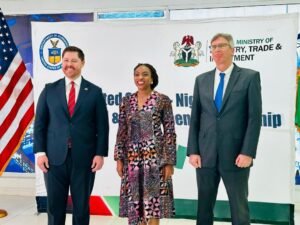
The ministerial drew senior U.S. officials, including Keith Heffern, U.S. Mission Chargé d’Affaires; Jason Hafemeister, U.S. Department of Agriculture Associate Administrator; and Heather Lanigan, U.S. Trade and Development Agency Regional Director. Nigerian participation included Ambassador Nura Rimi, permanent secretary of the ministry, and Gertrude Orji, director of investment.
Trade figures reflect the stakes of the partnership. Nigeria is the United States’ second-largest trading partner in Africa, with bilateral trade in goods and services amounting to nearly $13 billion in 2024. U.S. foreign direct investment in Nigeria rose 25.2 per cent year-on-year to $7.9 billion in 2024, signaling investor confidence in the West African economy despite global economic headwinds.
Analysts say the CIP’s focus on agriculture, digital services, and infrastructure is consistent with Nigeria’s broader industrial and export diversification strategy. By channeling investment from U.S. firms into these sectors, the initiative aims to create jobs, enhance technological capacity, and strengthen supply chains, while providing U.S. companies access to one of Africa’s largest consumer markets.
Looking ahead, both governments are expected to continue consultations on trade and investment issues, particularly in the non-oil sector, digital economy, and critical infrastructure projects.