The US dollar, long a symbol of American economic might, has fallen steadily this year.
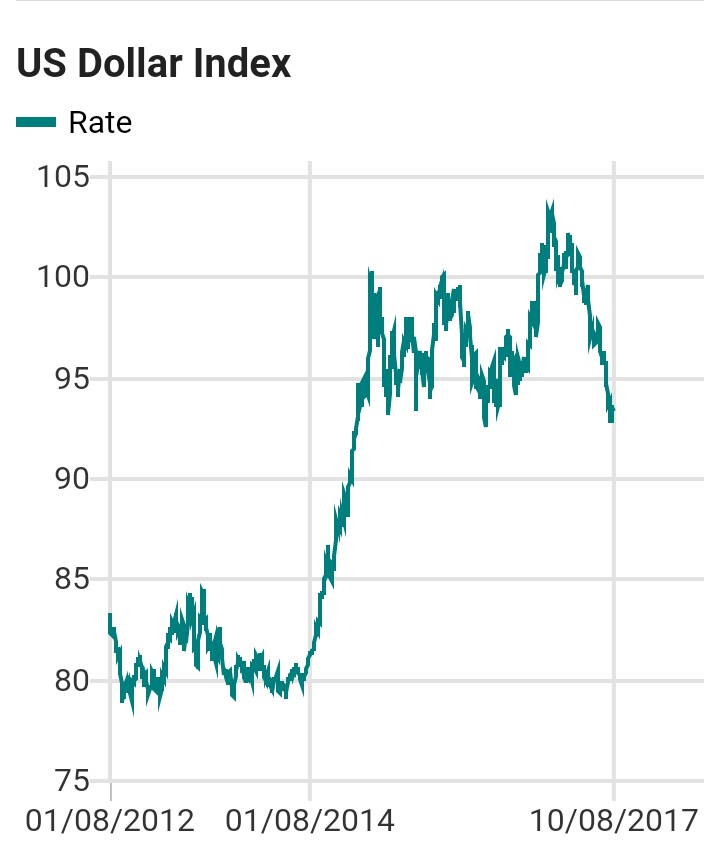
The value of the dollar index, which tracks the dollar against six major global currencies, has fallen about 10% since January.
It pushed lower on Friday, even as demand for other safe-haven assets – typically a category that includes the US dollar – rose amid sabre-rattling between the US and North Korea.
The dollar, which surged in 2014 as the US economy gained strength, is hardly in danger territory. The index is running just a bit lower than it was a year ago.
But key US economic data was weaker last year. So what’s behind this year’s decline?
Things are looking up in Europe.
In some ways, this is a good news story, driven by a better economy in Europe.
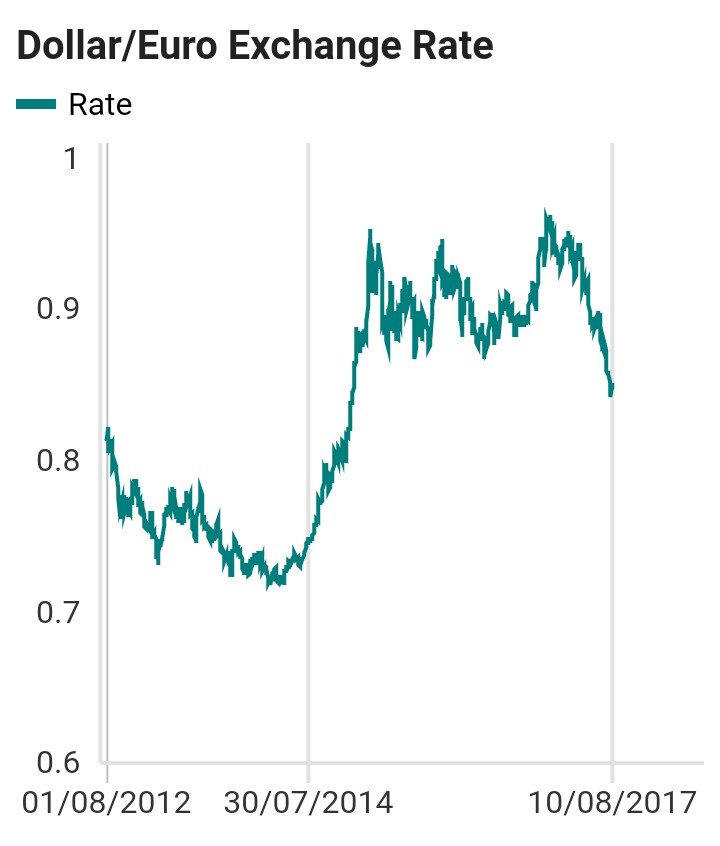
The euro lost ground against the dollar in 2014, when central bankers adopted a stimulus program, while the US started to move away from stimulus policies.
Now, as the Eurozone economy improves and the European Central Bank eyes an end to the stimulus, the currencies are starting to move closer together. The election of pro-EU Emmanuel Macron in France in June contributed to confidence in the Euro.
The Euro’s gain is the dollar’s loss. A Euro is now worth more than $1.17, up more than 10 cents since the end of last year.
Investors are reacting to political turmoil in America.
But this isn’t just a European story.
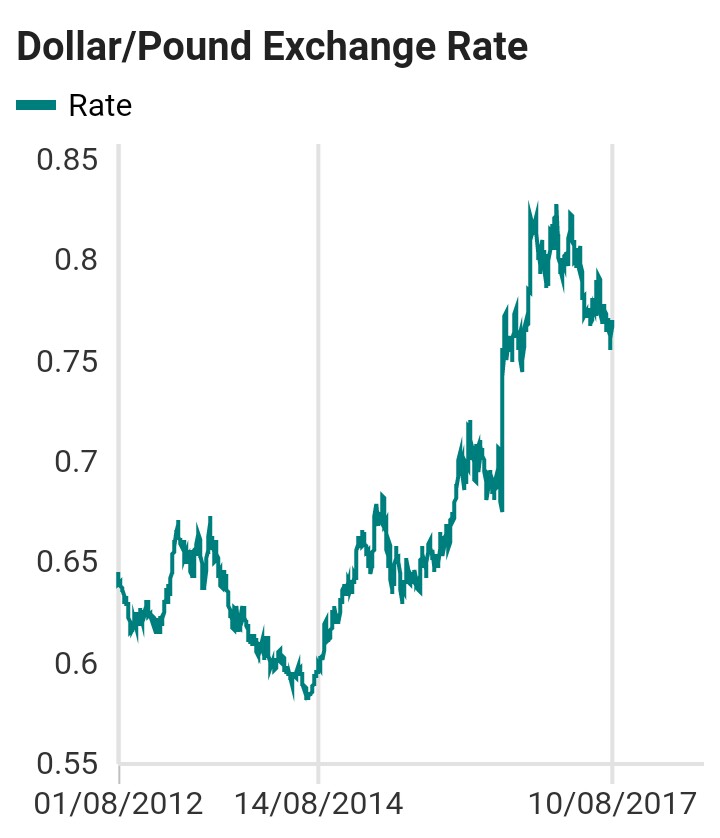
The dollar has lost ground against many other currencies, including the Japanese Yen, the Mexican peso and the Swedish Krona. Even the British pound, which plunged after the Brexit vote, has regained some of its power against the dollar in recent months. (It’s now valued at about $1.30, up from $1.22 in March.)
“This type of broad based decline shows you that it’s really people moving away from the dollar, rather than just moving towards these other currencies,” says Sameer Samana, a global quantitative and technical strategist at Wells Fargo based in St. Louis, Missouri.
The fall in the dollar reverses gains that occurred after Mr Trump’s election
Analysts trace the dollar’s surge in the final months of 2016 to his win, which fuelled expectations of tax cuts or infrastructure investment – spending expected to drive demand for the dollar.
Now they say the retreat shows traders recalculating, as Mr Trump’s economic agenda stalls.
An ongoing investigation into ties between Russia and the Trump campaign has cast a shadow over his administration. And alarm over Mr Trump’s erratic statements and foreign policy clashes – including with North Korea this week – has also increased.
“If people feel like there’s greater political uncertainty … they kind of vote with their dollar,” says Mr Samana says.
Expectations about interest rates and the US economy also play a role.
Rising interest rates are traditionally linked to stronger currencies, since higher rates attract investment.
The US central bank has raised interest rates four times since December 2015, and conventional wisdom calls for another in December. But Federal Reserve Chair Janet Yellen said recently that even supposing future hikes, interest rates are likely to remain historically low for some time.
Her caution in part reflects American economic growth that remains humdrum, with inflation and wage growth lagging.
“What’s going on now is an expectation that the Fed will continue to be relatively loose in its monetary policy, while the [European Central Bank] starts to tighten,” says Jeffry Frieden, a professor of government at Harvard University and the author of “Currency Politics”. “That is roughly analogous to saying there are expectations that the US will not grow as rapidly as anticipated.”
How serious is this ‘uncertainty’?
It’s tough to know where the dollar is headed next, since at the moment it’s neither strongly over- or under-valued, says Jeffrey Frankel, a professor of economics at the Harvard Kennedy School.
Richard Marston, a professor of finance at the University of Pennsylvania’s Wharton Business School, says he doesn’t read too much into the decline, pointing to US stocks over the same period, which soared to new records.
“It’s not a question of confidence in the US and the US government because that would also affect the equity markets,” he says.
But Mr Frieden says he thinks there is a risk of a free-fall, given disarray in Washington and uncertainty about the Federal Reserve. Ms Yellen’s term ends in February and it’s not clear whom Mr Trump will name to replace her.
“If [the dollar] started really declining in a continual way that seems not to be just random or small fluctuations … that would indicate a real loss of confidence in the US economy, a real loss of confidence in the US government,” says Mr Frieden.
“That would be a very bad thing and that would be something that the government had to respond to.”
So is this all bad news for America?
Mr Frankel says he used to predict the dollar would lose its status as an international currency, because of rising national debt and other factors.
But that forecast was confounded when investors flocked to the dollar during the economic turmoil of 2008 – even though America was the source of many of the problems.
“I finally stopped making that prediction and I’m not ready to switch back,” he says. “I think the dollar is still – in some ways even more so – the number one international currency.”
Mr Trump isn’t worried either. In a recent interview with the Wall Street Journal, Mr Trump said he liked a dollar that’s “not too strong”.
“Frankly, other than the fact that it sounds good, lots of bad things happen with a strong dollar,” he said.
It’s a trade-off between consumers and producers.
As an official presidential position, it was a radical statement, since for US consumers – who buy a lot from overseas – a weaker dollar means reduced spending power. The same is true for US manufacturers who rely on parts produced abroad.
“The weaker the dollar is, the poorer Americans are on average,” says Mr Frieden. “That’s not just rhetoric. That’s the reality.”
But Mr Trump’s pro-business administration has focused on reinvigorating US manufacturing and exports, which become cheaper and therefore more competitive globally if the dollar weakens.
US manufacturers gain competitiveness from a weaker dollar
US firms with global operations also get a boost to their bottom line, as the business overseas becomes more valuable. (That effect contributed to the stock market’s rise this year.)
Eventually, economic theory predicts a cycle, as more expensive foreign goods increase prices and inflation in the US, prompting the Fed to raise rates – which ultimately boosts the dollar.
“As a tourist, of course I want the dollar to be as strong as possible,” says Mr Marston. “As someone who watches the American economy, it’s good news.”