Zoho expands AI, security features in bid to streamline enterprise workflows

Onome Amuge

Zoho Corporation, a global technology company, is stepping up its bid to position itself as an alternative to sprawling enterprise software stacks, unveiling an overhaul of its Zoho One platform as businesses worldwide operate under rising integration costs, cybersecurity risks and worker fatigue linked to managing dozens of disjointed digital tools.

The globally active software group on Wednesday, introduced what it described as the most extensive redesign of Zoho One since the platform’s launch in 2017. Rather than focusing on new individual applications, the update highlights the suite as a unified operating environment for businesses under pressure to simplify workflows and rein in software budgets.

Kehinde Ogundare, Zoho’s country head for Nigeria, said customers were moving beyond the idea of licensing multiple standalone apps. “The Zoho One update reflects how work has evolved from using individual applications to operating within a unified platform,Zoho One customers are not simply licensing apps; they are choosing a solution that allows Zoho to handle the technology while they focus on productivity. The enhancements announced today deliver a cohesive experience built on unified integrations, context, and data,” he said. 

Zoho’s bet on consolidation appears well timed. The company says more than 75,000 organisations now run on Zoho One, using on average 22 applications inside the suite. That level of engagement is unusually high for a SaaS portfolio and reflects, in part, the group’s long-standing architecture built around native integrations and data governance; areas now under sharper scrutiny as cyber incidents increase and regulators tighten expectations around digital resilience.

The latest update further consists of a redesigned user experience that reorganises the suite around purpose rather than product. The new interface uses “Spaces” (personal, organisational and departmental zones) to group tools by workflow, with the aim of reducing the constant app-switching that has become a hallmark of modern office life. A consolidated search layer now sits over the entire ecosystem, enabling staff to surface information or trigger actions without navigating the platform’s 50-plus applications.
A revamped dashboard provides a single, customisable hub for operational data, aggregating metrics from both Zoho and external systems. Meanwhile, an expanded Action Panel offers a snapshot of meetings, messages and outstanding tasks, ensuring users can stay informed regardless of where they are working within the platform.

The company is also introducing Vani, a visual collaboration environment that merges whiteboarding, mind mapping, diagramming and video calling; a response to rising demand for shared planning spaces as hybrid work models mature.

Security and identity management form another cornerstone of the release. With organisations facing increasingly complex attack surfaces as they integrate third-party services, Zoho is tightening native connections between its apps and external tools. The inclusion of Zoho Directory gives administrators a centralised identity and access management system, reducing external entry points and improving anomaly detection.

A unified integrations panel now enables IT teams to oversee and configure all platform connections from a single location. The update also delivers outcome-based workflows such as Smart Offboarding, which automates transitions when employees leave.

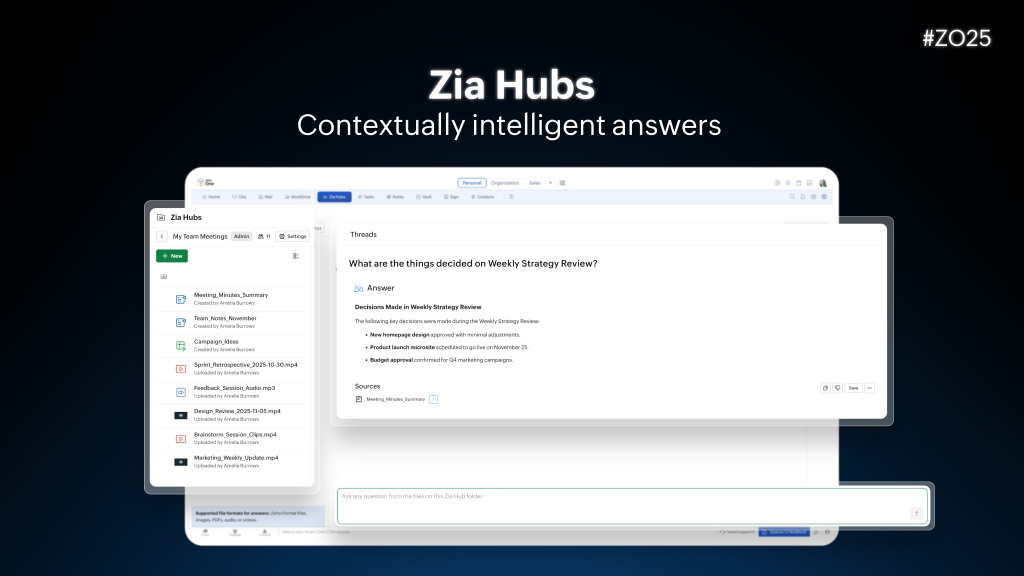
Zoho is further embedding its AI assistant, Zia, across the suite to supply what it calls contextual intelligence. Zia can draw on information across Zoho and external platforms such as Google Workspace to deliver aggregated insights. Zia Hubs automatically organise important content  including contracts and recordings, while Zia Search and prompt-based Ask Zia give employees quicker visibility into schedules, interactions and documents.


Leave a Comment

Zoho expands AI, security features in bid to streamline enterprise workflows

Onome Amuge

Zoho Corporation, a global technology company, is stepping up its bid to position itself as an alternative to sprawling enterprise software stacks, unveiling an overhaul of its Zoho One platform as businesses worldwide operate under rising integration costs, cybersecurity risks and worker fatigue linked to managing dozens of disjointed digital tools.

The globally active software group on Wednesday, introduced what it described as the most extensive redesign of Zoho One since the platform’s launch in 2017. Rather than focusing on new individual applications, the update highlights the suite as a unified operating environment for businesses under pressure to simplify workflows and rein in software budgets.

Kehinde Ogundare, Zoho’s country head for Nigeria, said customers were moving beyond the idea of licensing multiple standalone apps. “The Zoho One update reflects how work has evolved from using individual applications to operating within a unified platform,Zoho One customers are not simply licensing apps; they are choosing a solution that allows Zoho to handle the technology while they focus on productivity. The enhancements announced today deliver a cohesive experience built on unified integrations, context, and data,” he said. 

Zoho’s bet on consolidation appears well timed. The company says more than 75,000 organisations now run on Zoho One, using on average 22 applications inside the suite. That level of engagement is unusually high for a SaaS portfolio and reflects, in part, the group’s long-standing architecture built around native integrations and data governance; areas now under sharper scrutiny as cyber incidents increase and regulators tighten expectations around digital resilience.

The latest update further consists of a redesigned user experience that reorganises the suite around purpose rather than product. The new interface uses “Spaces” (personal, organisational and departmental zones) to group tools by workflow, with the aim of reducing the constant app-switching that has become a hallmark of modern office life. A consolidated search layer now sits over the entire ecosystem, enabling staff to surface information or trigger actions without navigating the platform’s 50-plus applications.

A revamped dashboard provides a single, customisable hub for operational data, aggregating metrics from both Zoho and external systems. Meanwhile, an expanded Action Panel offers a snapshot of meetings, messages and outstanding tasks, ensuring users can stay informed regardless of where they are working within the platform.

The company is also introducing Vani, a visual collaboration environment that merges whiteboarding, mind mapping, diagramming and video calling; a response to rising demand for shared planning spaces as hybrid work models mature.

Security and identity management form another cornerstone of the release. With organisations facing increasingly complex attack surfaces as they integrate third-party services, Zoho is tightening native connections between its apps and external tools. The inclusion of Zoho Directory gives administrators a centralised identity and access management system, reducing external entry points and improving anomaly detection.

A unified integrations panel now enables IT teams to oversee and configure all platform connections from a single location. The update also delivers outcome-based workflows such as Smart Offboarding, which automates transitions when employees leave.

Zoho is further embedding its AI assistant, Zia, across the suite to supply what it calls contextual intelligence. Zia can draw on information across Zoho and external platforms such as Google Workspace to deliver aggregated insights. Zia Hubs automatically organise important content  including contracts and recordings, while Zia Search and prompt-based Ask Zia give employees quicker visibility into schedules, interactions and documents.

[quads id=1]

Get Copy

Leave a Comment