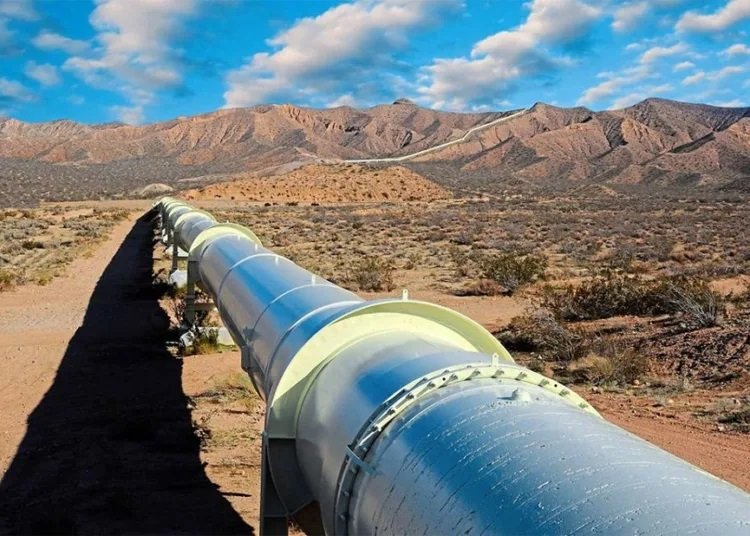
Leaders of West Africa regional bloc, the Economic Community of West African States (ECOWAS) have signed an agreement approving the construction of the 6,900 km gas pipeline project from Nigeria to Morocco, passing through 13 West African nations.
At a summit of the regional bloc in Freetown, Sierra Leone at the weekend, chaired by President Julius Maada Bio of Sierra Leone, the ECOWAS leaders declared through Maada Bio: “We have already signed the West Africa-Morocco gas pipeline. Don’t be surprised when the gas comes your way”.
Last week, Morocco’s National Office of Hydrocarbons and Mines (ONHYM) announced details of the construction of the gigantic energy project, including the cost which has been put at $25 billion.
The pipeline will run approximately 6,900 kilometers through 13 countries along the Africa’s western coast.
A study for the project, prepared by a consortium of four firms: France’s Phénixa and Oréade-Brèche, the US-based CSA Ocean Sciences, and Morocco’s ZIZ GEO Consulting, was commissioned by the Nigerian National Petroleum Company Limited (NNPCL) and Morocco’s National Office of Hydrocarbons and Mines (ONHYM).
The project will have four compression stations along the onshore route near Boujdour, Tan-Tan, Agadir, and Safi. These stations will be spaced 300 to 320 kilometers apart, and each will occupy roughly 64 hectares. Sites were selected near ports and transport networks to ease equipment delivery. The stations’ function is to restore gas pressure over long distances, keeping flow rates steady through the pipeline’s full length.
The Morocco section of the project will stretch 2,220 kilometers. It will include four compression stations, two receiving terminals, and six temporary construction camps, each housing up to 1,200 workers.
The project was first proposed in 2016 during the visit of Moroccan King Mohammed VI to Abuja, Nigeria.
The Nigeria-Morocco Gas Pipeline (NMGP) will be carrying Nigerian gas to Morocco before connecting to the Maghreb-Europe gas pipeline.
ONHYM, Morocco’s state hydrocarbon agency and NNPCL, Nigeria’s national oil company had earlier said in a statement that the project aimed to link Nigeran and West Africa’s gas resources to major regional markets, ending up in Europe’s $300 billion gas market.
Nigeria holds the largest proven natural gas reserves in Africa and ranks 8th globally. As of 2025, the country’s proven gas reserves stand at 210.5 trillion cubic feet (Tcf), which accounts for approximately 33 percent of the continent’s total natural gas resources.
The ONHYM-NNPCL statement also added that the pipeline project will “strengthen the integration of African energy markets and create a new development corridor linking West Africa, the Sahel, Morocco and Europe.
It further explained that the next phase include creating a “project company” based in Casablanca and a governing authority headquartered in Abuja before investors are brought on board and a final investment decision (FID) is taken, they added.
The FID on the big ticket project is expected in the fourth quarter of this year (Q4 2026), while construction is expected to begin in 2027, with the first gas deliveries targeted for 2031, according to ONHYM in the detail construction plan.
Gas value chain experts, one of whom is Friday Udoh, adduced that the major reason for revival of the NMGP was driven in part by Algeria’s recent decision to stop gas delivery to Spain via Morocco. In 2022, Algeria took a decision to stop supplying gas to Spain through the Moroccan route following the diplomatic row between the two countries (Algeria – Morocco).
Talks between Algiers and Rabat have broken down completely, a development that have forced Morocco, Africa’s 5th largest economy, with a GDP size of $194.33 billion, to revisit the opportunity provided by Nigeria-Morocco Gas Pipeline, NMGP.