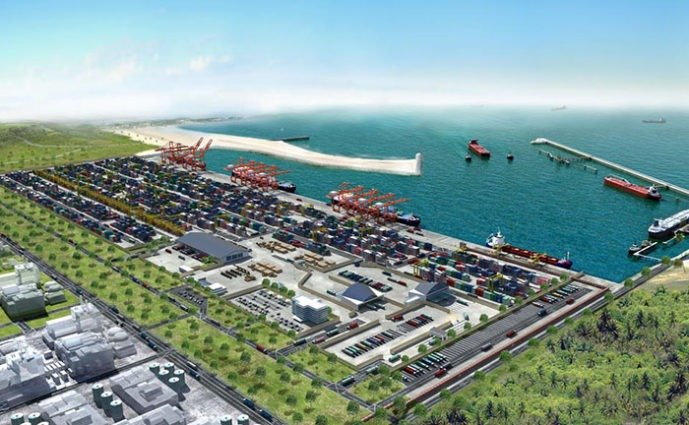
At the groundbreaking ceremony of the high-ticket project by President Bola Tinubu on November 13, Governor Bassey Otu of Cross River State described the Bakassi Deep Seaport project as a transformative undertaking that will redefine the economic fortunes of the state, unpack the vast agricultural and commercial potential of the state and the Gulf of Guinea, and strengthen Nigeria’s position in regional and international trade.
Otu expressed profound optimism that the project expected to cost some$3.5 billion, will be a game-changer with the capacity to unlock immense economic opportunities for Cross River and Nigeria.
According to him, the initiative represented the revival of a historic trade corridor with more than 600 years of commercial significance, linking coastal communities to trans-Saharan trade routes.
“…This trade route is over 600 years old, and reviving it is something wonderful that is going to happen to the people of this area,” the governor said, adding that the project would stimulate economic activities across several value chains, particularly commerce, transportation, maritime operations and other sectors connected to the Gulf of Guinea, with far-reaching implications for regional trade and development.
He reflected on the historical and economic significance of the deep seaport project, particularly against the backdrop of the challenges that followed the state’s loss of the oil-rich Bakassi Peninsula to Nigeria’s eastern neighbour the Republic of Cameroon in 2002 via an International Court of Justice (ICJ) ruling.
Governor Otu underscored the importance of restoring economic opportunities to Cross River’s affected oil-bearing riverine communities, whose people have continued to identify with Nigeria and trust in its protection and commitment to their aspirations.
Indeed the $3.5 billion Bakassi deep seaport sidesteps sovereign debt in favour of a structured public-private partnership (PPP). Backed by the African Export-Import Bank (Afreximbank) as the mandated lead arranger and $2.27 billion in initial funding approvals, the project combines a 20-metre deep-water draft, a 260-kilometre superhighway, and commercial agro-industrial zones to turn Cross River and eastern Nigeria into a bankable global trade corridor.
The project was initiated by ex-Governor Ben Ayade, in 2018, with the vision of restoring, recovering and modernising Cross River’s maritime and economic assets.
However, maritime economists say the real test is to move the project toward execution, if the project would achieve its intention: as a major intervention in Nigeria’s maritime infrastructure—designed to redistribute trade capacity, alleviate single-hub concentration, and unlock private capital across multiple value chains.
For institutional investors and project financiers, the thesis hangs on execution discipline beyond groundbreaking ceremonies. To deliver bankable returns requires uninterrupted capital mobilisation, reliable power and utility infrastructure, efficient customs administration, rigorous environmental impact mitigation to protect marine ecosystems and fishing livelihoods, and sustained industrial and agricultural output to keep cargo volumes flowing through the corridor.
According to Friday Udoh, a maritime economist, one of the strongest commercial arguments for Bakassi Deep Seaport project is its potential to break Nigeria’s heavy dependence on Lagos for maritime cargo operations. Businesses located in the South-South, South-East, and northern regions currently absorb huge inland haulage costs moving freight from Lagos to their factories and warehouses, as well as consumer markets.
Udoh believes that, a deep-water gateway in Cross River State provides an alternative entry and exit point—as complementary capacity that introduces inter-port competition, improves service efficiency, and strengthens supply-chain resilience as population and industrial volumes grow—not as an automatic replacement for Lagos.
Central to the deep seaport’s commercial proposition is a 20-metre draft, engineered to receive larger ocean-going vessels requiring greater water depth. Larger vessels usually carry higher cargo volumes per voyage. Hence, deep-draft capacity can lower unit shipping costs and attract international shipping lines that might otherwise divert cargo to competing West African ports with deeper berths and faster turnaround.
Additionally, beyond direct terminal and berth revenues, regular calls by larger vessels would stimulate an entire ecosystem of ancillary maritime services, including pilotage, towage, bunkering, vessel repairs, marine insurance, freight forwarding, warehousing, and specialised container, bulk, and liquid cargo handling.
However, to realise this upside requires sustained channel dredging, modern navigation systems, competitive tariffs, and dependable cargo throughput.
Governor Otu has sought to advance the inherited Bakassi Deep Seaport project from concept to execution without mortgaging the state’s balance sheet through conventional sovereign borrowing. Instead, the subnational administration is pursuing an investor-driven public-private partnership (PPP) model backed by institutional and multilateral arrangements.
Regulatory preparation led to wngagements with the Infrastructure Concession Regulatory Commission (ICRC), Nigerian Ports Authority (NPA), and Nigerian Shippers’ Council. At the federal level, the project aligns with the Tinubu administration’s marine and blue economy agenda—marked by the 2023 creation of the federal ministry of marine and blue economy and Nigeria’s first national policy on marine and blue economy.
By far, a seaport’s commercial viability depends as much on hinterland evacuation as on quay-side operations. In order to prevent port-gate congestion, the Bakassi seaport blueprint pairs maritime infrastructure with a 260-kilometre superhighway (alongside the state’s broader 217-kilometre superhighway plans and connectivity to the Lagos-Calabar coastal highway and state airport).
Creating a multimodal link of maritime, air, and road transport would give Cross River a logistics profile capable of supporting bonded warehouses, inland container depots, truck terminals, and industrial parks.
Recall that on July 1, 2025, the state presented hydrographic, geophysical, and geotechnical survey findings to guide engineering design, dredging requirements, and environmental management. This single facility has retired the colonial-era navigational charts dating back to 1903.
How far Governor Otu can go in realising the Bakassi seaport play will be seen in his discipline with the execution.