Onome Amuge
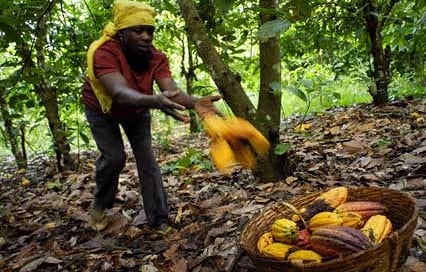
Cocoa prices may have soared to record highs this year, but for millions of farmers across West Africa, the boom has not translated into better living conditions. Beneath the headlines of market gains lies an uncomfortable truth, showcasing that the world’s love for chocolate continues to rest on the backs of impoverished smallholders struggling to survive.
The Cocoa Barometer 2025, published on Wednesday by a coalition of civil society organisations, found that while cocoa prices on global markets have hit unprecedented levels, smallholder farmers , who produce over 70 percent of the world’s cocoa, remain trapped in cycles of poverty, debt, and environmental risk.
The biennial report describes the global cocoa industry as “bad, better, and with a lot of room for improvement,” highlighting how structural inequities continue to define the trade. Côte d’Ivoire and Ghana still dominate global supply, controlling over 60 per cent of output, while Nigeria has emerged as a rising producer expected to deliver 350,000 tonnes in the 2024/25 season. Yet, the rewards of this production remain highly uneven.
“Farmer poverty is at the root of virtually all problems in the cocoa sector, from deforestation to child labour and gender inequality. Paying farmers fairly is both a moral and legal obligation, thanks to new human rights and environmental legislation. But political resistance in Europe is threatening the hard-won progress in regulation,” the report declares.
Notably, while cocoa traded at record levels, at times surpassing $10,000 per tonne in 2025, the system that determines how prices reach farmers is riddled with delays and distortions. Ghana and Côte d’Ivoire’s forward-selling mechanisms mean producers are paid based on older contracts negotiated before prices spiked. Nigeria, which operates a more liberalised export model, offers theoretically better price flexibility, but in practice, much of the profit is absorbed by middlemen, exporters, and processors.
The result is an industry that looks prosperous from the outside but remains fundamentally unsustainable. “We are witnessing an extraordinary market moment that has failed to improve the livelihoods of those most essential to the cocoa chain,” said a trade analyst based in Accra.
Beyond economics, the report points to cascading social and environmental consequences. Climate change, aging trees, and depleted soils are depressing yields across the region. Farmers, desperate to take advantage of higher prices, are increasingly clearing new forest areas to expand cultivation. This expansion, the report warns, is accelerating deforestation in protected regions and could set the stage for an oversupply crisis, and a price crash similar to the one seen in 2016.
“High prices today may be tomorrow’s downfall if unchecked expansion triggers another glut. Without effective supply management, the cycle of boom and bust will continue,” the report cautions.
Human rights abuses also remain widespread. Despite years of pledges by multinational chocolate companies, an estimated 1.5 million children still work in hazardous cocoa farming conditions across Ghana and Côte d’Ivoire. Women, who perform most of the fieldwork and post-harvest labour, remain largely excluded from land ownership, profit-sharing, and leadership roles in cooperatives. Farm and tenant workers, often migrants with no formal rights, are among the most invisible victims of the system.
The Cocoa Barometer blames weak governance for the persistent inequities. “There are too few accountability mechanisms, and too much dependence on voluntary industry commitments,” the report notes. Certification schemes, such as Fairtrade and Rainforest Alliance, identified to have brought visibility to sustainability issues, are criticised for failing to guarantee living incomes for farmers.
In Nigeria, where cocoa is the country’s leading non-oil export, similar governance challenges are evident. The absence of transparent farmgate pricing, inadequate farmer organisation, and limited access to finance have left many producers unable to benefit from higher export values.
The Cocoa Barometer 2025 also warns of a looming policy crisis in Europe. The EU’s new deforestation regulation and human rights due diligence law, which could have reshaped supply chain accountability, face mounting political opposition. Some member states are pushing to water down requirements that would force companies to prove their cocoa is deforestation-free and ethically sourced.
“Europe’s political hesitation risks undermining one of the most important reform opportunities in decades,” said a Dutch NGO involved in the report.
Still, the report offers a roadmap for progress. It calls for governments, industry players, and civil society to commit to systemic reform anchored on three pillars: fair pricing and a living income for farmers; environmental protection through a global moratorium on cocoa-driven deforestation; and inclusive governance that ensures both men and women farmers share decision-making power.
Some producing countries are experimenting with change. Ghana and Côte d’Ivoire introduced a living income differential in 2019 to guarantee farmers an additional $400 per tonne, though implementation has been inconsistent. Nigeria has yet to adopt a similar scheme, but discussions around a national cocoa sustainability framework are gathering pace, according to officials at the Nigerian Export Promotion Council (NEPC).
The Barometer concludes that time is running out. “The window for meaningful reform is closing fast. Without decisive action, the cocoa industry risks repeating its historical cycle of exploitation, inequality, and environmental degradation,”it stated.