Joy Agwunobi
Nigeria’s place in the global digital conversation became even more pronounced in 2025, as new data revealed that the country ranked among the world’s most mobile-engaged markets, reflecting how deeply smartphones have woven themselves into everyday economic and social life.
According to the State of Mobile 2026 report by Sensor Tower, a mobile analytics firm, Nigerians spent a combined 129 billion hours on their mobile devices in 2025, a rise from the previous year and enough to position the country firmly within the global top ten for mobile time spent. The milestone highlights not only Nigeria’s large population and rising smartphone adoption, but also the growing dependence on mobile platforms for communication, commerce, entertainment and work.
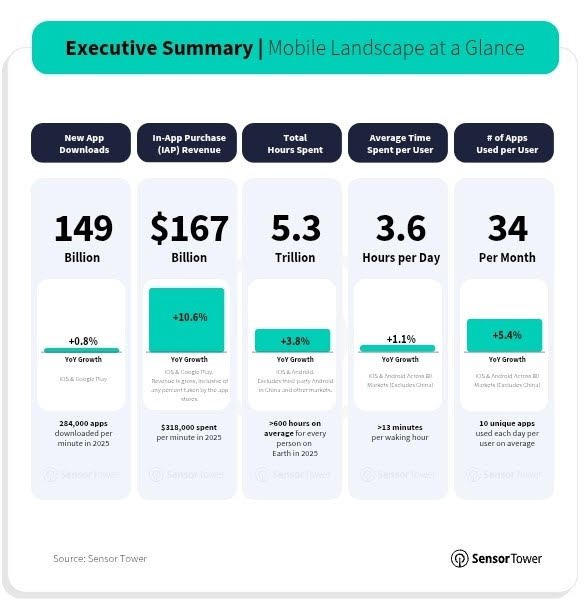
The report highlights a world increasingly shaped by mobile behaviour. Globally, smartphone users logged a total of 5.3 trillion hours on iOS and Android devices during the year, representing a 3.8 per cent increase compared with 2024. On average, each person spent more than 600 hours on their phone over the course of the year, translating to roughly 3.6 hours per day or more than 13 minutes of every waking hour.
Social media continued to command a dominant share of that attention. Users worldwide spent nearly 2.5 trillion hours on social media apps in 2025, averaging over 90 minutes per day per person. This marked a five per cent year-on-year increase, a trend the report links to the lingering effects of rapid smartphone adoption and behaviour changes that intensified during the pandemic years. Although overall growth in mobile time is beginning to slow in many mature markets, engagement levels remain on an upward trajectory.
Beyond sheer time spent, the way people interact with their devices is also evolving. Sensor Tower noted that the average mobile user now engages with about 34 different apps per month, a 5.4 per cent increase from 2024. Across 80 markets outside China, daily mobile usage rose by 1.1 per cent. This pattern indicates that while users may not be dramatically increasing their screen time, they are spreading their attention across a wider range of applications.
Artificial intelligence emerged as one of the most significant drivers of change in mobile behaviour. The report showed that AI assistant apps experienced explosive growth, entering the top ten app sub-categories by time spent after recording a 426 per cent year-on-year increase. This surge reflects a growing appetite for tools that help users automate tasks, generate content, personalise experiences and interact with technology in more intuitive ways.
Within this global landscape, Nigeria’s performance stood out alongside other major mobile markets. India remained the world’s largest market by time spent, with users clocking over 1.2 trillion hours in 2025, while Indonesia, the United States and Brazil followed with hundreds of billions of hours each. Nigeria’s 129 billion hours placed it ahead of several advanced economies and just behind China’s mainland market, which was one of the few top markets to record a decline in usage during the year. For Nigeria, the upward trend underscores the country’s expanding digital footprint and the central role of mobile connectivity in its fast-growing digital economy.
The report also pointed to significant shifts in how mobile usage translates into revenue. While time spent on mobile is beginning to plateau globally, monetisation is accelerating as app developers focus on subscriptions, in-app purchases and premium features. Global in-app purchase revenue reached $167 billion in 2025, representing a 10.6 per cent increase year on year across iOS and Google Play.
The United States remained the largest market for in-app purchase revenue, generating $59 billion during the year, followed by China’s iOS market and Japan. Other strong contributors included South Korea, the United Kingdom, Germany and France, reflecting the continued dominance of developed markets in mobile monetisation even as emerging economies like Nigeria drive engagement growth.
Individual apps also played a major role in shaping revenue and engagement trends. ChatGPT emerged as one of the biggest revenue growth stories of the year, recording a 254 per cent increase in in-app purchases as demand surged for AI-powered tools. Other fast-growing apps included ReelShort and CapCut, highlighting strong user interest in short-form video and creative content creation. Subscription-based services such as Google One, Canva, Duolingo and LinkedIn also recorded solid growth, reinforcing the shift toward paid digital services.
In terms of downloads, global users installed 149 billion new apps across iOS and Google Play in 2025, a marginal increase of 0.8 per cent from the previous year. This relatively modest growth suggests that the mobile market is entering a more mature phase, where competition for user attention is intense and success depends less on attracting new users and more on deepening engagement with existing ones.
For Nigeria, the findings underline both opportunity and responsibility. Rising mobile engagement creates room for innovation in fintech, e-commerce, digital media and AI-driven services, while also placing greater pressure on network quality, data affordability and digital skills development.