
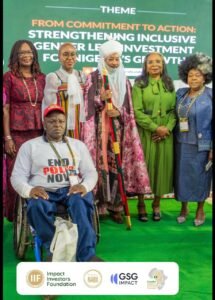
The Impact Investors Foundation (IIF), Nigeria’s leading platform for unlocking impact capital, has reinforced its central role in the country’s inclusive finance ecosystem with the hosting of the 4th Gender Impact Investment Summit (GIIS), positioning the gathering as the premier execution platform for the country’s $8 billion inclusive capital roadmap.
The summit, held in Lagos, marked a decisive development from policy articulation to implementation architecture, with the unveiling of the Inclusive Capital Scorecard and a landmark Gender Equity and Social Inclusion (GESI) Baseline Report.
Anchored on the theme “From Commitment to Action: Strengthening Inclusive Gender Lens Investment for Nigeria’s Growth,” the summit brought together regulators, development finance institutions, investors, and policymakers at a critical juncture in Nigeria’s efforts to deepen its National Women Economic Empowerment framework and unlock capital flows to underserved segments of the economy.
The discussions were centered on the need to translate Nigeria’s $8 billion inclusive capital roadmap, a long-term financing ambition aimed at expanding access to capital for women, youth, and persons with disabilities, into a structured delivery system capable of tracking outcomes, capital flows, and socio-economic impact in real time.
Organisers said the 4th GIIS has now evolved into the country’s principal execution platform for that agenda, moving beyond advocacy to what stakeholders described as “measurable accountability infrastructure” for inclusive finance.
Building on momentum from previous editions, where over 50 organisations committed to inclusive capital principles, this year’s summit is designed to ensure that commitments are no longer symbolic, but embedded into investment decision-making, regulatory frameworks, and capital allocation strategies.
The highlight of the summit was the unveiling of the Inclusive Capital Scorecard alongside the GESI Baseline Survey, which will serve as the reference framework for tracking progress across Nigeria’s inclusive investment ecosystem.
The scorecard is expected to standardise how investors and institutions measure gender-lens investing outcomes, including access to credit, enterprise growth, employment generation, geographic distribution of capital, and inclusion of underserved populations.
According to the organisers, the tools will function as both a diagnostic and accountability mechanism, ensuring that capital deployed under the inclusive finance framework is tracked against defined impact indicators rather than broad commitments.
Etemore Glover, CEO of the Impact Investors Foundation, said the baseline report provides the structural foundation required to correct long-standing inefficiencies in Nigeria’s financial system.
“The GESI Baseline Report is more than a document; it is the data-driven foundation required to fix structural barriers in our financial system. While women own nearly 40% of Nigerian businesses, they receive a disproportionately small share of formal credit. This report empowers stakeholders to identify acute gaps and benchmark progress as we move toward a truly inclusive economy,” Glover said.
The summit placed strong emphasis on embedding Gender Equity and Social Inclusion (GESI) principles into mainstream investment and policy frameworks, particularly as Nigeria seeks to scale inclusive growth through private capital mobilisation.
Ibukun Awosika, vice chair of GSG Impact and chair of GSG Nigeria Partner, described the summit as a turning point in transforming inclusive finance from aspiration to embedded investment practice.
“By providing the data-driven foundation needed to benchmark progress, it demands that stakeholders not only mobilise inclusive capital at scale but also embed GESI and gender lens investment principles into every investment decision and policy. This summit is the definitive platform to close investment gaps, unlocking Nigeria’s full economic potential and ensuring our growth is truly equitable and transformative,” Awosika said.
Beyond financial metrics, the summit focused on structural barriers that continue to exclude women, youth, and persons with disabilities from formal economic systems.
The 4th GIIS was framed as a platform aimed at dismantling these constraints by shifting attention from rhetoric to implementation systems that track both capital flows and impact outcomes.
See also: IIF drives transition from gender advocacy to financial market implementation
Organisers said the summit is designed to institutionalise accountability by requiring organisations to report not only on capital raised, but also on capital deployed, jobs created, enterprise growth trajectories, and geographic reach of investments.
This approach, stakeholders argue, is critical to ensuring that inclusive finance does not remain a parallel agenda but becomes integrated into core financial decision-making systems.
A key intellectual anchor of the summit was the recognition of Gender Equity and Social Inclusion (GESI) as a macroeconomic lever rather than a purely social development objective.
By addressing financing gaps affecting women-led enterprises, youth-owned businesses, and disability-inclusive ventures, Nigeria is effectively unlocking dormant productivity potential within its economy.
Speakers noted that inclusive capital is increasingly being viewed as economic infrastructure, essential for driving productivity, innovation, and long-term resilience.
The urgency of this intervention is reinforced by financial inclusion data presented at the summit, which shows that only 23 percent of Nigerian women have bank accounts, compared to 77 percent of men, underscoring deep structural disparities in access to formal financial systems.
A high-level policy roundtable at the summit brought together regulators, ministries, development finance institutions, and private sector leaders to strengthen alignment around the inclusive capital roadmap.
Discussions focused on accelerating policy implementation across key sectors, including climate-resilient industries, agribusiness, and digital innovation.
Participants also explored mechanisms for improving cross-sector coordination to ensure that gender and inclusion policies are effectively translated into operational investment frameworks.
The policy conversations were positioned as a step toward embedding inclusive finance considerations into national economic planning processes.
To bridge the gap between policy frameworks and investment execution, the summit introduced enhanced Deal Rooms, operating both virtually and physically, designed to directly connect investors with women-led, scalable enterprises.
The initiative is structured as a structured matchmaking pipeline aimed at improving deal flow efficiency and reducing barriers to capital access for underserved entrepreneurs.
According to organisers, the Deal Rooms generated soft investment commitments of $250,000, signalling early-stage investor engagement within the structured pipeline. While modest relative to the $8 billion roadmap ambition, the commitments are being interpreted as proof of concept for a scalable investment matching system.
Technical sessions at the summit focused on strengthening institutional capacity for integrating GESI and gender lens investing (GLI) into organisational systems.
Training covered diagnostic tools for assessing inclusion gaps, investment readiness frameworks, and data capture methodologies designed to support evidence-based decision-making.
The objective, according to organisers, is to ensure that both public and private institutions can operationalise inclusion frameworks beyond policy statements, embedding them into routine financial and investment processes.
The summit attracted participation from financial institutions, development finance institutions, and policymakers, reflecting growing consensus around the need for coordinated action to close Nigeria’s inclusion gap.
Through interactive panels and technical discussions, stakeholders were urged to move beyond discourse and actively integrate GESI principles into capital allocation strategies, using the newly introduced scorecard and baseline data as guiding instruments.
The 4th Gender Impact Investment Summit, organisers said, now functions as the operational hub for Nigeria’s inclusive capital agenda, ensuring that the $8 billion roadmap is not only aspirational but measurable, trackable, and implementable.








Dear Trevor: Africa is calling (1)