
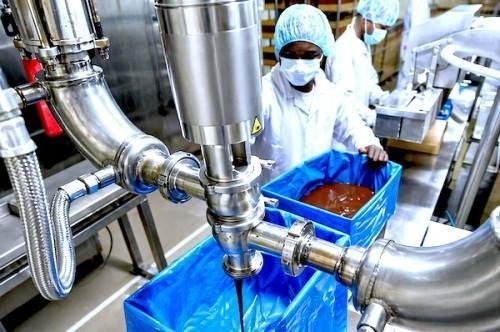
Nigeria’s cocoa processing plant at Ikom, Cross River State made zero naira in 2025, having not functioned for one day, because the plant was not completed by former Governor Ben Ayade in 2017, after spending some N7 billion in construction. Today, the massive complex at Atimaka area of Ikom LGA, is covered with bushes, without any activity whatsoever.
However, 27-km away from Ikom across the border into Republic of Cameroon, the cocoa industry here booms, with three processing plants fully operational in the West, Centre and East regions of the country.
Local processing of cocoa beans has steadily increased. According to the Cameroon National Cocoa and Coffee Board (ONCC), the country surpassed the symbolic threshold of 100,000 tons of cocoa beans processed locally for the first time during the 2024–2025 season. This shift is also improving Cameroon’s position in global markets.
A competitiveness report from the country’s ministry of economy shows that the country ranked as the world’s seventh-largest exporter of cocoa paste and ninth for cocoa butter in 2024.
Cocoa’s contribution to Cameroon’s export earnings is no longer driven solely by raw bean exports. In 2025, the country exported 162,257 tons of cocoa beans, generating CFA810.1 ($1.45 billion) billion, an increase of CFA127.6 billion (or $229.4 million) compared with the previous year. However, this performance increasingly reflects the rise of local processing.
In other words, Cameroon is gradually moving beyond raw exports to capture more value through industrial transformation, reinforcing the strategic role of the cocoa sector in the national economy.
The rise in processed exports reflects structural changes in Cameroon’s cocoa industry over the past decade. Since 2015, new processing companies such as Neo Industry, Atlantic Cocoa, and Africa Processing have entered the market, while existing operators have expanded their capacity. This includes SIC Cacaos, a subsidiary of Switzerland’s Barry Callebaut.
Last year, the Nigerian eastern neighbour received $687.59 million from its cocoa processing plants, according to data sourced from the country’s statistics agency, the Cameroon National Institute of Statistics (INS).
In sharp contrast, the Nigerian cocoa processing plant at Ikom, built at the cost of N7 billion in 2017 by former governor Ayade, has largely been inactive, with construction yet incomplete. The entire premises have been left to rot, despite the huge capital pumped into it. Till date, not a single cocoa powder, cocoa butter, cocoa paste, chocolate or any by-product has ever come out of the massive facility located at Atimaka area on the Ikom-Ogoja end of the Trans-African Highway (TAH), which links Nigeria and Republic of Cameroon.
The Ikom cocoa factory was expected to generate some $6.8 million annually for the Nigerian economy, as well as provide 5,000 direct and indirect jobs especially for the locals. All of this has remained a pipedream.
Nigeria saw a 606 percent rise in its cocoa exports to N1.2 trillion by Q4 of 2024, from N171 billion in the same period of 2023, with target to hit 500,000 tons in 2025. That was where it ended ― local processing is still a long way at the bottom.
On the flipside, neighbouring Cameroon continues to export cocoa-based products such as cocoa butter, cocoa paste, chocolate, and other products. According to the INS, the country generated CFA385.3 billion (about $688.03 million) in export revenue from cocoa processing in 2025, with total shipments reaching 99,190 tons. The INS said this marks an increase of CFA67.4 billion ($120.6 million) compared with 2024, when revenues stood at CFA317.9 billion (or $567.6 million) for 90,614 tons exported.
The growth in 2025 was largely driven by cocoa paste, which accounted for the largest share of earnings. Export volumes rose by 11,733 tons, from 61,527 tons in 2024 to 73,261 tons in 2025. This increase generated CFA261.3 billion (or $466.6 million) in revenue, up by CFA51.3 billion (or $91.57 million) year-on-year.
Cocoa butter also supported the overall performance. Cameroon exported 21,494 tons in 2025, generating CFA115.5 billion (or $206.4 million). In 2024, exports totalled 24,819 tons for CFA99.2 billion (or $177.13 million). Despite a drop of 3,325 tons in volume, revenue rose by CFA16.3 billion (or $29.1 million), likely due to higher international prices during the year.
In contrast, Cameroon’s exports of chocolate and other cocoa-based products declined slightly. They reached 4,435 tons in 2025, generating CFA8.4 billion (about $15.1 million). Compared with the previous year, this represents a decrease of 167 tons and CFA325 million (about $585,000) in value.








Dear Trevor: Africa is calling (1)