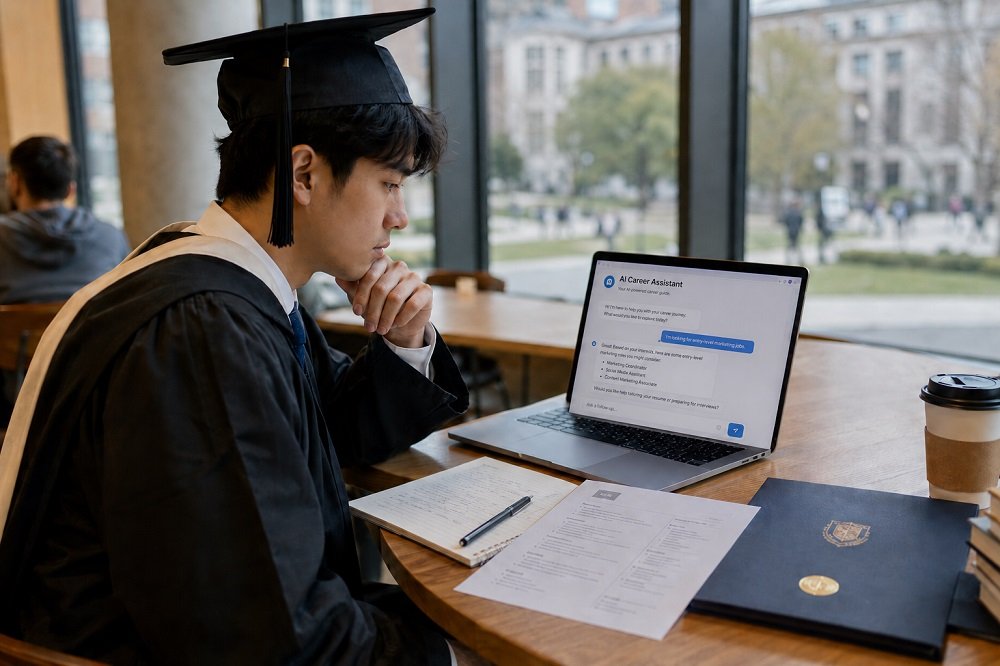
For decades, the final university examination represented the defining hurdle for British students preparing to enter the workforce. Today, however, securing a first job in an increasingly automated, AI-driven labour market, has emerged as a far greater source of anxiety.
New research from King’s College London has revealed a widening disconnect between higher education and the realities of modern employment, as students express growing concern that universities are failing to prepare them for a rapidly changing workplace shaped by artificial intelligence and automated recruitment systems.
The findings underscore mounting fears among students that traditional university degrees are losing their value as employers increasingly prioritise technological readiness and AI fluency over conventional academic credentials.
According to the data, 60 per cent of students believe artificial intelligence will make the graduate job market significantly more difficult, while only 36 per cent say their universities are adequately preparing them for this shift.
The concern comes as employers accelerate the integration of AI into recruitment, screening, and workplace operations, fundamentally reshaping how graduates compete for entry-level roles.
Despite widespread concern about AI’s impact on employment, students themselves are adopting the technology at remarkable speed.
Researchers found that students are increasingly relying on generative AI tools for learning, coursework support, research assistance, and productivity management, reflecting what analysts describe as a “survival strategy” in an intensely competitive labour market.
Yet the growing familiarity with AI has not eased fears about future employability.
Instead, anxiety levels continue to rise as students question whether university education is evolving quickly enough to remain relevant in an economy increasingly driven by automation, machine learning, and digital productivity tools.
The pressure is being amplified by deteriorating graduate labour market conditions across the United Kingdom.
Recent data from the Department for Education and the Institute of Student Employers indicates that graduate vacancies have tightened considerably amid broader economic uncertainty and changing hiring strategies.
At the same time, employers are increasingly automating recruitment processes.
According to industry surveys cited in the report, 62 per cent of employers now use AI within their hiring systems, while 70 per cent plan to expand automated candidate screening over the next five years.
The implications for students are significant.
While employers increasingly expect graduates to arrive with practical AI competencies, the government’s AI Labour Market Survey found that only 13 per cent of graduate schemes currently include structured AI training programmes.
In effect, many students are expected to enter the workforce “AI-ready” without receiving formal preparation from either universities or employers.
“The data shows a generation of students who have moved faster on AI than the institutions around them. They are already using it, deeply worried about its impact on their careers, and sensing that neither their university nor their future employer has a clear plan,” said Ankit Aggarwal, vice president of marketing at Amberstudent.
Aggarwal said students were increasingly questioning whether the traditional degree still guarantees employability in a labour market undergoing structural transformation.
“The degree still matters, but students are entirely right to ask whether it is keeping pace with reality,” he said.
The anxiety extends beyond concerns about temporary economic weakness or cyclical job shortages.
Many students now fear that AI could fundamentally reduce the availability of graduate-level work altogether, creating what researchers describe as a deeper structural fear around the future role of human labour.
The findings point to a growing perception among students that artificial intelligence may permanently reshape white-collar employment opportunities, particularly in sectors traditionally dominated by graduate recruitment such as finance, consulting, media, technology, and administrative services.
At the centre of the debate is criticism of how universities have responded to the rapid emergence of generative AI technologies.
ALSO : The $86bn threat hanging over Africa’s trade recovery
Rather than integrating AI capabilities into teaching models and workforce preparation strategies, many institutions have focused heavily on restricting or policing AI usage within academic assessments.
According to the report, 65 per cent of students said university assessment methods had changed primarily to limit AI use rather than teach students how to apply the technology productively and ethically.
The issue has become increasingly contentious across the UK higher education sector.
More than 2,000 students from Russell Group universities were reportedly penalised for AI-related misconduct during the 2024/25 academic year, nearly triple the number recorded the previous year.
The increase highlights both the rapid adoption of AI tools by students and the growing uncertainty institutions face in adapting traditional assessment systems to the realities of generative technology.
While official Department for Education statistics still show that graduates remain more employable than non-graduates, with graduate unemployment standing at 3.1 per cent compared to 5.6 per cent for non-graduates, the advantage is increasingly narrowing in the eyes of students concerned about automation.
The combination of automated recruitment systems, shrinking graduate opportunities, and limited AI workplace training is weakening confidence in the long-term value proposition of university education.
Industry observers warn that unless universities pivot toward practical AI literacy, digital adaptability, and workforce-oriented skills development, the credibility of traditional degree pathways could continue to erode.
“We are looking at a fundamental shift in what it means to be workplace ready,” Aggarwal said.
“Universities can no longer afford to treat AI purely as an academic misconduct issue. If higher education doesn’t pivot from policing AI to actively integrating it, the value of the traditional degree will continue to erode in the eyes of the students paying for it,” he added.