The first week of June delivered a brutal reminder that in today’s interconnected financial system, a single economic data release in the U.S can erase trillions in wealth globally. What began as a routine release of U.S. employment figures quickly evolved into a global market shock that sent investors scrambling for safety, triggering widespread selloffs across Nigerian equities, American technology stocks, cryptocurrencies, and precious metals. Within hours, a powerful chain reaction swept through global financial markets, leaving behind a trail of losses and raising fresh concerns about the outlook for risk assets in the months ahead.
The catalyst was a strong U.S. labour market report that fundamentally altered expectations about the future direction of American monetary policy. Investors who had spent much of the year betting on lower interest rates suddenly found themselves confronting a different reality of a resilient U.S. economy, stubborn inflationary pressures, and a Federal Reserve that may keep borrowing costs elevated for longer than previously anticipated.
The consequences were swift as global investors abandoned risky assets, shifted capital into dollar-denominated instruments, and accelerated a repositioning that reverberated across virtually every major asset class.
The impact was visible in Nigeria, where the stock market suffered one of its heaviest weekly declines of the year, shedding nearly N5 trillion in value as foreign and domestic investors rushed to lock in profits following a historic rally.
Nigerian market loses nearly N5 trillion
After months of relentless gains that transformed the Nigerian Exchange into one of the world’s best-performing equity markets, reality caught up with investors.
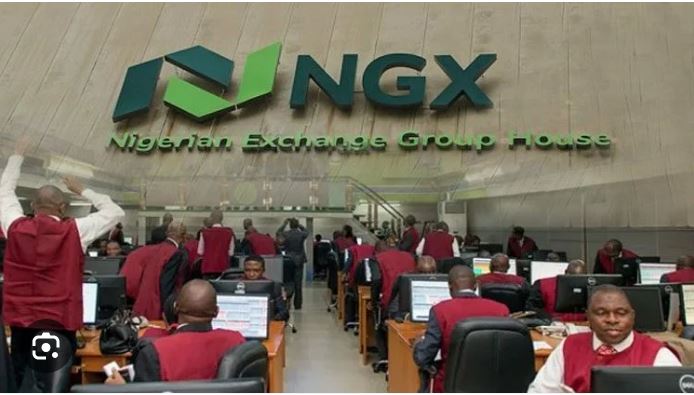
The Nigerian stock market entered June on a bearish note, with the benchmark NGX All-Share Index declining by 2.80 percent week-on-week to close at 243,379.63 points. Market capitalization fell by N4.41 trillion to N156.09 trillion, bringing total losses recorded since the beginning of June close to N5 trillion.
The correction comes after a remarkable run that saw the market rise more than 60 percent year-to-date in 2026, reaching historic highs in April and May.
For many institutional investors, pension funds, and asset managers, the rally had generated extraordinary returns over several months. With valuations stretched and global risks mounting, many elected to secure profits rather than remain exposed to a changing macroeconomic environment.
As a result, widespread selling emerged across major financial, consumer, industrial, and energy counters.
Heavyweight stocks that had driven much of the market’s impressive performance—including Aradel Holdings, MTN Nigeria, and BUA Cement, became focal points of profit-taking activities.
For emerging markets such as Nigeria, one of the most significant consequences of rising U.S. interest rates is the movement of foreign portfolio capital.
Often referred to as “hot money,” these investment flows are highly sensitive to changes in global interest rate differentials.
When yields in advanced economies rise, foreign investors frequently reduce exposure to emerging markets and redirect capital toward safer assets offering attractive returns.
That process appears to be unfolding once again. The strong U.S. employment report reinforced expectations that the Federal Reserve may postpone interest rate cuts, causing Treasury yields to rise sharply.
For international investors, the appeal of U.S. government debt suddenly increased. Rather than taking risks in emerging markets facing currency volatility and political uncertainty, investors found themselves able to earn attractive returns from dollar-denominated securities backed by the world’s largest economy.
The resulting capital migration exerted pressure on several frontier and emerging markets, including Nigeria.
The withdrawal of foreign funds coincided with domestic profit-taking, amplifying selling pressure across the Nigerian Exchange.
The selloff has also highlighted competition from fixed-income assets.
Nigeria’s Treasury bill market has become increasingly attractive to institutional investors, particularly as short-term government securities now offer yields approaching 16 percent. The attractiveness of these instruments has triggered a significant portfolio rotation.
Rather than remain exposed to stock market volatility, institutional investors are increasingly allocating funds toward government debt instruments that provide predictable returns with minimal risk. This trend is becoming a defining feature of Nigeria’s investment landscape.
While equities still offer long-term growth potential, many investors now view fixed-income instruments as a superior risk-adjusted opportunity in the current environment.
Consumer goods manufacturers continue to struggle with weakened purchasing power and slowing demand. Industrial firms face elevated production costs, supply chain bottlenecks, and foreign exchange pressures.
Not all sectors have suffered equally. Banking stocks continue to showcase relative resilience amid elevated interest rates. Higher rates generally support bank earnings by widening interest margins and boosting returns on interest-bearing assets.
However, even the banking sector was unable to escape the market correction entirely.The NGX Banking Index declined by 3.44 percent during the week
Sectoral performance remained broadly negative. The Oil and Gas Index recorded the heaviest decline, falling by 5.18 percent, while the Industrial Goods Index lost 4.40 percent.Commodity, Insurance, and Consumer Goods indices also closed lower. Despite falling prices, investor participation remained remarkably strong.
Trading volume rose 65.40 percent week-on-week, while transaction value climbed 57.55 percent to N175.78 billion. A total of 3.97 billion shares changed hands across 344,073 deals, indicating active portfolio repositioning rather than investor disengagement.
The global shock extended far beyond emerging markets. In the United States, technology stocks, particularly those linked to artificial intelligence, experienced a reversal as investors reassessed growth expectations.
For more than a year, AI-related companies had dominated financial markets, driving spectacular gains across the Nasdaq and creating some of the largest corporate valuations in history.
However, last week’s developments exposed growing concerns about sustainability, valuations, and future earnings growth.
Meta Platforms fell 5.5 percent after reports emerged that the company may pursue a massive capital raise to finance its AI ambitions.
Investors reacted cautiously, worried about dilution and the enormous costs associated with developing next-generation artificial intelligence infrastructure. Meanwhile, semiconductor companies also faced pressure.
Broadcom’s mixed guidance and reduced forecasts dampened investor enthusiasm, prompting broader selling across the chip sector.
The developments triggered a sector rotation away from some of the market’s biggest winners.
Investors who had enjoyed enormous gains from AI-related stocks began locking in profits, contributing to wider market weakness.
Bitcoin crashes below key support
Cryptocurrency markets suffered some of the most severe damage from the global liquidation wave.
Bitcoin plunged more than 6 percent in a matter of hours, breaking below the critical $60,000 level and triggering widespread panic across digital asset markets.
On the macro side, stronger U.S. economic data reduced expectations for interest rate cuts, undermining demand for speculative assets.
At the same time, institutional investors continued withdrawing funds from Bitcoin exchange-traded funds.
Spot Bitcoin ETFs recorded $4 billion in outflows over a two-week period, marking their worst stretch since launch. The withdrawals intensified selling pressure and weakened market confidence.
The decline triggered massive liquidations among leveraged traders. More than $200 million worth of long positions were wiped out in a single day as falling prices activated forced sales across trading platforms.
Ethereum also came under pressure, declining nearly 10 percent and dragging the crypto market lower.
Yet beyond monetary policy concerns lies another emerging narrative. Institutional capital appears to be migrating away from cryptocurrencies and toward artificial intelligence investments.
Large investment funds increasingly view AI infrastructure as the next transformational growth opportunity. Billions of dollars are now flowing into semiconductor manufacturers such as Nvidia, Broadcom, and Marvell, as well as private technology firms pursuing ambitious AI projects. Major fundraising rounds involving OpenAI, Anthropic, and SpaceX have attracted enormous institutional interest.
To participate in these opportunities, some investors are reportedly liquidating portions of their cryptocurrency holdings. In effect, capital that once fuelled Bitcoin’s momentum is increasingly being redirected into the AI revolution.
Analysts caution against interpreting the recent selloff as the beginning of a prolonged bear market. Instead, many view it as a healthy correction following extraordinary gains across equities, cryptocurrencies, and commodities.
In Nigeria, market breadth remained weak, with only 21 gainers compared to 68 decliners, but selective buying continued in stocks with strong fundamentals.
INTENEGINS emerged as the week’s top performer with a gain of 60.6 percent, while ABBEYBDS, IKEJAHOTEL, CONHALLPLC, and TRIPPLEG also recorded strong advances.
Analysts at Cowry Asset Management expect the market to remain cautious but active, supported by selective bargain hunting and sustained interest in fundamentally attractive companies.