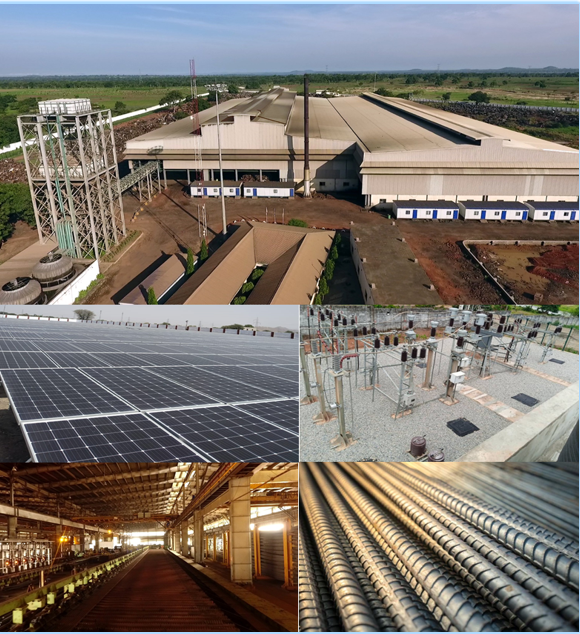
Nigeria took a notable industrial step recently as Joseph Tegbe, the minister of power, Abubakar Audu, the minister of steel development and John Owan Enoh, the minister of state for industry, joined Mohammed Umaru Bago, the Niger State governor and the leadership of Abuja Steel Mills Limited to break ground on what is expected to become the largest solar-powered industrial park project in sub-Saharan Africa.
The ceremony, which also included the formal handover of 500 hectares by the Niger State Government to Abuja Steel Mills, a subsidiary of African Industries Group, marked more than the start of a steel and industrial park development. It offered a practical glimpse of the industrial growth the President Bola Ahmed Tinubu administration could achieve when translated from policy ambition into productive infrastructure.
The project includes a 200MW solar mini-grid designed to power the industrial park and its anchor steel plant. By scale alone, it is a landmark development. But the deeper significance lies in the strategic choice behind it. Abuja Steel Mills is not turning to off-grid power as a temporary workaround to Nigeria’s electricity constraints. It is building one of the country’s most ambitious industrial energy projects outside the national grid by design.
The implications extend beyond one steel plant. Industrial-scale embedded generation offers manufacturers a way to reduce exposure to grid instability, improve energy cost visibility and build operations around a more dependable supply of power. In some cases, it also creates the basis for surplus power distribution to nearby communities or adjacent industrial users.
For a country with abundant solar resources and a large unmet need for industrial power, the replication potential is considerable. That is what makes the Niger State groundbreaking especially significant. If this model proves commercially viable at scale, it could become a template for industrial development in sectors ranging from steel and cement to agro-processing and manufacturing.
The structure of the Abuja Steel Mills project also points to a more practical route for accelerating Nigeria’s energy transition. Unlike large centralised grid expansion projects, embedded renewable systems can be developed faster, financed more flexibly and delivered with a clearer commercial logic when tied directly to industrial demand. What they require from the government is not necessarily heavy public spending, but targeted enablement: land, licensing clarity, regulatory support and policy consistency.
That is where Niger State’s role becomes commendable. Governor Bago’s allocation of 500 hectares to the project is considered more than a land transfer, but also a statement that subnational governments can play an active role in unlocking industrial energy investments.
The federal government’s presence at the ceremony carries its own signal. With the ministers of power, steel development and industry all represented, the project appears to have been positioned not as a narrow corporate investment, but as an industrial and energy initiative of wider economic significance. It is also considered an official recognition that mini-grid and off-grid infrastructure can serve not just households and rural communities, but also large-scale productive enterprise.