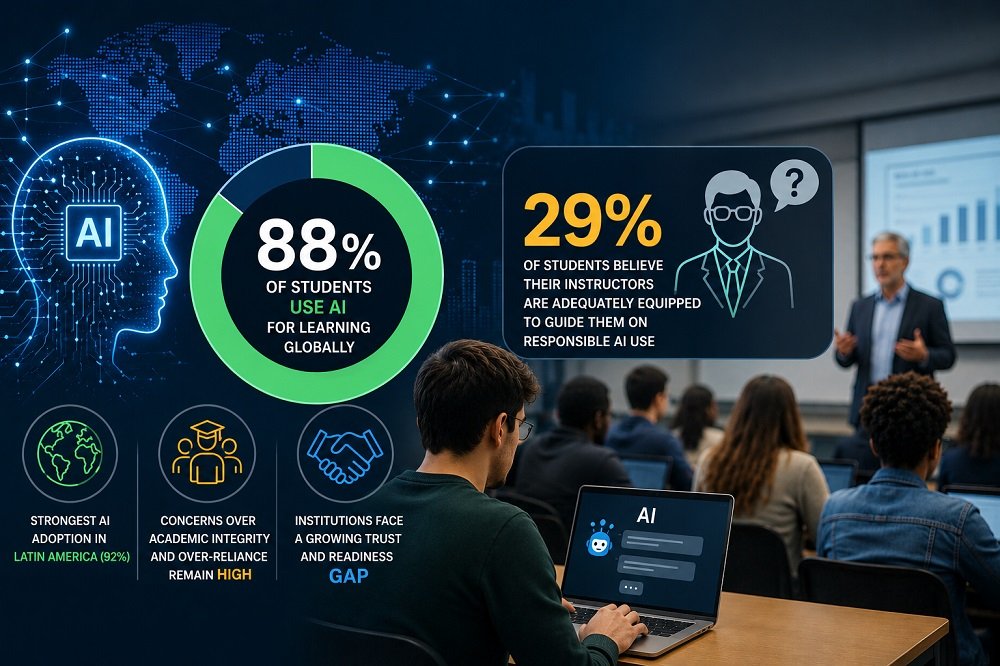
Artificial intelligence has become a mainstream learning tool for students across the world, but universities are struggling to earn students’ confidence in their ability to provide effective guidance on its use, according to the latest global survey by the Digital Education Council (DEC).
The Digital Education Council AI in Higher Education Global Survey 2026, which gathered responses from 45,398 students and faculty members across 118 higher education institutions in 35 countries, found that 88 percent of students worldwide now use AI as part of their learning, yet only 29 percent believe their instructors are adequately equipped to guide them on responsible AI use.
The report, regarded as one of the most extensive global assessments of AI adoption in higher education, highlights widening regional differences in how students and educators perceive the technology, even as AI becomes increasingly embedded in classrooms.
According to the findings, AI adoption among students is strongest in Latin America, where 92 percent reported using the technology for learning, followed by the Europe, Middle East and Africa (EMEA) region at 85 percent. Adoption was comparatively lower in the United States and Canada, where 65 percent of students reported using AI for academic purposes.
Despite its widespread use, the survey suggests that many students remain unconvinced that AI has fundamentally transformed their educational experience. Only five percent of respondents said AI had significantly changed the way they learn.
Concerns about AI’s long-term impact on education also remain widespread. Around 66 percent of students globally fear that increased reliance on AI could make learning more superficial, while 73 percent of faculty members expressed concern that students may depend on AI at the expense of developing their own critical thinking and problem-solving skills.
The report shows that these concerns are influencing attitudes toward AI differently across regions.
In Asia-Pacific (APAC), EMEA and Latin America, institutions continue to embrace AI despite reservations. Faculty members in these regions remain largely optimistic about integrating AI into teaching, with 57 percent of APAC educators saying they believe the technology can make education more effective and accessible.
By contrast, sentiment in the United States and Canada has become increasingly cautious. More than half of students in the region, representing 55 percent, said they would support institutional restrictions on AI use. Of these, 43 percent favoured a complete institution-wide ban, while another 12 percent supported partial restrictions.
Faculty enthusiasm has also weakened in North America. The proportion of educators intending to use AI in teaching fell from 76 percent in 2025 to 67 percent in 2026, marking the lowest adoption intention among all regions covered by the survey.
Academic integrity also emerged as a growing concern. Nearly 73 percent of students in the United States and Canada believe their peers are using AI to gain an unfair academic advantage. That compares with a global average of 60 percent and 48 percent in EMEA, suggesting stronger concerns over AI misuse in North American institutions.
The survey also points to growing anxiety about AI’s effect on future employment, particularly in the Asia-Pacific region. Half of students in APAC expect AI to reduce job opportunities in their chosen fields, significantly above the global average of 41 percent.
Perhaps the most striking finding, however, is the apparent gap between institutional efforts and student confidence. Although 64 percent of faculty members worldwide reported completing AI literacy training, fewer than one-third of students believe their instructors are sufficiently prepared to guide them. Confidence is especially low in the United States and Canada, where only 17 percent of students expressed trust in their instructors’ AI expertise.
Commenting on the findings, Alessandro Di Lullo, chief executive officer of the Digital Education Council, said the issue extends beyond students’ use of AI to the quality of institutional leadership surrounding the technology.
“The danger is not that students are using AI. It is that they are learning to use it without fully trusting their instructors to guide them, and they know it. What students need from their institutions is clarity, and that looks very different depending on where they are. A blanket policy will not serve any student or faculty well,” Di Lullo noted.
Danny Bielik, president of the Digital Education Council, said AI has evolved from a technology experiment into a strategic leadership issue for higher education institutions.
He noted that university leadership must play a more active role in coordinating AI adoption, strengthening institutional capabilities and maintaining clear communication with students, faculty, administrators and wider academic communities. Without a coherent institutional strategy, he warned, divisions over AI use are likely to deepen.
The latest survey builds on the Council’s earlier studies, including the Global AI Student Survey 2024, Global AI Faculty Survey 2025 and the AI in Higher Education LATAM Survey 2026, as universities worldwide continue to deal with balancing AI-driven innovation against concerns over academic integrity, learning quality and workforce preparedness.