
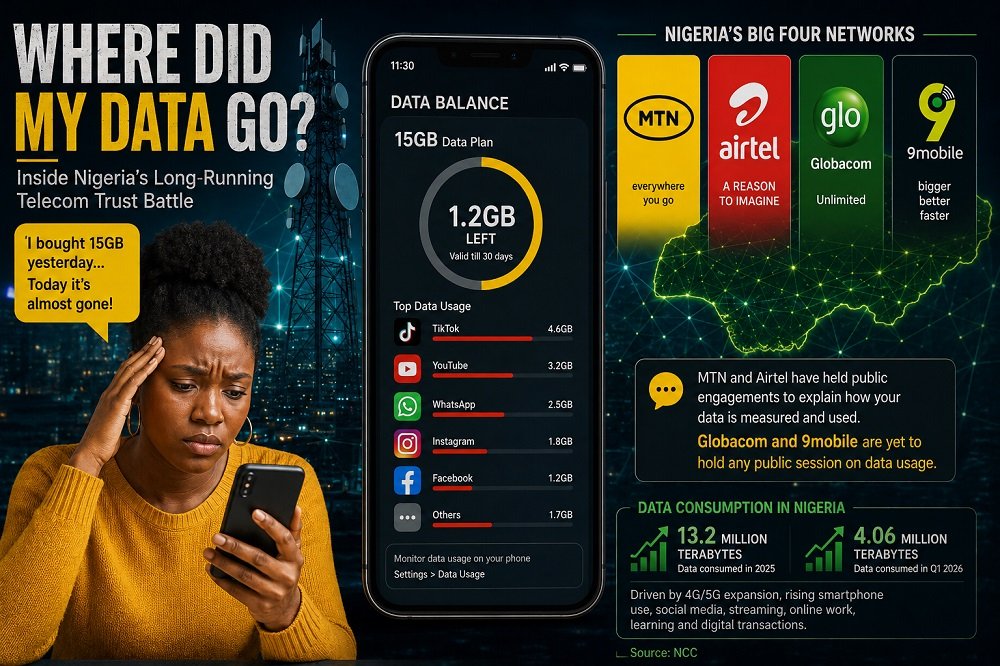
For millions of Nigerians, buying a mobile data bundle often comes with an expectation and, increasingly, a lingering suspicion.
The expectation is simply that the purchased data should last for a reasonable period based on personal usage. The suspicion emerges when that bundle appears to vanish much sooner than expected, prompting the familiar question that has roared across customer care lines, social media platforms and everyday conversations for years: Where did my data go?
It is a complaint that has survived multiple generations of mobile technology. From the early days of 3G internet access to today’s 4G and emerging 5G services, many subscribers have remained convinced that telecom operators deduct data faster than they should. Whether purchasing a modest daily plan or a monthly subscription worth tens of gigabytes, many users insist their internet bundles are depleted long before they believe they have consumed them.
Ironically, this scepticism has grown at a time when Nigeria is consuming more mobile data than at any other point in its digital history. According to industry statistics, mobile data consumption reached approximately 13.2 million terabytes in 2025, while another 4.06 million terabytes had already been consumed during the first quarter of 2026. Those figures tell the story of a country where mobile connectivity has evolved from a convenience into an essential utility supporting work, education, banking, commerce, healthcare and entertainment.
From basic handsets to always-connected lifestyles
Only a decade ago, mobile phones in Nigeria were primarily tools for calls and text messages. Internet access, where available, was slow, expensive and often limited to basic browsing or email checks. Feature phones dominated the market, and even early smartphones were used sparingly for online activities.
Today, that reality has been completely overturned. Smartphones have become multi-purpose devices that function as banks, classrooms, cinemas, offices and social hubs. A single device now supports video streaming, social media engagement, online payments, navigation services, cloud storage, remote work applications and even AI-powered tools.
Industry analysts attribute this shift to several converging forces. The expansion of 4G networks, the early rollout of 5G trials, the proliferation of affordable smartphones and the rapid adoption of social media platforms have collectively pushed data consumption to unprecedented levels. Increasing digitisation across sectors such as banking, education and commerce has further accelerated demand.
In practical terms, Nigerians are no longer simply “going online.” They are staying online.
The scale of digital engagement in Nigeria is most visible in app usage patterns. Social media and entertainment platforms dominate daily consumption habits, with short-form video and messaging leading the charge.
TikTok currently ranks among the most widely used platforms in the country, followed closely by YouTube. Facebook, Instagram and WhatsApp also remain deeply embedded in everyday communication. Interestingly, while WhatsApp is not always the most data-heavy platform in terms of content, it has one of the highest active user bases, serving as a primary channel for messaging, business transactions, information sharing and media exchange.
The result is a highly active mobile ecosystem where users often switch between multiple platforms simultaneously. A typical user may be watching videos on one app, chatting on another, streaming music in the background and uploading content to cloud storage, all within the same period of time.
This shift has redefined what it means to “use data.” It is no longer a single action but a continuous background process involving multiple applications running in parallel.
The enduring suspicion: where did my data go?
Despite this transformation, a large number of subscribers continue to express dissatisfaction with how quickly their data bundles are exhausted. The complaint is often framed in terms of loss or discrepancy, with many users believing that telecom operators are either overcharging or deducting data unfairly.
The sentiment has become deeply embedded in public discourse, shaping consumer trust and influencing how Nigerians relate to their mobile network providers.
However, telecom operators argue that the perception does not reflect the technical reality of modern data consumption.
Nigeria’s two largest operators, MTN and Airtel, which together account for a significant portion of the country’s mobile subscribers, have recently intensified public engagement efforts aimed at explaining how data is actually consumed and billed.
MTN’s explanation: how data is measured and consumed
At a customer engagement held earlier in June, themed around data usage transparency, MTN executives offered a detailed explanation of how mobile data is tracked across networks.
According to David Ogunsola, general manager for IT Operations at MTN Nigeria, data is universally measured in bytes across the world, regardless of region. He noted that whether a user is in Africa, North America or the Middle East, the fundamental unit of measurement remains the same.
He explained that data consumption is tracked at multiple levels, beginning from the user’s device. Smartphones record interactions with applications and websites, including background activity that users may not actively notice. Beyond the device layer, the network infrastructure also captures traffic, ensuring that data exchanged between users and content servers is fully accounted for.
A third layer, known as the charging system, aggregates this usage for billing purposes. Unlike voice calls or SMS, which are relatively linear and easier to track, data usage is multidimensional. Multiple applications can consume data simultaneously, even when users are not actively engaging with them.
Ogunsola also pointed out that differences in measurement standards can contribute to confusion. Device manufacturers often use a decimal system where 1,000 bytes equal 1 kilobyte, while the international standard adopted by the International Electrotechnical Commission defines 1 kilobyte as 1,024 bytes. While the difference appears negligible at small scales, it becomes more noticeable at higher volumes such as gigabytes and terabytes.
He further noted that modern digital experiences significantly increase data consumption. High-definition video streaming, cloud-based applications, automatic updates and real-time content delivery systems all contribute to faster data usage.
In his words, newer technologies and faster networks have not reduced data consumption but increased it, because users are now able to do far more within the same amount of time.
“Your phone has the receipts”
While technical explanations help describe how networks function, one question continues to dominate customer conversations: if operators insist their systems are accurate, why do so many subscribers believe their data disappears unexpectedly?
Speaking to that, Ugonwa Nwoye, chief customer relations and experience officer at MTN Nigeria, said investigations into customer complaints consistently reveal a strong correlation between device-recorded usage and network billing records.
According to her, whenever customers report unexplained data depletion, the company analyses both network records and the usage information available on the customer’s smartphone.
“The phone has the receipts,” she said, referring to the usage logs available on both Android and Apple devices.
These records allow subscribers to see exactly which applications consumed data, the amount used and the specific times the activity occurred. In many cases, applications running silently in the background account for a significant share of overall consumption.
Nwoye added that MTN’s confidence in its billing processes is reinforced by routine audits and regulatory oversight designed to ensure that network charging systems remain consistent with recorded usage.
The invisible consumption most users overlook
One of the strongest arguments presented by telecom operators is that a large portion of data usage occurs without direct user awareness.
Applications frequently run background processes such as automatic updates, cloud synchronisation, photo backups and content preloading. Social media platforms also play a significant role, with features like autoplay videos, continuous scrolling feeds and algorithm-driven content delivery increasing data usage.
Streaming quality is another major factor. Watching videos in standard definition consumes significantly less data than high-definition or ultra-high-definition formats. A shift from SD to HD, according to industry estimates, can triple data usage, while 4K streaming can multiply it several times over.
Beyond entertainment, everyday digital conveniences also consume data. Cloud backups, email synchronisation, map services, wearable devices and smart applications all contribute to continuous background consumption.
As networks become faster and devices more sophisticated, users are increasingly connected in ways that are not always visible on the surface.
Beyond defending its systems, however, MTN indicated that its broader objective is to help subscribers become more informed about monitoring their own data consumption through tools available both on smartphones and through the operator’s digital platforms.
Airtel’s perspective: transparency as a business strategy
While MTN focused largely on explaining the technical processes behind data billing, Airtel Nigeria approached the debate from a different angle, arguing that transparency should become a practical tool that enables customers to make more informed choices.
Speaking at its recent industry forum centred on data awareness and consumer control, Dinesh Balsingh, Airtel Nigeria’s chief executive officer, represented by Femi Adeniran,the company’s director of corporate communications and CSR, said trust has become increasingly important as smartphones and digital services continue to reshape internet consumption
To address subscribers’ concerns, Balsingh said Airtel recently introduced its Data Calculator, a tool designed to help customers estimate their data requirements based on activities such as video streaming, online gaming, video calls and social media use.
“The purpose of the Airtel Data Calculator is to provide greater visibility, support informed decision-making and place more information directly in the hands of customers. Because transparency should never be viewed as a compliance exercise. Transparency is good business,” he stated.
He dismissed claims that telecom operators deliberately deplete customers’ data, insisting that Airtel has no business incentive to shortchange subscribers.
“Airtel has no incentive to shortchange subscribers through inaccurate billing, forced spending or unnecessary data depletion,” Balsingh added.
He further noted that the company has continued to invest in network infrastructure, fibre capacity, digital platforms, artificial intelligence systems and customer support channels to enhance service quality.
Globacom and T2 mobile approach
Meanwhile, at the time of writing, Globacom and T2 mobile, formerly 9mobile, have taken a different approach to the ongoing data perception debate compared to MTN and Airtel.
Unlike their larger competitors, both operators have not held major public forums or large-scale media engagements specifically addressing data consumption concerns.
Instead, they have largely responded through individual customer care channels and established regulatory communication frameworks.
A review of T2’s official X (formerly Twitter) account shows a more subtle approach. The operator has been consistently sharing updates focused on data management tips, and general usage guidance for subscribers. In addition, customers reportedly receive periodic SMS messages containing advice on how to optimise data usage and reduce unnecessary consumption.
Although less visible than the campaigns mounted by MTN and Airtel, these efforts indicate that concerns over data depletion are being acknowledged across the industry, even if operators have chosen different ways of engaging with the conversation.








The financial cancer hidden in public sector governance