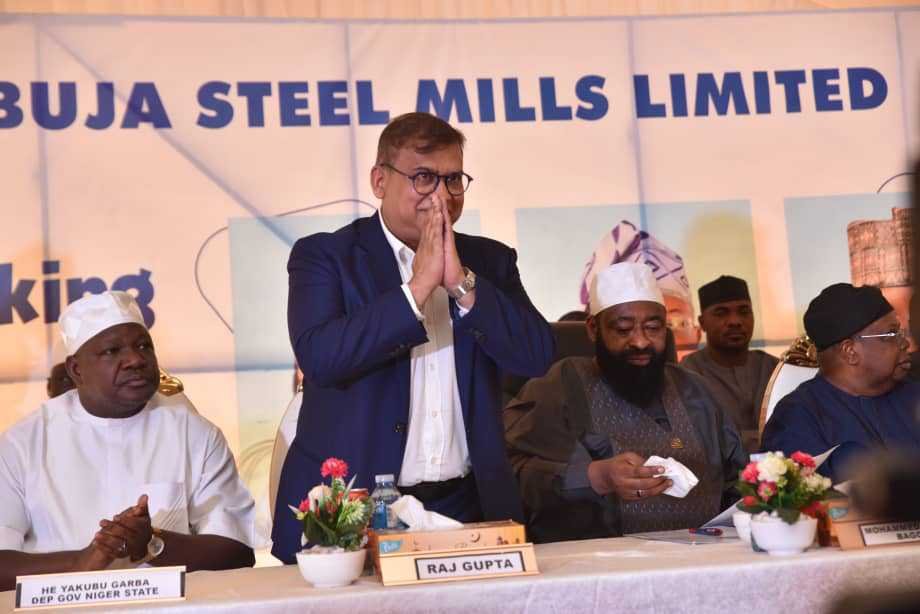
Niger State, with the largest landmass in Nigeria, has approved 500 hectares of land to Raj Gupta, Indian billionaire’s African Industries Group (AIG) to build what could become sub-Saharan Africa’s largest solar-powered steel plant in Nigeria, according to reports monitored by Business A.M.
Raj Gupta’s African Industries Group’s Nigerian subsidiary, the Abuja Steel Mills Limited will construct the large solar-powered steel manufacturing facility, alongside a new industrial park.
The project will combine large-scale steel manufacturing with a dedicated solar power plant, and initiative aligning with the north-central state’s broader plan to become a key industrial corridor, supported by additional land, gas pipeline access, and hydro assets.
Officials have stressed the role of steel and renewable energy investments in achieving Nigeria’s goal of building a $1 trillion economy by 2030. Moreover, following the country’s biggest industrialisation disappointments in the Ajaokuta Steel Complex, after sinking over $8 billion into the project, the plant has never produced commercial steel. This failure stems from a combination of obsolete, outdated blast furnace technology, deep-rooted corruption, and historical policy instability.
The AIG steel project will combine a large-scale steel manufacturing complex with a dedicated solar power plant and a proposed AIG Industrial Park, reflecting the growing push to reduce manufacturers’ dependence on the Nigeria’s unreliable electricity grid.
If successful, the project could become a model for how energy-intensive manufacturers across Africa power industrial growth with cleaner, more reliable, renewable energy.
Raj Gupta, chairman of African Industries Group, said the land allocated to his company was historic, adding that the solar installation could become the largest in Nigeria and potentially the biggest supporting a steel operation anywhere in sub-Saharan Africa.
Governor Mohammed Umar Bago said the investment is in line with his administration’s broader ambition to position Niger, the hydro-electricity producing state as Nigeria’s next major industrial corridor.
Governor Bago also announced plans to gazette an additional 200,000 hectares of industrial land stretching toward Kaduna State, to leverage the Ajaokuta–Kaduna–Kano (AKK) gas pipeline, abundant solar resources and the state’s hydropower assets, which include the Kainji, Jebba, Shiroro and Zungeru dams.
Minister of steel development Shuaibu Audu lauded African Industries Group for growing from a modest steel business into one of West Africa’s largest producers, and employing about 10,000 workers across its operations.
Audu said the AIG investment was linked to the federal government’s ambition of building a $1 trillion economy by 2030, with steel expected to play a central role.
The minister of state for industry, trade and investment John Owan Enoh said private-sector investments of this scale would be essential to reducing Nigeria’s dependence on imported steel products while creating jobs and expanding local manufacturing.
Nigeria spends $4 billion to $8 billion annually on steel imports. This massive expenditure which covers about 90 percent of the country’s total steel consumption, puts severe pressure on the country’s foreign exchange reserves, driving up local construction and manufacturing costs.
According to BillionairesAfrica, African Industries Group founded more than five decades ago, has grown into one of Nigeria’s largest industrial conglomerates, operating more than 30 manufacturing plants across sectors including steel, mining, chemicals, glass and real estate.
Abuja Steel Mills, AIG subsidiary, says the land assists its expansion into utility-scale solar as it seeks to power steel production with renewable energy instead of relying on unreliable national power grid, and costly diesel generators.