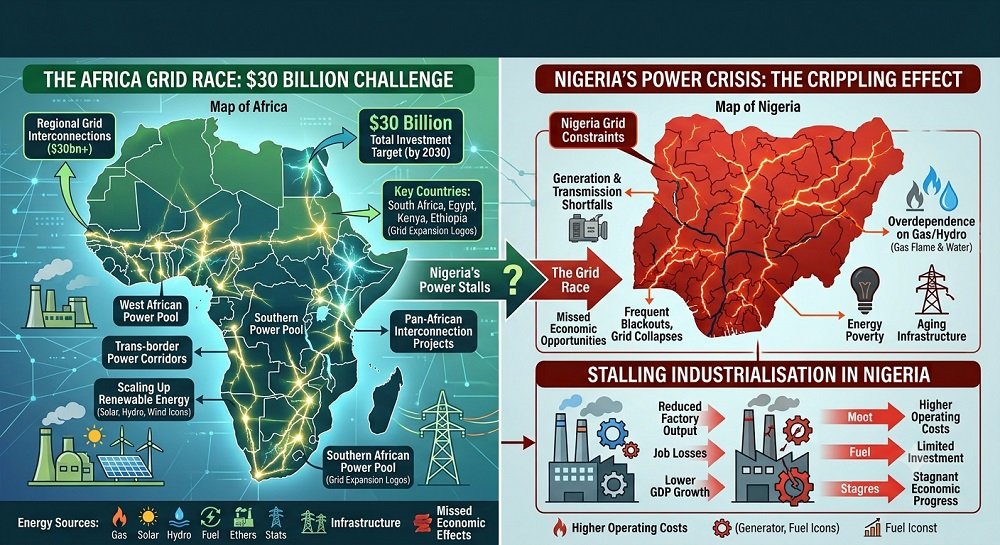
- Heavy dependence on private power generation
- Operates 40GW of off-grid generator capacity
- Electricity reliability deficit at $48bn
- Economy loses $26bn to power shortages
- $22bn on diesel, petrol, backup generators
As Africa prepares to nearly double electricity demand to 2,291 terawatt-hours (TWh) by 2050, industry leaders are warning that the continent’s biggest energy challenge is no longer generating power but moving it efficiently across borders. With Nigeria still battling repeated grid collapses, weak transmission infrastructure and a financially distressed electricity market, experts say Africa’s ambition to become a global industrial powerhouse could remain elusive unless countries invest massively in interconnected electricity markets capable of supporting manufacturing, trade and economic transformation.
Every time Nigeria’s national electricity grid collapses, factories fall silent, production lines grind to a halt, diesel generators roar into life and businesses begin counting losses almost immediately. For manufacturers, exporters, technology companies and millions of small businesses, the country’s recurring power failures have become more than an operational inconvenience. They have evolved into a structural cost of doing business; one that continues to derail productivity, discourage investment and undermine Nigeria’s competitiveness both within Africa and globally.
The consequences stretch far beyond Nigeria’s borders. As Africa races towards industrialisation under the African Continental Free Trade Area (AfCFTA), electricity is increasingly emerging as the single most decisive factor separating countries capable of attracting industrial investment from those trapped in cycles of low productivity and high operating costs.
It is against this backdrop that the African Energy Chamber (AEC) is making one of its strongest calls yet for the creation of interconnected electricity markets across Africa, arguing that regional integration, not isolated national grids, will determine whether the continent finally unlocks its enormous economic potential.
The Chamber believes Africa’s next great infrastructure challenge is no longer simply building power plants but constructing the transmission networks, regional electricity highways and cross-border trading systems capable of delivering reliable electricity to industries wherever demand exists.
According to industry estimates, Africa’s electricity demand is projected to almost double, reaching about 2,291 terawatt-hours (TWh) by 2050, a development that will require approximately $30 billion in transmission and grid infrastructure investments if the continent hopes to integrate new generation capacity and prevent valuable electricity assets from remaining stranded.
The warning comes at a particularly significant moment for Nigeria, Africa’s most populous country.
Only months after another nationwide grid disturbance exposed the fragility of the country’s ageing transmission infrastructure, Africa’s third largest economy finds itself once again at the centre of a continental conversation about electricity reliability, investment readiness and industrial competitiveness.
For decades, policy discussions around Africa’s electricity deficit have focused largely on inadequate generation capacity. Governments celebrated new gas-fired plants, hydroelectric dams, solar farms and wind projects as milestones toward energy security.
Today, however, energy experts increasingly argue that generation is no longer the continent’s primary bottleneck. According to them, the weakest link lies in the wires.
Africa is generating more electricity, but much of it risks remaining stranded as transmission infrastructure lags behind new investment.
Across the continent, governments and private investors are pouring billions of dollars into renewable energy, gas-fired plants and other generation projects. Yet weak transmission networks continue to limit the movement of electricity from power stations to homes, factories and businesses.
The disconnect is becoming a growing concern for investors. Without stronger grids, new power plants struggle to generate expected revenues, renewable projects face increasing curtailment, and industrial consumers remain trapped in unreliable electricity markets despite rising generation capacity.
It is this widening imbalance between supply and delivery that has prompted organisers of African Energy Week (AEW) 2026 to introduce a dedicated Power Africa Today platform, bringing together governments, investors, utilities and developers to examine how regional electricity markets can be redesigned around interconnected transmission systems rather than isolated national networks.
For Nigeria, the conversation could hardly be more relevant. Despite possessing one of Africa’s largest natural gas reserves and enormous renewable energy potential, the country continues to struggle with one of the continent’s most fragile electricity systems.
Repeated nationwide grid collapses have become almost routine. Transmission bottlenecks regularly prevent available generation capacity from reaching consumers. Distribution companies continue to face weak infrastructure, inadequate metering and poor revenue collection.
Generation companies complain of mounting debts. Gas suppliers remain unpaid.
Consumers increasingly depend on self-generation. The result is an electricity ecosystem trapped in a cycle of technical weakness and financial distress.
According to Chika Mbonu, a business analyst, the country’s electricity crisis persists because every segment of the value chain is simultaneously under pressure.
“The entire system is financially broken,” he observed during a recent television interview, arguing that Nigeria’s electricity challenge extends far beyond engineering deficiencies.
Instead, he described an industry weighed down by financial constraints, institutional weaknesses, political interests and structural inefficiencies that reinforce one another.
Mbonu argues that solving such a crisis requires far more than periodic tariff reviews or new ministerial appointments.
Instead, meaningful reform demands sustained political commitment capable of confronting vested interests that have become deeply embedded within the electricity value chain.
His comments echo concerns shared by many industry participants who argue that decades of inconsistent reforms have created a market where inefficiencies often prove more profitable than efficiency itself.
One of the most striking illustrations of this dysfunction is Nigeria’s enormous dependence on private electricity generation. Instead of relying primarily on the national grid, businesses across virtually every sector now maintain diesel or petrol generators as essential operational assets.
From neighbourhood shops and restaurants to banks, telecommunications companies, hospitals and manufacturing plants, self-generation has become an unavoidable cost of survival.
Industry estimates show that Nigeria now operates about 40 gigawatts of off-grid generator capacity, creating what analysts increasingly describe as a “shadow electricity system” that is several times larger than the average electricity available from the national grid.
Maintaining this parallel electricity economy comes at an enormous financial cost.
Businesses and households are estimated to spend $22 billion annually purchasing diesel, petrol and maintaining backup generators.
This expenditure represents productive capital that could otherwise finance factory expansion, research and development, digital transformation, workforce development or export growth. Instead, it is consumed simply keeping the lights on.
The wider economic losses are even greater. According to Standard Bank’s Africa Trade Barometer, electricity shortages cost Nigeria’s economy an estimated $26 billion annually through lost productivity, interrupted production and reduced business activity.
Combined with expenditure on backup generation, the country’s electricity reliability deficit approaches $48 billion every year, an amount exceeding the annual budgets of several African economies.
Even more conservative estimates from the World Bank place annual economic losses at roughly $29 billion, equivalent to nearly ten percent of Nigeria’s gross domestic product.
Regardless of methodology, the conclusion remains remarkably consistent. Electricity has become one of Nigeria’s largest hidden economic taxes.
Unlike formal taxation, however, this burden appears nowhere in government budgets.
Instead, businesses absorb the costs through higher production expenses, delayed deliveries, damaged equipment, lower productivity and diminished competitiveness.
Foreign companies compare Nigeria’s electricity environment with competing investment destinations across Asia, Europe and increasingly North Africa. The implications extend beyond national economic performance.
As African countries seek to deepen regional trade under AfCFTA, unreliable electricity threatens to undermine one of the agreement’s central promises of creating globally competitive African manufacturing industries.
A manufacturer producing textiles in Lagos, pharmaceuticals in Accra or processed foods in Lusaka ultimately competes not only with neighbouring African producers but also with firms operating in countries where electricity remains consistently available and significantly cheaper.
Reliable electricity therefore becomes more than an infrastructure issue. It becomes an industrial policy, a trade policy, and an investment policy. Increasingly, it also becomes a geopolitical issue.
The African Energy Chamber argues that integrated electricity markets offer a fundamentally different pathway.
Rather than viewing electricity solely as a national public utility, interconnected power pools would increasingly treat electricity as a regional commodity capable of flowing efficiently across borders according to demand, pricing and system requirements.
Such an approach, the chamber says, promises multiple benefits.
According to the AEC, countries would gain access to more diversified electricity sources, utilities could reduce reserve capacity requirements, and renewable energy integration would become easier.
They added that it would enable investors to enjoy larger electricity markets capable of supporting larger projects, while industrial consumers could benefit from improved reliability and potentially lower costs.
For Nigeria, participation in a stronger West African electricity market could transform the country’s role from being merely Africa’s largest electricity consumer into becoming one of the region’s most influential electricity trading hubs. Yet achieving that vision requires confronting the same structural weaknesses that continue to undermine Nigeria’s domestic electricity market today.
The urgency of those reforms extends well beyond Nigeria. Across Africa, the continent’s electricity crisis has increasingly become less about access alone and more about reliability, resilience and the ability of power systems to sustain industrialisation.
According to the World Bank’s Africa’s Pulse report and Enterprise Surveys, 78 percent of firms across Africa experienced electricity outages within the past year, while 41 percent identified electricity as the single biggest obstacle to their operations, the highest proportion recorded in any region of the world.
For businesses operating in sub-Saharan Africa, electricity interruptions averaged 56 hours every month in 2024, equivalent to almost 25 working days lost annually. By comparison, firms in East Asia and the Pacific experienced around 20 hours of outages monthly, while businesses in Latin America averaged just five hours.
These statistics reveal more than an infrastructure deficit. They expose what economists increasingly describe as an invisible competitiveness tax.
Unlike import duties, corporate taxes or inflationary pressures, electricity unreliability does not appear explicitly on financial statements. Yet it quietly raises production costs, reduces productivity, discourages investment and weakens the competitiveness of virtually every business operating on the continent.
For Nigeria, where manufacturers routinely spend more on diesel than on productive investments, the implications are particularly severe.
Economists identify four principal channels through which unreliable electricity erodes economic performance.
The first is lost production. Factories cannot simply resume operations where they stopped after a power outage. Interrupted manufacturing processes often lead to damaged equipment, wasted raw materials and cancelled production cycles. For sectors such as pharmaceuticals, food processing, cement manufacturing and cold-chain logistics, even brief interruptions can translate into substantial financial losses.
The second cost is self-generation. Businesses that can afford backup power effectively pay twice for electricity; first through tariffs charged by electricity distribution companies and again through diesel, petrol, maintenance and generator replacement. This parallel electricity economy has become one of Africa’s least discussed but most expensive industrial subsidies.
The third cost lies in investment distortion. Every naira, dollar or rand invested in generators represents capital diverted from technology upgrades, product innovation, workforce training or production expansion. Instead of financing productivity-enhancing investments, businesses are compelled to finance infrastructure that, in more efficient economies, would ordinarily be provided through public utilities.
In addition, unreliable electricity creates a structural competitiveness gap. African firms competing in global markets carry an embedded cost burden that rivals elsewhere simply do not face. The result is lower profitability, weaker export competitiveness and slower industrial growth. These realities are becoming increasingly difficult for policymakers to ignore.
It is partly why discussions at African Energy Week (AEW) 2026 are expected to move beyond traditional debates about electricity generation towards a conversation about market integration, regional transmission planning and electricity trading.
According to NJ Ayuk, executive chairman of the African Energy Chamber, the debate has evolved considerably.
“Interconnected electricity markets are the foundation of Africa’s industrial future. The question at the 2026 Africa Energy Week is not whether integration is possible. The evidence is already there,” Ayuk stated.