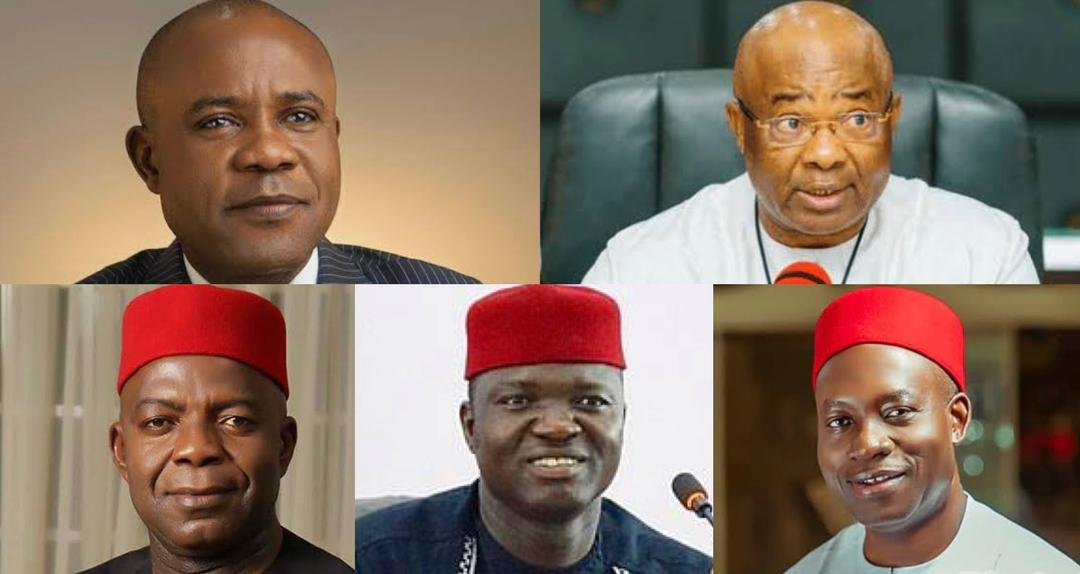
The five South-East governors went on external borrowing spree accumulating in two years a total of $534.72 million between 2023 and December 2025, according to a report released by private think tank, ACUF Initiative for Policy and Governance headed by Chiwuike Uba, a professor of economics and governance and public financial management expert.
In a detailed analysis of the external borrowing behaviours of the five states, the report explained that, “most governors (in the South-East) increased external borrowing in the early phase. [The] second phase shows slower accumulation and partial stabilisation. External debt expansion is front-loaded but persistent.”
Focusing on the year 2023, in particular, the region’s total external borrowing by the governors stood at $453.76 million but this steadily went up by 14.9 percent or $67.56 million in June 2025. Additionally, by December of 2025 the five governors increased the borrowing by $13.40 million (or 2.6 percent) to reach $534.72 million.
Governor-by-governor performance
A breakdown of the borrowing by state showing “governor-by-governor performance” indicates that Abia under Governor Alex Otti increased the state’s borrowing during the period under review from $92.33 million to $105.23 million, a difference of $12.90 million (or 14.0 percent). However, from June to December 2025, the borrowing went up by 1.8 percent to $107.16 million (a difference of $1.93 million), in what the professor described as “controlled but continuous external build-up.”
Anambra State under Governor Chukwuma Soludo reduced the state’s borrowing to $98.52 million down from $105.58 million, showing a difference of –$7.06 million (or – 6.7 percent). However, the governor would later raise the state’s external debt to $102.58 up from $98.52 million between June to December 2025, a difference of $4.06 million (or 4.1 percent), in what the report tagged “external stability with mild volatility”.
For Ebonyi, the state which goes with the motto: “Salt of the Nation”, Governor Francis Ogbonna Nwifuru of the All Progressives Congress (APC) party, embarked on an “aggressive external debt expansion”, accumulating more than $95.55 million by June 2025 up from $57.36 million in 2023 when he came in as successor to David Umahi (who had defected from the PDP to the ruling APC). This showed an increase of $38.19 million or 66.6 percent.
Between June and December 2025, Governor Nwifuru further increased Ebonyi’s external debt to $108.02 million, a difference of $12.46 million or 13.0 percent. The report described his performance as “aggressive external debt expansion”.
In Enugu, the “Coal City State”, Governor Peter Mbah’s performance was described as “external deleveraging amid domestic expansion”. He had reduced the state’s external debt by –5.2 percent to –$6.32 million, from $120.67 million in 2023 down to $114.35 million by June 2025. Additionally, between June and December 2025, he further reduced the state’s external debt down to $99.88 million, a difference of –$14.47 million or –12.7 percent.
Imo State, the “Eastern Heartland State” under Governor Hope Uzodinma, accumulated external debt by an additional $29.86 million or 38.4 percent from $77.81 million in 2023 to $107.67 million by June 2025. This further went up to $117.08 million between June and December 2025, a difference of $9.40 million or 8.7 percent.
The economics professor Uba described the Imo governor’s performance during the period under review as “sustained external debt accumulation”.
Assessment of the governors
Providing a governor by governor overall assessment with regards to external borrowing between 2023 and 2025, the report noted the following:
Abia: “Moderate but steady increase in external borrowing. Growth slows significantly in the second phase”.
Anambra: “Initial reduction followed by mild rebound. Overall near-stable external position”.
Ebonyi: “Strong early expansion in external borrowing. Continued increase, though slower in the second phase”.
Enugu: “Continued reduction in external debt. Contrast sharply with rising domestic debt trends”.
Imo: “Consistent external borrowing increase. Slowing but persistent upward trend”.
In a summarised verdict statement on the governors’ external borrowing actions, the report noted that Abia State’s Otti “managed external exposure,” and had a “gradual FX risk accumulation,” disposition.
In the case of Anambra State’s Soludo, it had a “stable and controlled external debt profile,” with “minimal risk shift”.
Ebonyi State under Nwifuru faces “high external debt acceleration. Significant FX exposure risk”.
Enugu State under the watch of Mbah, has “strong external debt discipline,” However, “domestic substitution risk remains”.
Imo State’s Uzodinma faces “rising FX exposure. Dual debt expansion pressure”.