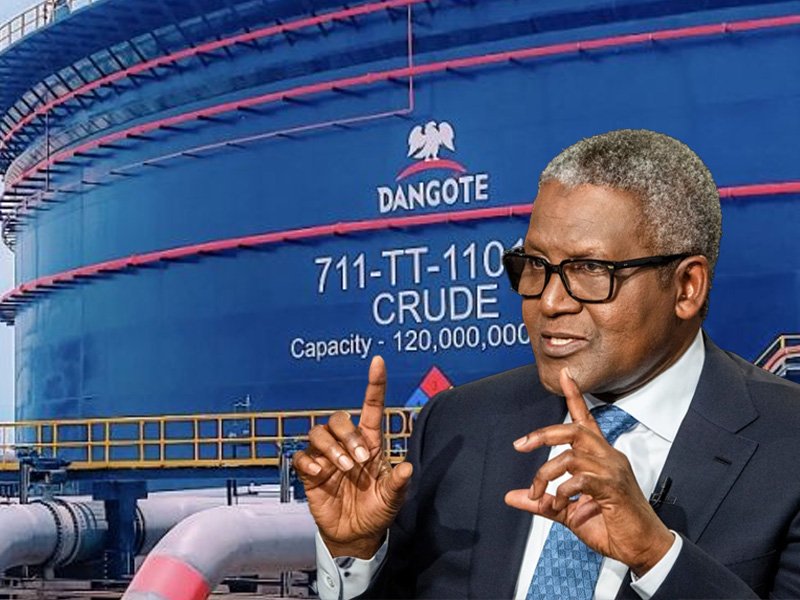
Dangote refinery has warned that despite its $20 billion facility producing more than enough petrol for domestic consumption, rising imports is still taking up 43 percent of Nigeria’s petroleum market, forcing the 700,000 bpd capacity refinery to export surplus fuel abroad.
In particular, the refinery says due to rising petrol imports by importers licenced by Nigeria’s ministry of petroleum resources and the national oil company, NNPC Limited, domestic demand becomes harder to predict.
David Bird, chief executive officer of Dangote Petroleum Refinery and Petrochemicals (DPRP) told Reuters that imports of premium motor spirit (PMS) otherwise called petrol supplied 43 percent of Nigeria’s petrol in July 2026, up sharply from about 12 percent in May this year.
The situation potentially adds a new twist to Nigeria’s uncertain fuel trade.
Official figures confirm the estimate. According to data from the Nigerian Midstream and Downstream Petroleum Regulatory Authority (NMDPRA), in July, imports averaged 19.7 million litres per day, while total petrol supply stood at 45.5 million litres per day.
That implied that imports accounted for roughly 43.3 percent of PMS supply during the month. Domestic refineries (in this case only Dangote because the four state-owned facilities are off stream) supplied the remaining 25.8 million litres per day.
Dangote refinery, the only facility which has made Nigeria to be more self-sufficient in refined petroleum products, and a net-exporter of the products, warned that the growing presence of imported petrol has complicated production planning and inventory management.
As it stands, Dangote Refinery is exporting more petrol because imports now take a larger share of Nigeria’s domestic fuel market.
The refinery says its excess inventory is increasingly being sold overseas rather than stored given rising competition from imports, a development that comes as Nigeria’s refined-fuel exports surge, with Dangote driving much of the increase.
According to the Lekki, Lagos-based petroleum and petrochemicals facility, significant volumes of imported petrol entering Nigeria have made domestic demand increasingly difficult to predict, leaving the $20 billion facility with excess inventory that it must sell overseas rather than store.
David Bird the chief executive, said the refinery now increasingly exports products that cannot be absorbed by the domestic market rather than continue carrying the costs of storing and financing excess inventory.
He maintained that the exports should not be interpreted as an inability or unwillingness to supply Nigeria. “Instead, we describe them as a commercial response to the amount of imported fuel competing for customers in the home market’.
Is Nigeria making imports comeback?
Oil industry watchers question if the latest figures reveal Nigeria’s petrol imports comeback, at a period it should easily ride on the economy of scale provided by the supply advantage via Dangote’s solo effort.
In particular, in May, the country’s imported petrol averaged just 5.9 million litres per day, accounting for about 12 percent of total supply. While domestic sources provided 41.5 million litres per day, or 88 percent, the balance shifted dramatically the following month. For instance, imports surprisingly jumped to 18.1 million litres per day in June, an increase of more than 200 percent from May, which left domestic supply dropping to 32.5 million litres per day.
By July, imports rose further to 19.7 million litres per day with domestic supply declining further to 25.8 million litres.
To wit, this development was a reversal from earlier one in the year when Nigeria appeared to be moving rapidly towards eliminating petrol imports. At that time NMDPRA had stopped issuing petrol import licences in February after determining that domestic production was sufficient to meet demand. At the time, Dangote alone was supplying about 36.5 million litres of petrol per day.
Under the Petroleum Industry Act (PIA), imports are only intended to cover gaps when domestic refiners cannot adequately meet national demand. However, this has not been the situation, as industry watchers strongly believe that Dangote Refinery has been more than meeting domestic demand.
Energy analysts say the resurgence of imports reintroduces a long-running dispute over Nigeria’s appropriate balance between protecting billions of dollars invested in local refining and maintaining competition in the country’s deregulated fuel market.
Earlier in the year, Dangote refinery had flipped Nigeria’s fuel trade with exports surging seven-fold and imports falling below 130,000 bpd. Nigeria exported an average of 350,000 barrels of petroleum products per day during the second quarter of 2026, courtesy of Dangote Refinery, compared with just 46,000 barrels per day in 2023.
Overall seaborne petroleum products shipments, including supplies which moved between Nigerian ports, reached 561,000 barrels per day in the period.
Whereas, seaborne petroleum products imports fell significantly from about 400,000 bpd in 2023 to less than 130,000 bpd in the second quarter of this year. This, analysts said, indicates that Nigeria is actually exporting more fuel despite its recent rising petrol imports.
The International Energy Agency (IEA) said Dangote’s refinery has made Nigeria more self-sufficient in refined petroleum products at the same time increasing supplies to international markets.
In particular, Europe received about 130,000 bpd of Nigerian petroleum products exports during Q2 2026, which is more than three-fold the 40,000 barrels per day recorded in 2025.
Also, shipments to other African countries reached nearly 120,000 bpd.
According to one energy analyst, Dangote Refinery is readily balancing rising petrol imports at home with growing exports of refined fuel, including aviation fuel, to international markets.
Meanwhile, the US Energy Information Administration recently said Nigeria’s seaborne petroleum products exports had increased more than sevenfold since 2023, driven immensely by in-country production from the Dangote refinery.
Indeed, the arrival of Dangote’s refinery (in 2024) has dramatically changed Nigeria’s petroleum industry equation.
For once, it has brought about a remarkable reversal for Nigeria. For decades, the African top crude oil producer exported crude, while ironically depending heavily on foreign refineries for its petrol and other petroleum products’ needs.
But when industry watchers adduce that just when the citizens were beginning to enjoy the proceeds of domestic production, the regulators are taking the country back to the era of “petroleum agony”.
By far, Dangote refinery says it has enough capacity to satisfy Nigeria’s domestic petrol requirements, but warned that it cannot indefinitely maintain inventories when imported products are competing for a substantial share of domestic demand.
Caught in-between export and import:
Oil industry watchers say Dangote refinery is caught in a Nigerian self-induced intricate web – exporting petroleum products, yet importin petrol amid awash local supply. Since the facility began operations in 2024 with an initial crude-processing capacity of 650,000 bpd, it has maintained steady progress. Its maintenance and expansion completed in February 2026 pushed capacity to about 700,000 barrels per day, according to the IEA.
Meanwhile, the refinery has said it could supply up to 65 million litres of petrol daily to Nigeria while exporting another 15 to 20 million litres.
Indeed, the refinery now plans to double its capacity by adding another 750,000-barrel-per-day crude distillation unit by 2028. However, this could be jeopardised, as the company is at the time being fighting challenges on both sides of its operations – rising imports – amid significant excess supply.
Worse still, the refinery does not seem to secure crude feedstock locally. While it complains about imported petrol competing with its products in in-country, the refinery has also struggled to secure all the Nigerian crude it needs at prices it considers commercially competitive.
Chief executive David Bird said the refinery is importing part of the crude needs to keep its massive processing units running, while Nigerian government continues to sanction increased imports of the petrol the refinery actually produces.
Not willing to suffer supply glut, Bird said they are shipping to customers elsewhere in Africa and Europe, growing volumes of Nigerian refined products.
According to the CEO, the argument remains that more of the fuel the refinery produces could be stored at home if imported petrol were not taking such a large share of its domestic market.