- Rising asset valuation, not new productive investment
- Global household wealth reach record $570trn
- Equities account for 57% of household wealth rise
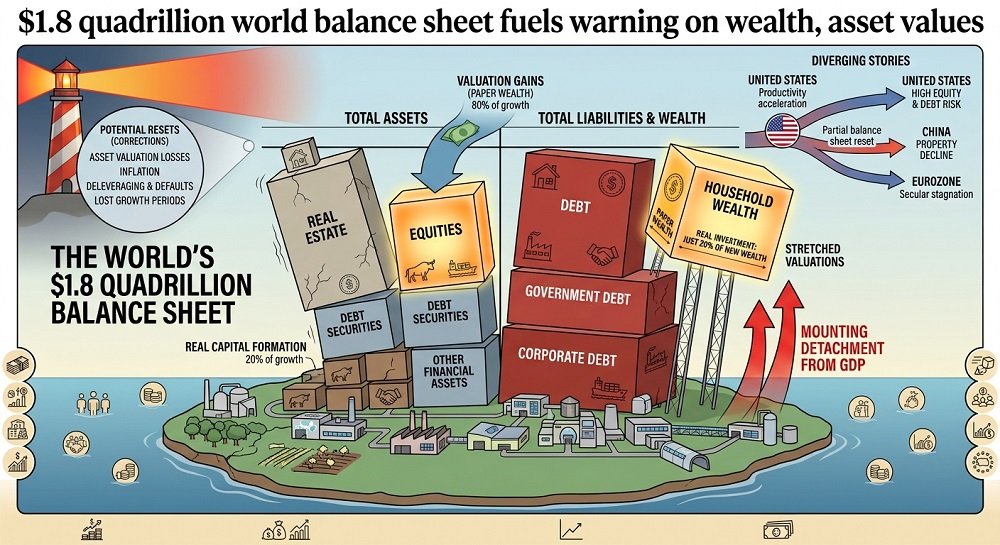
The world’s financial balance sheet has swollen to almost $1.8 quadrillion, but a growing share of the increase reflects rising asset valuations rather than new productive investment, raising fresh questions over the sustainability of global wealth.
New research from the McKinsey Global Institute shows that the global balance sheet reached nearly $1.8 quadrillion in 2025, up from about $1.7 quadrillion a year earlier. At the same time, global household wealth climbed to a record $570 trillion.
The figures illustrate a striking feature of the post-pandemic economy: financial wealth has continued to expand at a pace that has outstripped the growth of the underlying real economy.
McKinsey estimates that households gained around $40 trillion in wealth during 2025, but only about 20 percent of that increase came from net new capital formation. The remainder was largely generated by inflation and higher valuations of assets already in existence.
It marks a continuation — and intensification — of a longer-term trend. Between 2000 and 2024, McKinsey estimates that roughly 30 percent of the increase in global wealth resulted from net investment.
Equities take a bigger role
The composition of wealth is also changing.
Real estate remains the world’s largest asset class, but equities have become an increasingly important driver of household wealth. In 2025, equities accounted for 57 percent of the increase in global household wealth, compared with around 15 percent for real estate.
The shift has been particularly pronounced in the United States, where equity valuations have risen substantially relative to the assets and earnings of the underlying corporate sector.
McKinsey estimates that US equity values reached around 2.4 times corporate net assets, highlighting the degree to which financial-market valuations have moved ahead of the tangible economic base.
The result is what the consultancy describes as an increasingly divergent global balance sheet: some assets have moved closer to historical norms relative to GDP, while equities, government debt and liquidity remain unusually elevated.
The productivity test
For investors and policymakers, the crucial question is how the gap between asset values and economic output eventually closes.
There are three broad possibilities.
The least disruptive would be a sustained acceleration in productivity and economic growth, allowing corporate earnings and national incomes to catch up with today’s elevated asset valuations.
Artificial intelligence could potentially provide part of that catalyst if the technology produces a sufficiently large increase in productivity and economic output.
A second route would be inflation, which could gradually reduce the real value of existing financial claims and debt.
The third would be a more painful adjustment through falling asset prices, potentially involving a major correction in equity and other financial markets.
McKinsey argues that productivity growth would be the preferable outcome because it would allow the real economy to “grow into” existing valuations rather than forcing a destructive repricing of assets.
A wealth boom built on paper gains
The scale of the numbers is remarkable.
Global assets now amount to roughly 15 times annual global GDP, while household wealth has increased more than fourfold since 2000. The growth in wealth has not, however, been matched by a comparable expansion in productive economic capacity.
That distinction matters because an asset is ultimately a claim on future economic output.
If valuations rise without a corresponding increase in future earnings, rents or productive capacity, the system becomes increasingly dependent on those valuations remaining high.
McKinsey’s analysis therefore presents a paradox: the world has never been wealthier on paper, but that wealth is increasingly vulnerable to how the global economy converts financial valuations into real economic growth.
For businesses and investors, the next phase may depend less on the accumulation of assets and more on whether the global economy can generate the productivity gains needed to justify their price.
The $1.8 quadrillion balance sheet is therefore not simply a measure of unprecedented global wealth. It is also a measure of the scale of the claims that the real economy must ultimately support.