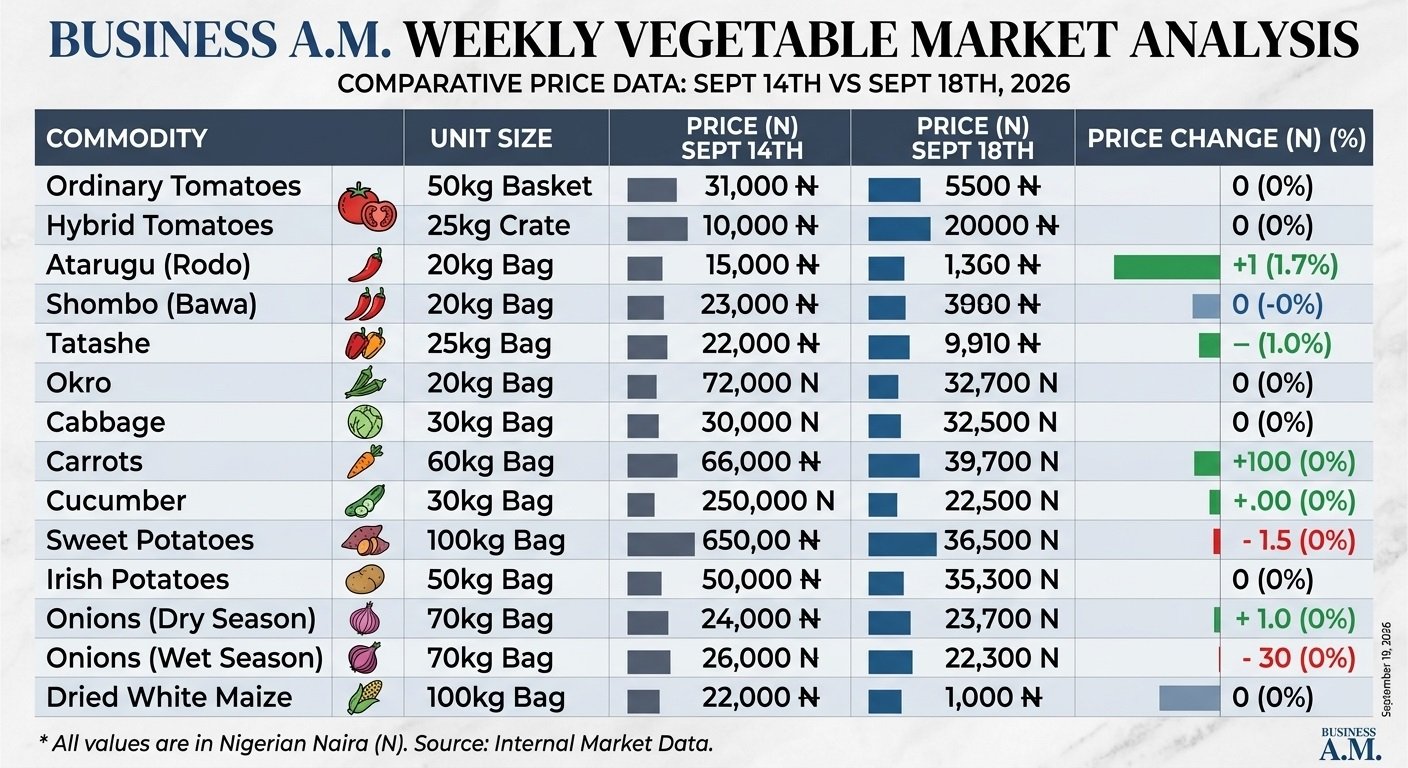
The Nigerian vegetable market remained largely stable between Monday and Friday, with most of the commodities monitored recording no change in their listed market prices, even as sweet potatoes and wet-season onions declined by N5,000 each and atarugu, also known as rodo pepper, increased by the same amount.
The latest price comparison for September 14 and September 18, 2026, shows a market characterised more by price stability than broad-based inflationary pressure, with tomatoes, shombo, tatashe, okro, cabbage, carrots, cucumber, Irish potatoes, dry-season onions and dried white maize retaining their Monday price levels.
At the same time, the movements in selected commodities underline how supply conditions can differ significantly across individual crops even within the same fresh-produce market.
Ordinary tomatoes remained at N35,000 per 50kg basket on Friday, unchanged from Monday’s listed price of N35,000. Hybrid tomatoes also held at N35,000 per crate, while shombo, or Bawa pepper, remained at N25,000.
Tatashe was unchanged at N35,000, while okro remained at N15,000. Cabbage and carrots also held at N35,000, while cucumber stayed at N30,000.
Among the commodities that moved, sweet potatoes recorded one of the clearest declines, falling from N55,000 on Monday to N50,000 on Friday, a reduction of N5,000 or about 9.1 percent on the listed price.
Wet-season onions also declined by N5,000, from N70,000 to N65,000, representing a reduction of about 7.1 percent.
The movement was offset partly by atarugu, which rose from N30,000 on Monday to N35,000 on Friday, an increase of N5,000 or 16.7 percent.
Dry-season onions remained expensive at N95,000, unchanged over the period, while Irish potatoes also held at N80,000.
Dried white maize was similarly stable at N38,000 per 100kg bag.
The broad stability in the listed prices indicates that there was no widespread price shock across the monitored vegetable basket during the four-day period.
Of the 14 commodities tracked, 10 retained their listed prices, while three recorded changes and one requires some caution because the original Monday data does not specify a package weight for the commodity.
Pepper market records contrasting movements
The pepper segment produced one of the clearest divergences during the week.
Atarugu increased by N5,000, taking the listed price from N30,000 to N35,000. That represents the largest percentage movement among the commodities tracked.
Shombo, by contrast, remained at N25,000.
The divergence shows that price pressures were not uniform even among closely related pepper products. Differences in harvest availability, supply routes, quality and market demand can produce distinct movements within the same commodity category.
Tatashe was also stable at N35,000.
Potato and onion prices show some easing
The most notable downward movements came from sweet potatoes and wet-season onions.
Sweet potatoes fell from N55,000 to N50,000, while wet-season onions declined from N70,000 to N65,000.
Dry-season onions, meanwhile, remained at N95,000, leaving a N30,000 difference between the listed price of dry-season and wet-season onions on Friday.
Tomatoes remain firm
Tomatoes, one of the most closely watched fresh-food commodities because of their importance to household consumption and food businesses, showed no movement in the listed prices.
Ordinary tomatoes remained at N35,000, while hybrid tomatoes also stayed at N35,000.
The stability provides a contrast with the movements recorded in pepper and potato markets and suggests that, during the period under review, price pressures were concentrated in particular commodities rather than across the entire vegetable basket.
Maize price holds at N38,000
Dried white maize also maintained its Monday price of N38,000 per 100kg bag.
The unchanged price puts the commodity at N380 per kilogramme on the basis of the stated 100kg unit, although the retail price faced by consumers can differ significantly depending on location, processing and market channel.
Maize prices are particularly significant beyond household consumption because the crop is also an important input for livestock and poultry feed producers.
Consequently, sustained stability in maize prices can have implications beyond the immediate food market, including for the cost structure of animal-feed businesses and, eventually, meat and poultry prices.
A market of stability, but not necessarily lower food costs
The Friday data points to a vegetable market that was broadly stable over the four-day period rather than one experiencing a generalised price decline.
Only three commodities recorded changes in their listed prices. Atarugu rose by N5,000, while sweet potatoes and wet-season onions fell by N5,000 each.
The stability of the remaining commodities may offer some short-term predictability for traders and food businesses. But it would be premature to interpret four days of largely unchanged quotations as evidence of a sustained easing in food inflation.
Fresh-produce prices can shift quickly with changes in harvest volumes, rainfall, transportation costs, market arrivals and seasonal availability.
More importantly, the differences in package sizes between the Monday and Friday quotations mean that a more rigorous assessment of price inflation would require standardising every commodity to a common unit, preferably price per kilogramme.
For now, the market picture is one of limited price movement rather than broad-based relief.
Sweet potatoes and wet-season onions have become cheaper on the listed units, while atarugu has moved in the opposite direction. For most of the basket, however, Friday’s prices remained where they were on Monday.
The next question for food-market participants is whether that stability will persist or whether changes in seasonal supply, logistics and demand will begin to push more commodities in either direction.