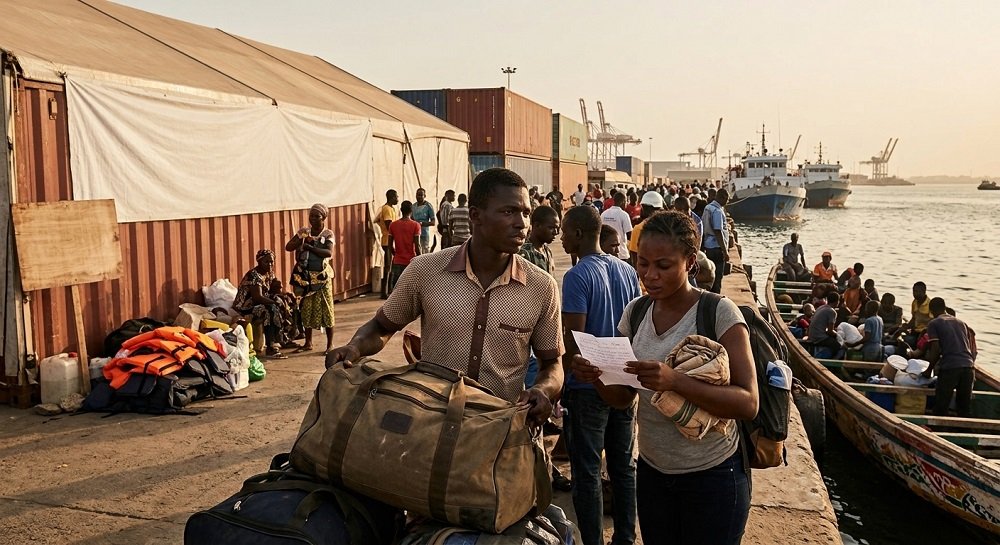
A job offer is increasingly becoming a reason to cross an African border. From young graduates to workers struggling with stagnant incomes, the continent’s labour market is pushing a growing number of people to consider whether their economic future lies elsewhere.
The pressure is increasingly visible in migration intentions across the continent, with nearly half of Africans surveyed saying they have considered leaving their countries, while the majority of those contemplating emigration cite the search for work or escape from economic hardship as their primary motivation.
The findings, contained in Afrobarometer’s “African Insights 2026: Beyond Borders”, show that migration is becoming less a peripheral demographic issue and more a measure of how effectively African economies are converting a rapidly expanding working-age population into productive employment.
Across 38 countries surveyed in 2024/2025, 45 percent of respondents said they had considered emigrating, including 25 percent who had thought about leaving “a lot”. Among those considering migration, 50 percent said they would leave in search of work, while another 29 percent cited poverty or economic hardship.
The pressure is particularly concentrated among the continent’s younger and better-educated population; precisely the demographic expected to drive future productivity, entrepreneurship and industrialisation.
Afrobarometer found that 32 percent of respondents aged 18 to 35 had given serious thought to emigrating, compared with 11 percent of those above 55. Similarly, 31 percent of respondents with post-secondary education had thought “a lot” about leaving, compared with 18 percent among those with no formal education.
The migration numbers are occurring against a structural employment problem that extends far beyond the decision to cross an international border.
In Nigeria, the pressure is visible even before workers reach a passport office.
A July 2026 survey by SBM Intelligence found that 45.3 percent of households across 21 cities had experienced a job loss, business closure or inability to find work during the previous 12 months. Even more strikingly, 79.1 percent of respondents said they would consider relocating from their geopolitical zone for a good job.
The pattern points to a labour market in which geographic mobility is increasingly being used as a substitute for economic opportunity.
The Nigerian survey found that 21.2 percent of respondents would definitely relocate for a good job, while 57.9 percent would consider doing so depending on the conditions. Only 20.9 percent preferred to remain where they were.
The pressure was strongest in the South-South, where 92.6 percent of respondents were open to relocating, followed by the South-West at 86.3 percent and South-East at 75.7 percent.
The South-South finding is particularly notable because it showcases the disconnect between resource wealth and employment creation. Despite being Nigeria’s principal oil-producing region, respondents in Port Harcourt, Warri and Calabar reported substantial difficulty finding jobs, with the region’s non-oil economy failing to absorb its growing workforce at sufficient scale.
Further analysis by Business A.M. finds that the employment challenge is becoming more urgent because the continent is entering a period of rapid labour-force expansion.
Nigeria provides a notable example of the scale of the problem. The Nigerian Economic Summit Group estimates that the country needs to create 27.3 million new formal jobs between 2025 and 2030 (an average of 4.55 million net formal jobs annually), simply to maintain an unemployment rate of 4.3 percent.
The organisation estimates that informal employment currently accounts for about 92 percent of total employment, while formal employment would need to rise from 6.3 million in 2024 to 33.6 million by 2030 under its jobs scenario. That gap helps explain why migration can become an economic pressure valve.
Where domestic economies cannot create sufficient jobs, workers respond by moving to regions, countries or continents where the wage structure, labour demand and career opportunities are more attractive. The result is a form of labour-market arbitrage, where workers sell their skills, believing their productivity will command a higher return.
Afrobarometer’s findings also show that this labour arbitrage is increasingly oriented towards markets outside the continent. Among potential emigrants, 32 percent identified Europe as their preferred destination and 28 percent North America. Only 17 percent preferred another country within their subregion, while 5 percent selected another African country outside their subregion.
Across 31 countries where comparable data were available, the share of potential emigrants preferring another African country declined from 36 percent in 2016/2018 to 26 percent in 2024/2025, while serious consideration of emigration increased from 18 percent to 25 percent.
The result indicates that Africa is not only experiencing more migration pressure; it is also competing against external labour markets for its workforce.
Europe’s ageing population and shrinking working-age base create an important counterforce. As European economies confront labour shortages, Africa’s youthful population represents a potentially significant source of workers; particularly in healthcare, construction, technology, logistics and other sectors facing persistent skills gaps.
Skilled workers increasingly look abroad
Greater access to education, digital technology and professional training is giving African workers more opportunities to compete in overseas labour markets, creating a challenge for economies seeking to retain skilled talent.
An analysis by Brian Muloni, a senior finance business partner based in Nairobi, Kenya, titled The Exodus Generation: Why Are Africa’s Young People Heading West?, cited data showing that the number of sub-Saharan African immigrants living in the United States reached about 2.5 million in 2024, more than three times the level recorded in 2000.
The analysis also cited a 77 percent labour-force participation rate among sub-Saharan African immigrants in the US in 2024, compared with 63 percent among US-born adults, while about 46 percent of sub-Saharan African immigrants held at least a bachelor’s degree.
For Nigeria, the educational profile is particularly pronounced, with the analysis citing Brookings data showing that about 67 percent of Nigerian immigrants in the US had attained at least a bachelor’s degree. This, according to analysts, makes the issue more complex than a simple “brain drain” narrative.
The migration of skilled Africans is producing both economic gains and costs. Destination countries benefit from an expanding pool of educated workers capable of filling labour shortages, while households back home receive remittances that support livelihoods and investment.
However, the continued departure of professionals often worsen skills shortages across sectors that African economies need to develop, potentially undermining productivity growth and efforts to achieve structural economic transformation.
Migration exposes tension over African labour markets
Africans increasingly want the ability to move in search of economic opportunities, but many remain opposed to admitting more foreign workers into their own countries, highlighting a challenge for deeper regional integration.
Afrobarometer found that 64 percent of respondents favoured admitting fewer or no foreign job seekers, while 70 percent held the same view about refugees. At the same time, 77 percent said they would welcome or not mind having immigrants or foreign workers as neighbours.
Opinions on immigrants’ economic contribution were almost evenly divided, with 45 percent viewing them positively and 44 percent negatively.
The findings suggest that support for cross-border mobility can become more contested when migration is perceived as competition for jobs and economic resources, a potentially important issue as African countries deepen economic integration through the African Continental Free Trade Area.
Nigeria’s migration pressure points back to jobs crisis
Nigeria’s growing labour mobility is increasingly being driven by the quality and availability of jobs, with regional differences in wages, skills, infrastructure and access to finance shaping workers’ decisions about where to live and work.
SBM Intelligence found that low pay was the leading employment constraint in the South-East and South-South, while skills shortages were more pronounced in the North-West and North-East. Poor infrastructure and limited access to capital were major concerns in the South-West, while credit access remained a significant constraint in the North-Central.
Digital skills emerged as the most preferred training option nationally, with 52.7 percent of respondents selecting it.
The findings highlight a persistent mismatch between labour supply and the sectors capable of generating productive employment. Technology, agriculture, agro-processing and manufacturing are regarded as high-potential industries, but their current capacity to absorb workers remains insufficient. This mismatch is turning migration into an economic outlet for workers seeking better opportunities.
The challenge, analysts contend, is therefore to make domestic employment more competitive by expanding formal jobs, supporting productive businesses, improving infrastructure, strengthening vocational and digital skills and widening access to finance.
It is further argued that the willingness of Nigerians to relocate within the country for better jobs shows that the migration impulse begins long before international travel. Ultimately, workers are not simply moving away from places. They are moving towards opportunity.