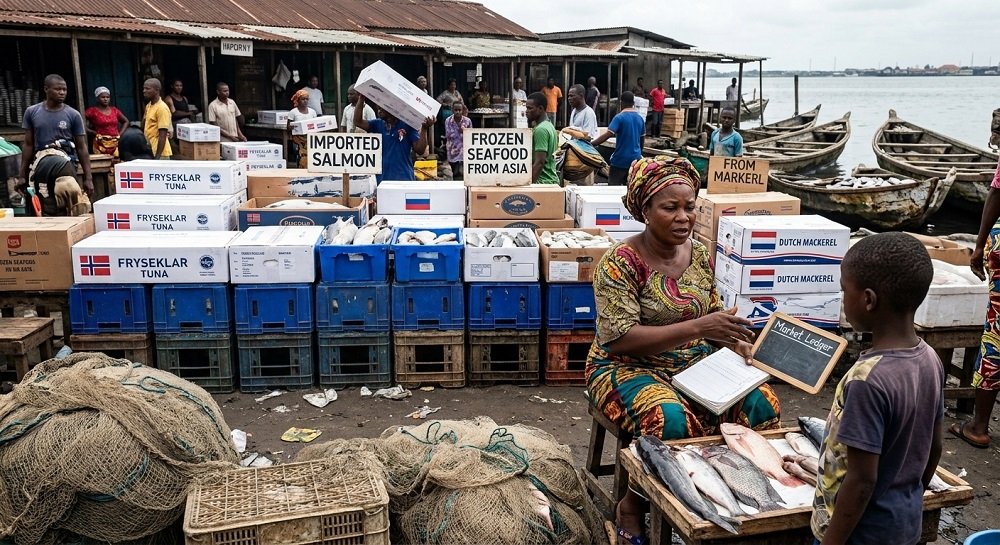
An $866 million seafood market is increasingly being captured by foreign suppliers as Nigeria’s fisheries sector struggles to expand domestic production and commercialise its maritime resources.
Nigeria spent $866 million on frozen fish and seafood imports in 2025, up from $606 million in 2023, according to Thaddeus Udofia, director-general of the International Maritime Institute of Nigeria.
The rising import bill is drawing attention to an investment gap across the fisheries value chain, from fishing and aquaculture to cold storage, processing, logistics and port infrastructure.
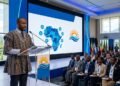
Speaking at the 2026 National Conference on Sustainable Fishing, organised by the Maritime Correspondents’ Organisation of Nigeria (MARCON), Udofia said the country was effectively exporting demand and foreign exchange to overseas seafood suppliers despite possessing significant fisheries and aquaculture potential.
The conference was themed, “Sustainable Fishing in Nigeria: Pathways to Growth, Food Security and Coastal Livelihoods.”
“Ironically, Nigeria remains one of the largest importers of seafood in Africa. Expending hundreds of millions of scarce dollars annually to bridge the huge domestic supply deficit,” Udofia said.
Udofia attributed the supply deficit to weaknesses in the management of the country’s aquatic resources, identifying aggressive overfishing, climate change and illegal, unreported and unregulated fishing as major pressures on the sector.
The situation, he said, had created a paradox in which Nigeria possesses substantial fisheries resources but continues to depend heavily on imported seafood to feed its growing population.
A major concern is the activity of foreign industrial trawlers operating within Nigeria’s Exclusive Economic Zone, which Udofia said was damaging marine ecosystems while putting additional pressure on artisanal fishermen.
“Foreign industrial trawlers operating like predatory ghosts within our EEZ are systematically troubling our marine worlds and illegally depredating our sovereign aquatic resources. They do not merely steal fish. They actively sabotage our micro-economic growth through destructive, uncontrolled bottom trawling,” he said.
The economic consequences extend to coastal communities whose incomes depend on fishing.
“When a local fisherman ventures out to sea and returns with an empty net, that is not simply a bad day at work. That is a direct, violent hit to Nigeria’s national food security,” Udofia added.
The debate is increasingly shifting from conservation alone to the economic value that Nigeria could unlock by developing its fisheries as part of the wider blue economy.
Ismail Aniemu, president of MARCON, said fisheries should be treated as a productive component of the national economy rather than as a peripheral activity overshadowed by oil and gas.
“Fish itself is part of our national economy. We can’t be discussing blue economy and keeping fish in isolation,” Aniemu said.
He argued that Nigeria’s extensive coastline and aquatic resources could support significant job creation and wealth generation if the sector received greater investment.
“You can have the waters, but when you are not fishing it means you are not reaping the value of those waters,” he noted further.
Aniemu also called for stronger participation by Nigerians in fishing and related activities, particularly at the artisanal level, alongside greater investment by state governments.
Beyond the depletion of fish stocks, industry stakeholders identified inadequate infrastructure for landing, storing, processing and transporting fish as another major constraint preventing Nigeria from capturing more value from its marine resources.
The Nigerian Ports Authority (NPA) said specialised fishing terminals could provide part of the infrastructure needed to build a more efficient fisheries value chain, particularly because fish is highly perishable.
Abubakar Dantsoho, managing director of the NPA, represented by Adebite Adewunmi, assistant general manager, corporate and strategic planning, said dedicated fish terminals would require cold-storage facilities, ice plants, processing facilities, navigational channels, loading and unloading areas, and efficient road, rail or inland-waterway connections.
He said the NPA had already designated a special terminal as a dedicated fish terminal, with cold-storage and export-processing facilities available to operators.
Dantsoho pointed to Spain as a potential model, where specialised port terminals are designated for different cargo categories, including fish.
Udofia said closing Nigeria’s fisheries deficit would require a coordinated strategy combining regulation, scientific research, technology, investment and community participation.
He called for stronger collaboration among maritime security agencies, economic regulators and fisheries authorities to improve enforcement against illegal fishing and protect Nigeria’s marine resources.
He also advocated the use of scientific data to determine catch limits, closed seasons and marine protected areas, arguing that fisheries policy should be built around credible assessments of fish stocks rather than short-term exploitation.