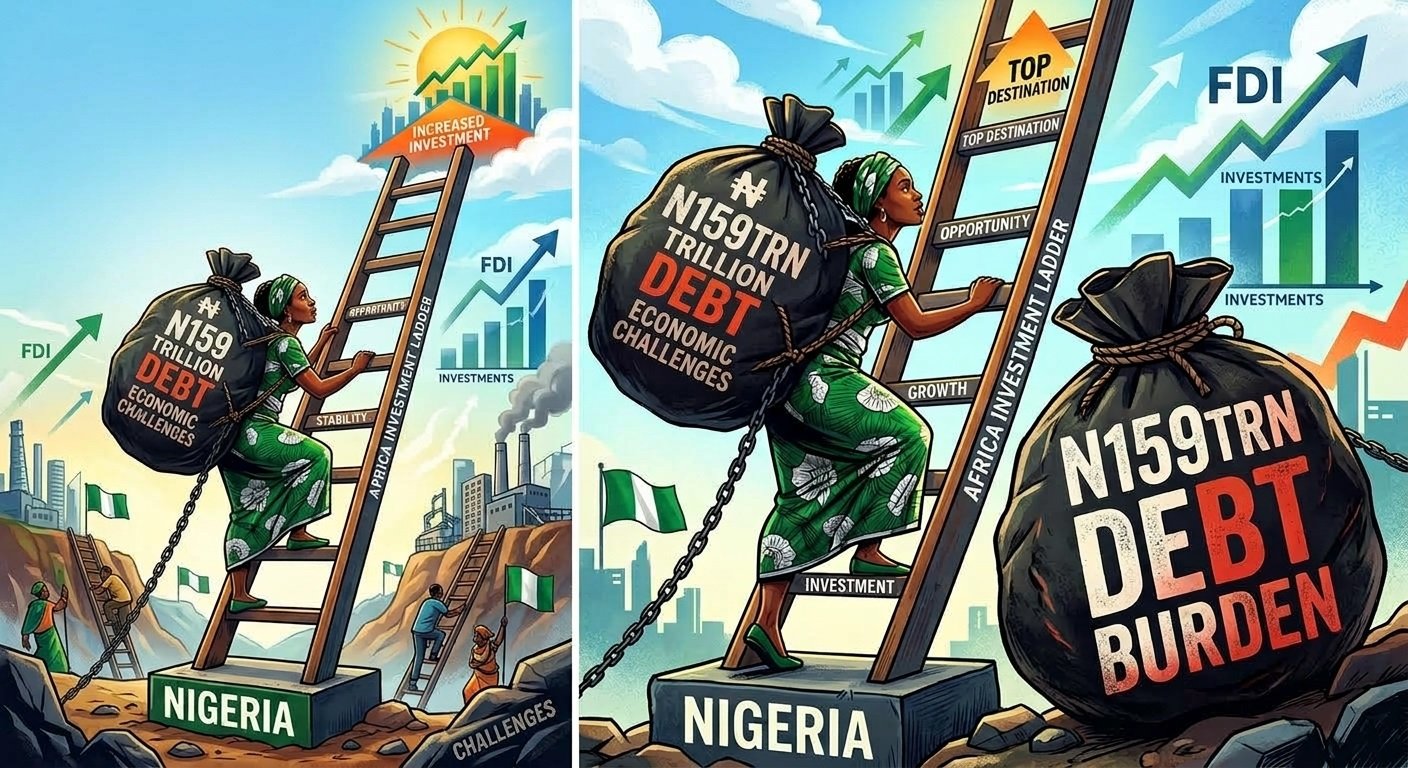
Nigeria’s improving standing among Africa’s investment destinations is colliding with a growing fiscal challenge, as the country climbs four places on Bloomberg Economics’ 2026 Investment Risk-O-Meter even after its public debt stock surged to N159.28 trillion.
The ranking, which places Nigeria eighth among 19 African economies assessed, marks one of the biggest improvements in the latest scorecard and puts the country ahead of Rwanda, Tanzania, Kenya and Namibia. Mauritius emerged as the continent’s most investable economy, while South Africa slipped from the top position it occupied in the previous assessment.
The contrasting trends capture the central question confronting investors assessing Africa’s largest economy: whether the macroeconomic gains associated with President Bola Tinubu’s reform programme can translate into durable fiscal stability, stronger private investment and more resilient growth.
Nigeria’s rise was driven by improvements in three of the five indicators used by Bloomberg Economics. These include; economic strength, fiscal strength and external vulnerability.
The improvement follows the removal of the petrol subsidy, foreign-exchange market liberalisation and electricity tariff reforms introduced since 2023. These measures sought to reduce fiscal distortions, improve currency-market functioning and address structural losses in the power sector.
Economic growth has also strengthened over the review period. Real gross domestic product expanded by 3.85 per cent in 2025, compared with average growth of 3.19 per cent in 2024, before recording 3.89 per cent in the first quarter of 2026.
However, the fiscal picture remains more complicated. Debt Management Office figures show that Nigeria’s total public debt rose from N87.38 trillion at June 30, 2023 to N159.28 trillion at December 31, 2025, an increase of N71.90 trillion, or approximately 82.3 per cent. The DMO attributed the rise to additional borrowing, exchange-rate adjustments and the securitisation of legacy obligations.
The increase does not, by itself, establish that Nigeria’s debt sustainability has deteriorated by the same proportion. Exchange-rate movements can raise the naira value of foreign-currency liabilities, while debt sustainability also depends on government revenue, borrowing costs, maturities and the economy’s capacity to generate income.
Nevertheless, the expanding debt stock places greater importance on revenue mobilisation and expenditure discipline, particularly as debt-service commitments compete with spending on infrastructure, healthcare, education and social protection.
Bloomberg’s latest assessment points to progress in selected macroeconomic indicators, rather than a comprehensive resolution of the constraints that have historically weighed on investment, including infrastructure deficits, institutional weaknesses, currency uncertainty and limited fiscal space.
The country’s growth performance also requires perspective. Although output has expanded, sustained growth must eventually generate more jobs, improve household purchasing power and strengthen domestic demand if the benefits of reform are to extend beyond headline economic indicators.
The adjustment costs of subsidy removal, foreign-exchange reform and higher electricity tariffs have placed considerable pressure on households and businesses. According to analysts, for productive investment to accelerate, improvements in macroeconomic stability will need to be accompanied by more reliable infrastructure, predictable policy implementation and access to affordable financing.
Nigeria’s performance also comes against changing conditions across the continent. Botswana fell two places, while South Africa dropped one position amid weaker growth prospects. Mauritius’s emergence at the top of the scorecard reinforces the competition among African economies for investment capital.