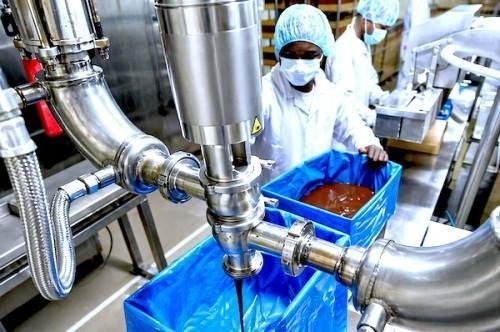
Nigeria is losing an estimated $2 billion annually in potential revenue from inadequate utilisation of its cocoa processing capacity, exposing a structural weakness in the country’s drive to convert agricultural production into industrial output, jobs and higher-value exports.
The federal government’s disclosure that the country uses only about 30 per cent of its installed cocoa processing capacity has raised fresh questions about the effectiveness of investment in agricultural production without corresponding expansion in processing, storage and manufacturing infrastructure.
The problem extends beyond idle factory capacity. Cocoa productivity remains between 250kg and 300kg per hectare annually, according to the Cocoa Research Institute of Nigeria (CRIN), while industry estimates indicate that substantial quantities of agricultural produce are lost after harvest. The combination of weak productivity, inadequate processing and supply-chain inefficiencies continues to limit the economic returns Nigeria earns from its agricultural resources.
At a time when the federal government is seeking to diversify export earnings away from crude oil, the cocoa industry illustrates the gap between possessing an exportable commodity and building a domestic industrial value chain around it.
Abubakar Kyari, minister of Agriculture and Food Security, disclosed the estimated annual revenue loss at the two-day Africa Cocoa and Coffee Conference in Lagos, organised by the Cocoa and Coffee Farmers Alliance Association of Africa (COCEFAAA), in partnership with the ministry and CRIN.
Represented by Ajayi Olututobaba, deputy director of Tree Crops at the ministry, Kyari said Nigeria had an installed cocoa processing capacity of approximately 2,000 tonnes annually, with only about 30 per cent being utilised.
He called for increased investment in domestic processing to enable the country to produce cocoa butter, liquor, powder and chocolate rather than depend predominantly on exports of raw beans.
“Roughly $2 billion in value addition slips away every year. It is not a shortage of resources; it is an opportunity waiting for the right investors,” the minister said.
Production gains fail to translate into higher productivity
The gap between agricultural support and actual farm performance is another constraint confronting the industry.
Abiodun Adedeji, acting executive director of CRIN, said Nigeria’s cocoa productivity had remained between 250kg and 300kg per hectare annually despite years of government-backed distribution of improved planting materials.
He said the institute distributed 601,000 cocoa pods to farmers free of charge between 2011 and 2015 and supplied 300,000 seedlings during the COVID-19 period. The federal government has now mandated CRIN to produce and distribute one million improved hybrid cocoa seedlings.
However, the persistence of low productivity suggests that seedling distribution alone has not been sufficient to deliver a substantial improvement in farm output.
Farmers also require reliable extension services, better farm management, effective pest and disease control, suitable agricultural inputs and access to research that supports higher-yielding, climate-resilient varieties.
Without these complementary interventions, expanding the supply of improved seedlings may not generate the consistent volumes and quality required to sustain an efficient domestic processing industry.
The government said it was working to strengthen cocoa and coffee production through improved seedlings, research, extension services and climate-smart agricultural practices. It also pledged support for rehabilitating ageing farms and expanding coffee cultivation.
Raw bean exports leave Africa with a fraction of the value
Nigeria’s processing shortfall reflects an imbalance in the global cocoa industry, where African countries supply a substantial proportion of the world’s beans but capture only a small share of the value generated by chocolate manufacturing.
Conference participants put Africa’s share of global cocoa production at between 70 and 80 per cent, although estimates varied across speakers. They said the continent captures less than 10 per cent of the value associated with the global chocolate industry, estimated at more than $130bn.
Adeola Adegoke, global president and founder of COCEFAAA, said fluctuations in international cocoa prices underscored the vulnerability of countries that depend heavily on raw commodity exports.
He cited the 2023–2024 season, when a global cocoa deficit of approximately 490,000 tonnes drove prices above $10,000 per tonne, before subsequent market developments and expectations of improved supply contributed to a sharp decline.
The volatility reflects the difficulty of building stable farm incomes and predictable investment returns around a commodity whose prices are influenced by production shocks and developments in international markets.
“When there is bumper harvest, price goes down. When there is shock, price goes to $12,000, Robusta $15,000. Why should we produce more and earn less?” Adegoke asked.
Industry stakeholders argue that processing beans into intermediate and finished products would enable producing countries to participate in additional stages of the value chain, including manufacturing, packaging, branding and distribution.
Alex Omari, chief executive officer of Host Place Group and Zylex Holding, similarly argued that exporting raw agricultural commodities means transferring potential industrial activity and employment opportunities to countries where those commodities are processed.
He called for a transition towards domestic processing and manufacturing, supported by predictable policies, infrastructure investment and long-term financing.
Post-harvest losses compound the investment problem
The industry’s processing constraints are compounded by losses occurring between harvest and market.
Omari estimated that Nigeria loses between 30 and 50 per cent of its agricultural output to post-harvest inefficiencies, representing approximately 30 million to 40 million metric tonnes of wasted produce and about N5tn in potential economic value. He also cited an estimate that about 37 per cent of cocoa output is lost after harvest.
Inadequate storage, transportation constraints and limited processing facilities can reduce the quantity and quality of produce reaching buyers. They also weaken the commercial case for processors that depend on consistent supplies of suitable raw materials.
Omari called for the development of agro-processing zones closer to production areas, arguing that strategically located facilities could reduce transportation costs, limit losses and improve connections between farmers and manufacturers.
He also urged private investors and development finance institutions to provide patient capital and blended financing for processing facilities, noting that industrial agricultural investments require long-term funding.
Policy certainty critical to private investment
The federal government said it wanted to make it easier for investors to establish cocoa processing facilities while maintaining Nigeria’s position as a dependable exporter.
Kyari stressed that the policy objective was to increase value addition rather than simply expand production volumes.
The approach leaves room for raw bean exports while encouraging domestic processors to capture a larger share of the industry’s earnings. For investors, the critical question is whether the policy direction will be matched by consistent implementation, appropriate incentives and an operating environment that supports competitive manufacturing.
Omari warned that policy declarations would have limited impact without clear implementation frameworks, timelines and measures to protect farmers during the transition.
He argued that abrupt changes to export arrangements could expose smallholder farmers to additional risks, particularly when their production and investment decisions depend on prevailing prices and access to buyers.
A more predictable framework would help farmers and processors plan investments while giving manufacturers confidence that raw materials would remain available in sufficient quantities.
The government also highlighted the importance of preparing for the European Union’s deforestation regulation, saying effective traceability systems and early compliance measures would help African producers retain access to international markets.
Compliance will require credible supply-chain records and coordination among farmers, exporters, processors and relevant public institutions. Failure to meet buyers’ regulatory requirements could create additional barriers for Nigerian cocoa in a market where traceability and sustainability standards are increasingly important.
Regional cooperation could strengthen bargaining power
Participants at the conference also called for greater collaboration among African cocoa- and coffee-producing countries to strengthen research, harmonise standards and improve their negotiating position in international markets.
Ransford Abbey, chief executive of the Ghana Cocoa Board, said Africa’s dominant position in cocoa production had not translated into a commensurate share of the industry’s value.
“We do not need charity. We deserve equity. The time has come for Africa to process its own wealth, protect its farmers and negotiate with one voice in the global cocoa market,” he said.
According to industry analysts, strengthening Nigeria’s cocoa industry requires a coordinated value-chain strategy that integrates productivity improvements at farm level with technology adoption, domestic processing and market development. Competitiveness depends not only on the availability of raw materials but also on the institutions, infrastructure and financing needed to convert them into higher-value output.
The persistence of low yields and underutilised processing capacity indicates that Nigeria has yet to translate its agricultural resources and research capabilities into commensurate industrial gains. Addressing these weaknesses will require complementary investments in production systems, logistics, processing technology and market access, supported by a predictable policy environment.
The policy priority is to improve the commercial viability of domestic processing through better farm performance, reliable infrastructure and patient capital. Failure to address these constraints would perpetuate a commodity-export model in which a disproportionate share of downstream employment, manufacturing activity and value creation accrues outside Nigeria.