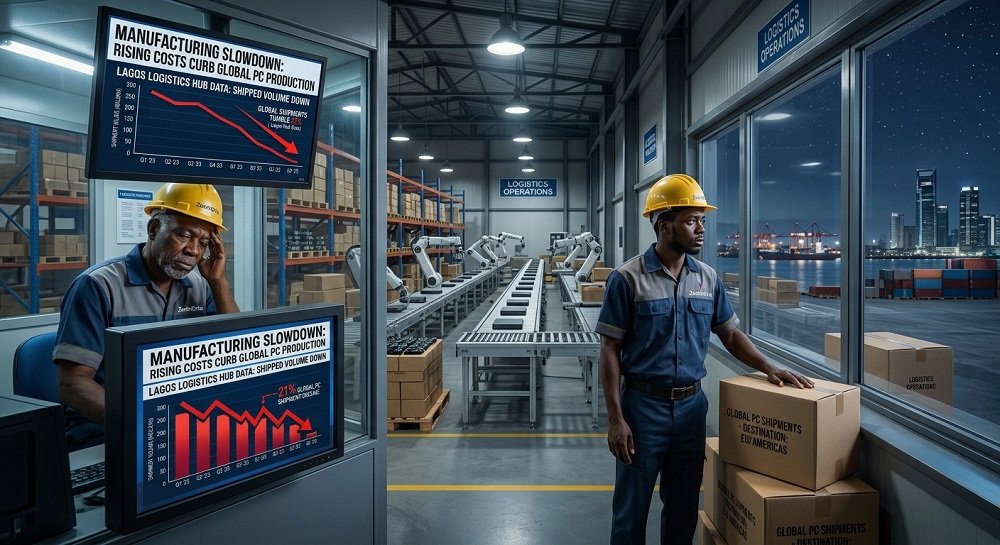
Global personal computer (PC) shipments fell 21 per cent year-on-year to 57 million units in the third quarter of 2026 as rising memory and other component costs pushed up computer prices and weakened consumer demand, according to Counterpoint Research.
The contraction puts pressure on manufacturers to maintain affordable product lines as consumers delay replacing existing devices and businesses weigh the cost of upgrading their computer systems.
The downturn follows a similar decline in the global smartphone market. Business A.M reported earlier in October that smartphone shipments fell 20 per cent year-on-year in the third quarter, reaching their lowest level for the period in 14 years as rising memory costs and supply shortages disrupted production and pushed device prices higher.
Counterpoint Research, in its recent preliminary global PC shipment report said shipments also declined 13.8 per cent quarter-on-quarter, reflecting continued weakness in consumer demand despite relatively resilient purchases by businesses replacing older computers.
The research firm attributed the contraction partly to rising memory and other component costs, which have increased the pressure on manufacturers to adjust prices. It warned that fewer affordable configurations could make it harder for price-sensitive buyers to replace ageing devices, even when the need for an upgrade remains.
The downturn also reflects a tougher comparison with the previous year, when purchases ahead of the October 2025 end of Windows 10 support and inventory adjustments linked to tariffs helped boost shipments.
Minsoo Kang, senior analyst at Counterpoint Research, said higher component costs were pushing system prices upwards and encouraging consumers to delay replacement purchases.
According to Kang, commercial replacement cycles and the migration to newer Windows systems continued to support demand, but were no longer sufficient to offset weakening consumer purchases.
The pressure has been uneven across major PC manufacturers, with some companies recording smaller shipment declines than the overall market.
Lenovo retained its position as the world’s largest PC vendor, shipping 15 million units during the quarter, although its shipments fell 23 per cent year-on-year. The company held a 26.3 per cent market share.
HP remained in second place, with shipments dropping 31 per cent to 10.3 million units, giving it an 18.1 per cent market share. Dell ranked third, shipping 7.6 million units, down 25 per cent year-on-year, as commercial demand failed to fully shield manufacturers from the wider market slowdown.
Apple and ASUS recorded smaller declines, outperforming the overall market. Apple’s shipments fell 11 per cent to 5.6 million units, lifting its market share to 9.8 per cent from 8.7 per cent a year earlier. Counterpoint attributed part of Apple’s relative resilience to the MacBook Neo.
ASUS shipped 5.2 million units, representing a seven per cent annual decline and the smallest year-on-year drop among the top five vendors. Its shipments also increased 19.4 per cent from the preceding quarter, raising its market share to 9.2 per cent from 7.8 per cent.
Together, Lenovo, HP, Dell, Apple and ASUS accounted for 76.7 per cent of global PC shipments in the third quarter. Shipments by other vendors fell 16 per cent year-on-year to 13.3 million units.
David Naranjo, associate director at Counterpoint Research, said the industry was entering a period of adjustment as higher component costs, rising system prices and longer replacement cycles reshaped market demand.
He said manufacturers would need to balance profitability with affordability, particularly as consumers became more cautious about spending on new computers.
Counterpoint expects global PC shipments to decline by 27 per cent year-on-year in the fourth quarter of 2026. Shipments in 2027 are forecast to remain broadly flat compared with 2026, suggesting that the market may stabilise at a lower volume rather than return quickly to growth.
The outlook raises questions about the availability of lower-priced computers as manufacturers contend with rising production costs and consumers become more reluctant to replace existing devices.
For manufacturers, the challenge will be to maintain competitive pricing without putting further pressure on margins. While AI-enabled computers, premium displays and other differentiated products could create new opportunities, Counterpoint said competitive pricing, supply-chain discipline and value for consumers and businesses would remain important to sustaining demand.