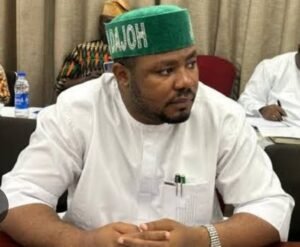
Philip Agbese, Labour Party leader in Benue State and member representing Ado/Okpokwu/Ogbadibo Federal Constituency, has defended the federal government’s proposed $21.7 billion supplementary external borrowing plan, arguing that investments in critical infrastructure and national security justify the additional debt.
Agbese said the proposed borrowing should be assessed against the economic value of projects it is expected to finance, rather than its headline figure, describing the package as strategic investment in productive national assets rather than expenditure on consumption.
His defence comes amid growing public debate over the Tinubu administration’s 2026–2027 external borrowing proposal, with questions surrounding Nigeria’s debt sustainability, the cost of external financing and the expected returns on government-funded infrastructure projects.
The lawmaker maintained that the administration’s investments in roads, rail, electricity transmission and defence demonstrate the need for sustained financing to address the country’s longstanding infrastructure deficit.
“This is not borrowing for the sake of borrowing. It is investment in the future of Nigeria,” Agbese said.
He identified transport infrastructure as a major component of the proposed financing, noting that more than $10 billion is earmarked for the sector, including the Lagos-Calabar Coastal Highway, Sokoto-Badagry Super Highway and strategic rail corridors.
According to him, the projects would improve connectivity, reduce transportation costs, stimulate commercial activities and create economic opportunities across the country.
“When you look at the allocation—over $10 billion for transport infrastructure alone, including the Lagos-Calabar Coastal Highway, Sokoto-Badagry Super Highway and key rail corridors—you see a government deliberately creating assets that will generate long-term economic value far exceeding the cost of the loans,” he said.
Agbese also defended the allocation for defence and security, arguing that increased investment in the Armed Forces and other security agencies remains essential to tackling terrorism, banditry and kidnapping.
He said the government must provide security personnel with the resources, equipment and operational capacity required to consolidate recent military gains and restore confidence in vulnerable communities.
“The Federal Government is putting resources behind the men and women in uniform so they can finish the job against bandits, terrorists and kidnappers,” he added.
On infrastructure delivery, the lawmaker cited progress on major highway projects under the Ministry of Works, particularly sections of the Abuja-Kaduna-Zaria-Kano highway, where the administration has adopted concrete pavement technology.
He also referenced the commissioning of initial sections of the Lagos-Calabar Coastal Highway and several other road projects across the federation as evidence that government infrastructure commitments are translating into physical development.
In the power sector, Agbese pointed to approvals for the proposed East and West Super Grids, which are designed to expand electricity transmission capacity and address persistent constraints in the national grid.
He argued that investments in transmission infrastructure would complement broader efforts to improve electricity supply, support industrial production and strengthen Nigeria’s economic competitiveness.
The lawmaker further said the proposed borrowing framework would benefit state governments and the Federal Capital Territory, with a substantial portion allocated to subnational development projects.
He maintained that the structure, including financing from multilateral and bilateral partners on concessional terms, would ensure that the benefits of the borrowing extend beyond the Federal Government.
On the financing arrangements, Agbese said a significant share of the proposed facilities would come from development institutions and bilateral partners at relatively favourable interest rates, while the commercial components were competitive compared with previous market conditions.
He also argued that fiscal reforms undertaken by the Tinubu administration, particularly the removal of petrol subsidy, had created additional fiscal space for infrastructure investment and improved the government’s capacity to pursue long-term development programmes.
However, the lawmaker dismissed criticisms centred primarily on the size of the proposed borrowing, insisting that the quality of projects, financing conditions and capacity to generate economic returns should form the basis of legislative scrutiny.
He said Nigeria inherited a substantial infrastructure deficit that requires considerable capital investment to overcome, warning that opposition to borrowing without considering its intended application could delay critical development projects.
On security, Agbese credited the Armed Forces with recording operational successes, including the neutralisation of terrorists and bandits, mass surrenders and the rescue of abducted citizens.
He argued that sustained funding would be necessary to preserve these gains and strengthen the country’s capacity to respond to emerging security threats.
“Look at what has been achieved in just over three years: major highways moving from paper to asphalt and concrete, rail lines advancing, and power infrastructure receiving the attention it has long been denied,” he said.
Agbese urged lawmakers across party lines to approach the borrowing request on its economic merits when it comes before the National Assembly, rather than allowing political affiliations to determine their positions.
“Every progressive country borrows to build. What matters is whether the money creates lasting assets and strengthens national security. On both counts, this plan passes the test,” he declared.
He added that communities in his constituency, like other parts of the country, required improved roads, dependable electricity and safer environments to support economic activities and improve living standards.
“We in the opposition must be honest enough to acknowledge progress where it exists. The people of Ado, Okpokwu and Ogbadibo, like Nigerians everywhere, want better roads, reliable power and safer communities.
“The Federal Government is taking concrete steps in that direction, and supporting the necessary financing is the responsible thing to do,” Agbese concluded.