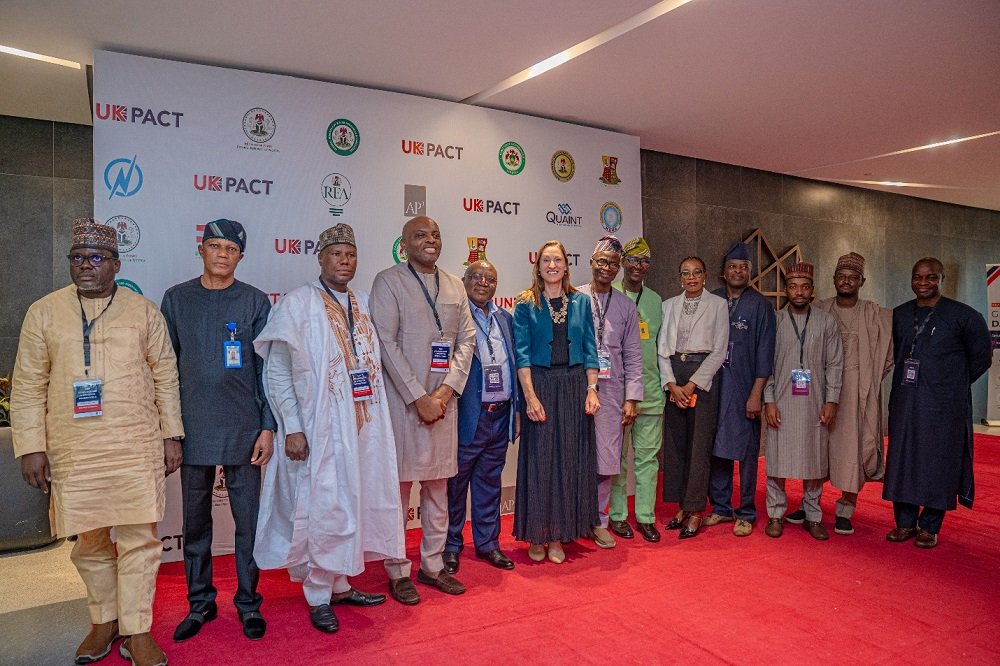
The United Kingdom and Nigerian government partners are intensifying efforts to attract private investment into small hydropower projects, targeting three pilot schemes in Oyo, Kano and Plateau states to expand electricity supply, stimulate rural industrialisation and unlock underutilised renewable energy resources.
The drive gained momentum at a stakeholder and investor roundtable held in Abuja on Wednesday, October 28, under the UK Partnering for Accelerated Climate Transitions (UK PACT) Clean Energy Transition Run-of-River Small Hydropower programme, where policymakers, financiers and project developers discussed moving the projects from technical preparation towards financial close.
The projects cover the Ikere Gorge scheme in Oyo State, Ghari Dam in Kano State and the rehabilitation of the NESCO hydropower cascade in Plateau State. The initiative, implemented by Africa PPP Advisory (AP3) and Ratio Consulting Ltd., has supported feasibility studies, dam safety assessments, environmental and social safeguards, energy audits, financial modelling and transaction structuring.
The discussions centred on attracting private capital, strengthening project bankability and resolving outstanding commercial and technical issues that could delay investment decisions.
British Deputy High Commissioner Vicky Seymour said the UK was working with Nigerian partners to develop a cleaner, more reliable and inclusive energy system, stressing that the programme needed to translate technical assessments into tangible improvements in communities’ access to electricity.
“Our note today is about moving from evidence to action together across the three pilot sites,” Seymour said, adding that the initiative’s success should ultimately be measured by its impact on people’s lives, particularly in communities with limited access to reliable power.
Joseph Olasunkanmi Tegbe, Nigeria’s Minister of Power, represented by Martin Olajide, Special Adviser to the President on Power, reaffirmed the federal government’s commitment to creating an enabling environment for renewable energy investment.
Tegbe said the Electricity Act 2023 had widened opportunities for private participation and the development of state electricity markets, creating additional pathways for investors to participate in power generation and distribution.
“Our task today is to advance these opportunities towards financial close, and I expect the deal rooms to resolve outstanding questions on hydrology, evacuation, power purchase agreements, and payment security,” he said.
He added that project structuring should incorporate community benefits, dam safety and environmental protection to ensure that investment delivers both commercial returns and wider economic value.
Hybrid hydropower, solar seen boosting generation
Beyond rehabilitating existing infrastructure and developing dormant sites, stakeholders identified hybrid hydropower and solar generation as an opportunity to increase capacity, improve seasonal reliability and strengthen the commercial case for investment.
Gori Olusina Daniel, managing partner of AP3 and programme director of the UK PACT run-of-river small hydropower programme, said combining the two technologies could significantly increase the generation potential of selected sites.
At the NESCO cascade in Plateau State, solar integration could raise the system’s potential from about 30 megawatts to 100 megawatts or more, according to Daniel, depending on the hybrid configuration and project development.
Established in 1929, the NESCO system comprises eight dams and eight power stations. Its installed capacity of 25.5 megawatts is operating below potential because of ageing equipment, while the rehabilitation programme is targeting approximately 40.25 megawatts.
At Ikere Gorge, which has remained dormant for decades, technical studies have identified hydropower potential of up to 14 megawatts. The proposed addition of solar generation could raise the target capacity of the hybrid system to 100 megawatts.
The project is being advanced by concessionaire Quaint Energy in collaboration with the Oyo State and Federal Governments.
The proposed development also illustrates the potential link between renewable power investment and agricultural value chains. Tegbe highlighted plans for an integrated poultry project in Oyo State designed to produce one million eggs daily, with a hybrid hydropower and solar system potentially supplying electricity to feed mills, hatcheries and poultry facilities.
The associated agricultural plan includes irrigation across 7,000 hectares to support maize and soybean production for animal feed, demonstrating how reliable electricity could support both food production and agro-industrial expansion.
Nigeria’s untapped hydropower potential
Representing the Rural Electrification Agency (REA), Jaafar Dikko said Nigeria had more than 3,500 megawatts of small hydropower potential, much of which remained undeveloped.
He said existing dams could provide electricity for rural communities, waterworks and agro-processing facilities, while the agency was prepared to support viable projects through public-private partnerships and appropriate financing mechanisms.
The initiative is also seeking to strengthen the policy framework required to scale up investment. Participants reviewed the zero draft of Nigeria’s National Small Hydropower Policy, alongside regulatory provisions under the Electricity Act 2023 and coordination with the World Bank’s SPIN master plan.
The Small Hydropower Deployment Toolkit was also presented as a resource to help state governments, project developers and financiers replicate project-preparation approaches and improve the pipeline of investment-ready schemes.
Developing a consistent policy framework and a credible pipeline of bankable projects will be important to mobilising private capital, particularly where investors must assess hydrological risks, infrastructure requirements, revenue certainty and the capacity of electricity buyers to meet payment obligations.
During technical discussions, Mike Imafidor, senior transactions specialist for UK PACT’s run-of-river small hydropower programme, and hydropower specialist Emmanuel Katepa emphasised the importance of reliable hydrological data, clear power evacuation arrangements, bankable power purchase agreements and credible payment-security mechanisms.
Deal rooms target investment bottlenecks
The roundtable concluded with project-specific deal rooms involving Quaint Energy and AP3 for Ikere Gorge, the Kano State Government and AP3 for Ghari Dam, and NESCO and AP3 for the Plateau cascade.
The sessions were intended to address outstanding issues and clarify the steps required to move each project closer to financial close.
Recognition awards were also presented to the Plateau, Kano and Yobe state governments and the REA for their contributions to renewable energy development and rural electrification.