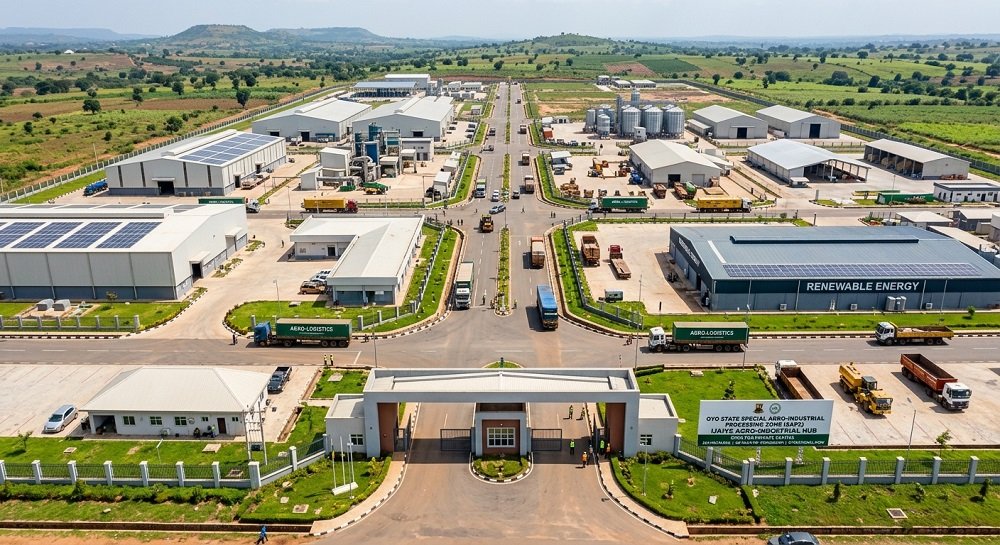
Oyo State is moving to secure private-sector investment for a 200-hectare expansion of its proposed Ijaiye Agro-Industrial Hub, with the state government preparing to launch a competitive procurement process for an anchor investor and operations partner before the end of December 2026.
The proposed concession, which could run for an indicative 35 to 40 years, represents the commercial centrepiece of the state’s Special Agro-Industrial Processing Zone (SAPZ) initiative, designed to establish an integrated agro-processing and logistics platform capable of attracting domestic and international investors.
At an investor round table convened virtually on November 11, prospective zone operators, commercial banks, capital-market investors, agro-processors, energy and cold-chain providers, logistics companies and development partners examined the investment proposition and the public-private partnership (PPP) structure for developing and operating the Ijaiye hub.
About 69 participants attended the meeting, organised by the Halcrow Consortium, transaction adviser to the Oyo SAPZ, on behalf of the Oyo State Agribusiness Development Agency (OYSADA) and the State Project Implementation Unit.
The immediate investment opportunity centres on Phase 2 of the 300-hectare industrial hub in Ijaiye, Akinyele Local Government Area, which will be developed by a private anchor investor through a special purpose vehicle (SPV) jointly owned with the state government.
The indicative concession period of 35 to 40 years, subject to negotiation, is intended to provide a long-term framework for private capital to participate in the development and operation of the zone, while the state provides the institutional and infrastructure foundation for the project.
The transaction team said the Request for Qualifications (RFQ) for the anchor investor and operations and maintenance concessionaire would be finalised and issued before the end of December 2026. A bidders’ conference, prequalification exercise and Request for Proposals will follow, with contract award targeted within approximately 60 to 90 days after the close of the RFP.
Feedback from prospective investors will also inform the final procurement structure, including whether the anchor investor and operations and maintenance operator should be separate entities.
Gori Olusina Daniel, managing partner of AP3 Advisory, lead financial adviser and deputy team lead of the Halcrow Consortium, said the project’s investment proposition was based on creating an integrated industrial ecosystem rather than another conventional agribusiness location.
“What we’re doing in Oyo is not building another agribusiness location. We are building West Africa’s premier agro-industrial hub,” Daniel said, urging investors to recognise opportunities across production, processing, warehousing, logistics and shared services.
“You have in Oyo a partner that will be there today, and that will be there in 25 years,” he added.
The development is structured around a hub-and-spoke model in which five agricultural catchment zones and the Eruwa Agricultural Transformation Centre, covering approximately 3,250 hectares, will supply the Ijaiye industrial hub. The Eruwa centre is expected to provide a significant part of the agricultural production base, while additional land at Ijaiye can be designated for feedstock cultivation.
The hub’s location, approximately 25 kilometres from the Moniya rail terminal and inland dry port, is also being presented as a logistics advantage for processors seeking access to domestic and export markets.
The project is being implemented in phases, with the first 100 hectares supported by catalytic public investment from the African Development Bank (AfDB) and the Oyo State Government.
The state has provided the land, groundbreaking has been completed at both Ijaiye and Eruwa, and design-build consultants are already on site. The Environmental and Social Impact Assessment has received provisional approval, although final federal approval remains outstanding.
The hub could become operational as early as 2028/29, according to the project presentation.
The AfDB’s national SAPZ programme is also preparing a second phase with a total financing package of $600 million, following approval of an initial $200 million tranche by the bank’s board in December 2025.
The financing pipeline provides a national policy and investment context for the Oyo project, although the proposed national funding should not be confused with an allocation already committed to the Ijaiye expansion.
Debo Akande, director-general of OYSADA, said the state’s agro-industrialisation strategy was aimed at reversing Nigeria’s dependence on exporting unprocessed agricultural commodities and importing higher-value processed products.
“We are exporting wealth and importing poverty. We export our raw materials, and we import processed materials, when we have all it takes as a nation to turn those raw materials into processed products for export. That is what I have seen SAPZ doing,” Akande said.
OYSADA is positioned as the single point of contact for investors, with a statutory mandate intended to provide institutional continuity across successive state administrations.
The agency is also pointing to the full subscription of the Fasola Agribusiness Industrial Hub as evidence of investor appetite for organised agro-industrial infrastructure in the state, while Ijaiye is being prepared for a wider private-sector investment process.
However, the investor discussions exposed the commercial conditions that will determine whether the hub can move beyond infrastructure development into sustainable industrial operations.
Financiers indicated interest in providing capital across different segments of the agricultural value chain but stressed the need for self-liquidating financing structures, predictable cash flows, clear exit routes and protection against utilisation, interest-rate and performance risks.
They also identified the need for meaningful borrower equity contributions or guarantee support, while processors and financial institutions sought stronger assurances around the availability and consistency of agricultural feedstock.
The transaction team said approximately 6,000 hectares could be made available for feedstock production, comprising the Eruwa Agricultural Transformation Centre and additional land at Ijaiye that could be designated for agricultural production.
The availability of land, however, will need to translate into dependable commercial supply arrangements involving farmers, aggregators, processors and off-takers if the hub is to operate at the scale envisaged.
Bernard Onzima, AfDB’s SAPZ task manager, cautioned that infrastructure development alone would not establish a successful agro-industrial zone.
“Infrastructure becomes transformational only when farmers, processors, financiers and markets connect commercially around it. The task before us is to move the catalytic infrastructure investments into sustainable agro-industrial investments,” he said.
The round table also emphasised the need for utility-scale services, particularly electricity, water and waste management, to reduce operating costs and improve the competitiveness of businesses locating within the hub.
Tomiwa Aregbesola, chief executive officer of Halcrow Infrastructure and team lead of the Halcrow Consortium, said the intention was to provide essential services within the zone so that processors could concentrate on their core operations.
“You don’t have to think about power. You don’t have to think about water. You don’t have to think about sewage. You don’t even have to think about logistics. All of these things will be provided within the zone,” he said.
Energy and cold-chain providers at the meeting nevertheless stressed the importance of reliable power from multiple sources and clearer visibility of prospective tenants’ energy and service requirements.
Some prospective partners have already indicated possible areas of participation, although the expressions of interest remain non-binding and do not constitute confirmed financial commitments.
FirstCap indicated interest in investing at the project SPV level and in utility providers operating within the zone. It also offered to facilitate engagement with carbon-credit and International Renewable Energy Certificate (I-REC) partners.
Stanbic IBTC expressed interest in financing tenants, outgrowers, agricultural activities and renewable energy infrastructure.
Virtuos Consulting indicated interest in developing a circular-economy waste-management utility for the hub.
The transaction team is encouraging interested processors, tenants, service providers, off-takers, financiers and development partners to submit non-binding Letters of Intent or Expressions of Interest to OYSADA and the project team ahead of the procurement process.
The submissions are expected to identify proposed investments, land or facility requirements and intended services, with prospective participants subsequently invited into commercial discussions. Agreements reached at this stage are expected to be novated to the project SPV.
Nufi Barnabas Yohanna, PPP consultant to the National Coordinating Office of SAPZ Nigeria, said the round table was an opportunity for investors to engage with the project and help shape its commercial proposition.
“The message to prospective investors is simple. This is the time to engage, explore the opportunities, shape the commercial proposition, and position yourself to participate in the development of this transformative initiative,” he said.
The national SAPZ programme is also working with participating states and development partners to consolidate a national policy framework and fiscal and non-fiscal incentives aimed at attracting investment into the zones.
For Oyo State, the next stage will be to translate expressions of interest into bankable investment commitments, secure a credible anchor investor, establish dependable feedstock arrangements and ensure that the utilities and logistics infrastructure can support industrial-scale operations.