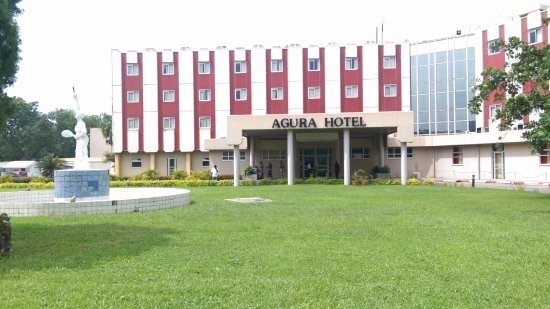
Agura Hotel, one of Abuja’s oldest hospitality establishments, has remained shut for more than a month following its sealing by the Nigeria Revenue Service (NRS) over an alleged ₦155 million tax liability, raising concerns about the financial consequences of prolonged enforcement restrictions on an established hospitality business.
The closure, which followed restrictions on the hotel’s access to its bank account, has brought operations at the 40-year-old establishment to a halt, disrupting its revenue generation, staffing arrangements and ability to meet routine operating expenses.
Commissioned in 1986, the hotel was sealed on October 14, 2026, over an outstanding tax liability covering the 2010–2015 assessment period, according to Idris Isah, its general manager.
Isah noted that management had been making payments towards reducing the liability before the latest enforcement action, bringing the amount down from its earlier level to ₦118 million.
He said the hotel had entered into an arrangement to remit ₦1 million monthly alongside its current tax obligations, but accumulated interest and penalties had continued to increase the outstanding amount.
The dispute had already affected the hotel’s financial operations before the premises were sealed, following the placement of a lien on its bank account by the NRS in December 2025.
According to Isah, the restriction limited the hotel’s ability to conduct transactions, making it difficult to generate revenue and maintain normal business relationships. He said customers and business partners had also become reluctant to transact with the establishment because of the restrictions.
For a hospitality business, access to operating funds is central to maintaining daily operations. Hotels depend on regular cash flows to pay employees, settle suppliers, maintain facilities, meet utility bills and sustain the services that attract paying guests.
When access to bank accounts is restricted, the resulting pressure can extend beyond the immediate tax obligation, affecting the ability to maintain service quality and generate the income required to meet other financial commitments.
Management said Agura Hotel had continued providing limited services after the bank account restrictions were imposed, largely to meet essential expenses such as staff salaries, security and electricity.
However, the sealing of the premises in October ended that limited operating arrangement, forcing management to send some workers home and suspend normal hotel activities.
The hotel has since appealed to the revenue service to reopen the premises, arguing that a resumption of operations would enable it to generate funds towards settling the outstanding liability.
Isah also said management had requested official documentation confirming the account lien and the sealing of the property, which it intends to use in approaching potential creditors for financial assistance.
The request for documentation highlights another dimension of the hotel’s financial predicament, considering its ability to secure external funding while its operating assets and cash flow remain constrained.
Potential creditors assessing a hospitality business generally consider its capacity to generate revenue, meet repayment obligations and maintain operational continuity. A prolonged shutdown can weaken these fundamentals, particularly where the business depends on daily customer transactions.
Agura Hotel’s situation also raises questions about the management and commercial performance of a hospitality asset in which a federal government agency holds a majority interest.
The Nigerian Ports Authority (NPA) announced in September 2017 that it had assumed control of the hotel following a court judgment in its favour against Fasel Services Limited and other parties.
The development places the hotel’s current difficulties within a broader context of public-sector asset management, particularly the financial and operational challenges associated with maintaining commercial investments.
For an established hospitality property, prolonged closure can carry costs beyond lost room and service revenue. Maintenance obligations, security, deterioration of facilities, staff retention and the eventual cost of restarting operations can add to the financial burden.
The longer the business remains inactive, the greater the possibility that reopening will require additional capital to restore facilities, rebuild customer confidence and re-establish commercial relationships.
This creates a difficult financial equation for management. While the outstanding tax liability remains a legal and financial obligation, the hotel’s ability to generate the cash needed to meet that obligation has been weakened by the restrictions on its operations.
Management’s argument is that reopening would restore its capacity to earn revenue and continue payments towards the debt, rather than leave the establishment without a viable source of operating income.
The NRS enforcement action, meanwhile, underscores the consequences businesses can face when outstanding tax obligations remain unresolved. For companies with substantial operating costs and relatively continuous cash-flow requirements, restrictions on financial accounts and business premises can have implications extending to employees, suppliers and other commercial partners.
The central issue in Agura Hotel’s case is therefore no longer limited to the amount of tax being demanded. It also concerns the financial condition of a long-established hospitality business, the management of an investment with government ownership interests and whether the establishment can resume commercial operations while resolving its outstanding obligations.
For now, the hotel’s appeal for reopening represents an attempt to restore the revenue-generating capacity that management considers necessary to support its proposed settlement of the tax liability.
Until operations resume, however, the establishment remains deprived of its principal source of commercial income, leaving the future of one of Abuja’s older hospitality businesses tied to the resolution of its tax dispute and the financial arrangements that follow.