By Maria Ana Vitorino
How licensing and price competition can lead to win-win agreements.
Perhaps George Clooney has tempted you to buy a single-serve coffee machine or maybe you’ve seen an amazing deal for one. Did you hesitate before committing to your purchase because you didn’t want to be locked into buying only one type of coffee? If multiple brands made compatible pods, would that make that great deal seem like a better investment?
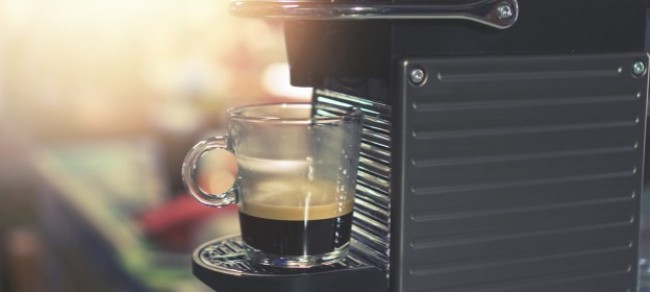
Tied goods, like single-serve coffee machines and the pods/capsules, are companion products which are linked such that you can’t have one without the other. Printers/cartridges and razors/blades are other good examples. One business model has been to price the durable product – the coffee machine, printer or razor – low and make money on the more expensive (over time) consumable product – the coffee pod, ink cartridge or razor blade. This framework, unsurprisingly, is called the razor-razor blade business model.
In patenting the durable item, firms can choose to lock out competitors or license other companies to make similar consumable products. If a firm does license the use of its patents, it has several options in terms of pricing agreements.
In “Licensing and Price Competition in Tied-Goods Markets: An Application to the Single-Serve Coffee System Industry”, in Marketing Science, P.K. Chintagunta of Chicago Booth, M.S. Qin of Temple’s Fox School of Business and I developed an economics model that examines market outcomes of alternative licensing agreements based on the single-serve coffee industry in Portugal between 2005 and 2012. Our model quantifies the impact of licensing and pricing agreements on profits, pricing and competition both on the primary market of coffee machines and the aftermarket of coffee pods.
Massive increase in pod market share
In the period we studied, the market share of coffee pods in Portugal increased from 3 percent in 2005 to nearly 65 percent of all coffee in 2013.
We looked at four companies in particular, which made up more than 93 percent of the Portuguese pod coffee market in 2013. Each brand entered the market with coffee machines that only worked with their own coffee pods.
On average, once consumers buy a coffee machine, they are locked in for three years. Because these consumers are a captive market, supermarkets are unlikely to have special offers on the pods so there isn’t much variance in consumption over a year. We found that negative profit margins on coffee machines are compensated by the positive profit margins on coffee pods (between 20 and 30 percent), which is common in tied-goods markets.
Based on existing data, we built an economics model that allowed us to not only get a sense of the drivers of purchase but also to simulate a variety of scenarios, including what could happen when a coffee system entered the market with or without licensing agreements with other pod makers.
Demand for particular coffee machines is responsive to the price per pod. Across all price changes, we estimate that when a brand raises the price of its pods by 1 percent, sales of its coffee machines decline by more than 5 percent on average. A firm doesn’t necessarily make money from selling the machines so that’s no great loss, but fewer coffee machines sold curbs coffee pod sales over time.
Who profits?
Once the pod market opens up and other coffee brands license pods, our simulations showed that it wasn’t the licensee who paid the least in royalties that profited the most. Brands that paid royalty rates in the 10 to 15 percent range for their licensed pods were the ones likely to have the highest profits.
As we saw in price responsiveness between machines and pods, coffee machine makers can benefit through licensing their pods. Consumers would be more likely to buy a single-serve coffee machine if there were multiple options in the coffee pod aftermarket. This is a benefit of compatibility, especially when a variety of flavours is appealing.
In our model, if coffee pods were licensed at a lower royalty rate (5 percent), coffee machine makers would be reluctant to low-ball the price of their machines, setting off a cycle of fewer coffee machines sold with lower demand for certain pods. If machines were not attractively priced, there would be a drop-off in the consumable pod market.
Win-win agreement
We learnt that licensing has important effects on price competition when we simulated either uniform pricing or independent pricing. A uniform pricing agreement implies that the durable goods manufacturer establishes a single price across all brands including its own. An independent licensing agreement, on the other hand, allows different brands to set their own prices.
For a licensee, the coffee pod creator in our model, profits were always lower with a uniform pricing agreement so it is clearly important for them to set their own prices. If a licensee had to have the same price as the main brand, this wasn’t as lucrative because they couldn’t pitch themselves as either a down-market or up-market choice.
But for a licensor, the durable goods manufacturer, the benefit of either uniform pricing or independent pricing is dependent on the royalty rate they choose to charge licensees. Uniform pricing is preferred when the royalty rate is low, since it kills price competition. When the royalty rate is high, however, independent pricing is preferred as it facilitates price discrimination.
Overall, within the relevant range of royalty rates in which the licensor and licensee have an incentive to enter a licensing agreement, if the machine maker charges a royalty rate of around 10 to 15 percent, an independent pricing agreement is the better choice for both sides.
Again, one of the benefits of compatibility is that consumers prefer systems with multiple brands – licensing the aftermarket product encourages this. Whether it’s Clooney or the low price of the durable product that lures consumers in, opening up choice may lead to a win-win licensing agreement.
The authors of this research are grateful to Delta Cafés for its assistance. A Portuguese company founded in 1961, Delta Cafés is active in the production, marketing and distribution of coffee. It is one of the most well-known brands in Portugal and the overall leader in the coffee market there.
Maria Ana Vitorino is an Associate Professor of Marketing at INSEAD.