Do you prefer dogs or cats? Vanilla or chocolate? Winter or summer? The answers to these simple questions reveal a little something about who we are and what we like. We want to answer them because they’re fun, and because it broadcasts a bit of information about our personality, our values, and our desires.
The co-authors of the paper, which was published in the Journal of Marketing, are Jacqueline Rifkin, assistant marketing professor at the University of Missouri-Kansas City’s Henry W. Bloch School of Management, and Katherine M. Du, assistant marketing professor at the University of Wisconsin-Milwaukee’s Lubar School of Business.
Berger joined Knowledge@Wharton to talk about the study. Listen to the podcast at the top of this page, or read an edited transcript of the conversation below.
Knowledge@Wharton: How does answering questions about personal preferences make people want to give more money?
Jonah Berger: There’s a fundamental question that many organizations or people have thought about, which is, how do we increase pro-social behavior? If I’m the Red Cross, how do I get more donations? If I’m a barista at a coffee shop or a waiter at a restaurant, how do I get people to tip me? If I’m trying to raise money for a museum, how do I go about doing that? It’s obviously very hard. Lots of people mean to donate, they want to donate, but there are lots of causes and lots of things going on. In the end, it often doesn’t happen.
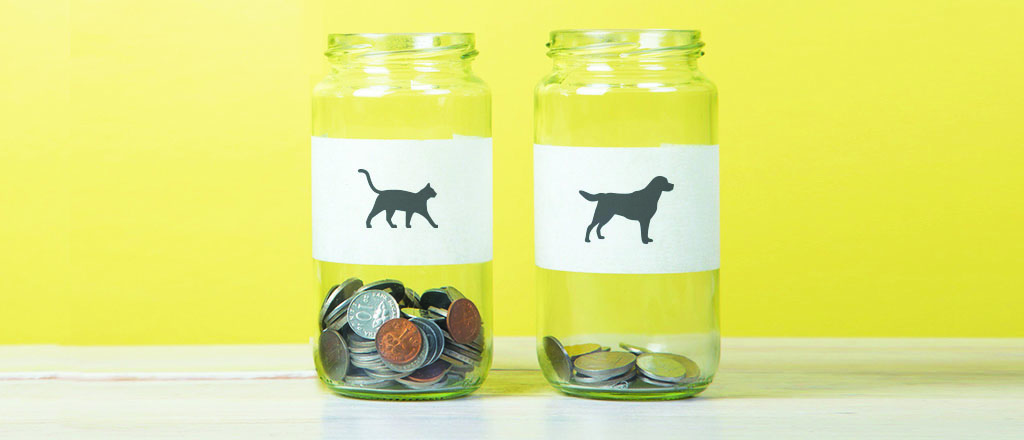
We all love self-expression. We do it all the time through our cars and clothes and music. [My co-authors and I] wondered whether we could leverage this tendency and this desire for self-expression to encourage pro-social behavior. Part of this idea actually started from something we saw in coffee shops. You might walk into a coffee shop, and rather than having a tip jar there for you to drop in a buck or two, instead there are two jars with pictures on them. One might say “dog” and one says “cat.” They might say “vanilla ice cream” or “chocolate ice cream.” Or they might say “Star Wars” or “Star Trek.”
Coffee shops are using that approach for a reason. They think it’s engaging their customers in some way and hopefully increasing tips. But we wondered, does it work? There are many things that businesses try that don’t work, so does this actually work? Does it work all the time? Can we apply this more broadly? Knowing that people drop in a couple of extra cents for cats versus dogs is nice for a coffee shop. But if I’m the leader of a big nonprofit, or I’m trying to raise money for a foundation, could something like this be useful for me? Is it just something for coffee shops, or can it tell us something broader about human behavior and ways that organizations can leverage these insights to increase pro-social behavior?
Knowledge@Wharton: How did you study this? It seems subjective, so how did you make this analytical and objective?
Berger: I’ll give you a couple of examples. One experiment we did was very much in the exact setting we talked about: a local coffee shop. We went in and, for different periods of time, we had different tipping situations. Sometimes there would be a single jar that would say “tips.” Other times, we randomly manipulated whether it had just a jar or this idea of dueling preferences — these two things that customers could vote on based on their opinions. They could choose cats or dogs through their tipping. We manipulated the time of day across multiple days, counterbalancing for everything — almost like an A/B test — to get a sense of what affects donations.
You could say, “Well, hold on. You’re asking people to make a choice. Cats and dogs have nothing to do with tipping. Maybe it’s going to decrease donations. Maybe people are going to feel overwhelmed. They’re not going to make a choice.” But that’s not what happened. Giving people a choice mattered. Just making two jars and putting “cat” and “dog” on them led people to tip more than twice as much compared to a tip jar.
It wasn’t just restricted to tipping. We did a very similar experiment with donations to the American Red Cross. Rather than simply asking for donations — and that’s what we did for some people — some people were asked to donate by voting. Would you prefer chocolate ice cream or vanilla ice cream? Again, chocolate and vanilla ice cream have nothing to do with the American Red Cross. You could say, “Well, hold on. Won’t people think this is frivolous or doesn’t matter? It’s not going to help.” But that’s not what occurred. In fact, just the opposite: It increased donations by 28%.
In a variety of different contexts, we can use dueling preferences. It’s giving people a self-expressive choice as a way to motivate action and, in this case, motivate giving.
Knowledge@Wharton: Were you surprised by the experiment results, or did they line up with what we already know in the literature about identity and consumer behavior?
Berger: I was surprised by the size of these results. This isn’t a couple of pennies here and there. A 28% increase to the American Red Cross is a big deal. That’s a lot of money for that organization. I was certainly surprised by the size of the effect, but it was also interesting to see when this happens and why it happens. I’m not suggesting just to give anybody a choice or that any choice will work. It really has to be a way for people to express their preference. It has to be something that they care about, and they feel that expressing their preference on that dimension is diagnostic of who they are. Sports rivalries are the same way, right? Maybe it’s the Yankees and the Red Sox. That’s something people feel very strongly about. They want to share their opinion.
It’s about understanding the context. Pick a choice that the audience cares about and feels self-expressive. Caring about chocolate and vanilla ice cream is not the most important domain in the world, but it’s something people feel says something about them. The same with dogs and cats. There are cat people and there are dog people who feel like it says something about them. We can use that to motivate behavior even in an unrelated domain.
There’s lots of research that clearly shows that if you’re the type of person who drives a BMW, that’s a desirable identity for you. You’re going to pay more for a BMW than someone who doesn’t hold that [identity]. It’s clear we care about identity. It’s clear that identity motivates behavior.
Knowledge@Wharton: Given this information, what can marketers, managers, or even charity directors do to help increase giving?
Berger: I think the place to start is to stop just thinking about you. Your cause is very important, but think about your audience. What this research shows is, yes, if I’m the American Red Cross — or whatever organization it might be — I can go out there and say, “This is an important problem. Please donate money to this problem.” And I will get people to donate. I will get a set of people who have donated in the past to donate to my cause.
Those aren’t small circles of people. But if I want to move beyond those circles of people, I have to think [bigger]. There are other important causes. There’s the environment, and there’s cancer — there’s a variety of things people could give their money to. I have to think beyond just my cause and people who inherently believe in that cause to begin with, and start thinking about, “Well, what do those folks care about?”
Even people that may care about the cause to begin with — what’s a way to motivate them to give? This isn’t just about making it a game, though it does feel a little bit like a game. It’s really about allowing them to express themselves. Maybe your local grocery store does this competition where they say, “Collect receipts, give them to your local school, and the school that gets the most receipts gets a big donation from the grocery store.” That’s not just allowing people to express themselves, but to compete. It allows those expressions to be public signals of the self.
If I were a marketer, if I were a manager, if I were a charity director, I would think about how to harness self-expression. I would think about the right opportunity to give people the right choice. How can I motivate my audience to give by providing them an opportunity to express their preferences?
Knowledge@Wharton: What’s next for this line of research?
Berger: One thing I’ve thought a bit about lately is the value of asking questions rather than making statements. I talk about this a bit in my most recent book, The Catalyst. We did some research on it here, and we’re doing some research on it more generally. But questions are really powerful in a number of ways.
Often, when we want to persuade people, we think that telling them to do what we want — making a statement, if you will — is the best way to get them to take action. But people often push back on statements. Questions do a number of interesting things. First, they allow us to collect information. If you ask questions, you can better understand the people you’re communicating with, the people you’re trying to persuade. Second, it gives people some freedom and autonomy. Just like we talked about today, it allows them to express themselves. It allows them to participate.
If you’re a boss trying to get people to stay late after work, and you tell them what you need, they may push back. Instead, if you say, “What kind of company do we want to be, a good one or a great one?” And they answer, “A great one.” And then you ask, “What can we do to get there?” They think about it, and they give you some answers, and you adopt those answers. Now, they’re more brought into the process. I think questions can be a great way to make people feel like they have a role in the process, which makes them much more likely to be engaged and to help [achieve] a desired outcome.