
Business A.M
No Result
View All Result
Saturday, October 17, 2026
  • Login
  • Technology
  • Finance
  • Comments
  • Companies
  • Commodities
  • ONLINE & DIGITAL CONTENT PACKAGE
Subscribe
Business A.M
  • Technology
  • Finance
  • Comments
  • Companies
  • Commodities
  • ONLINE & DIGITAL CONTENT PACKAGE
No Result
View All Result
Business A.M
No Result
View All Result
Home Frontpage

WTO chief seeks cooperation to address hike in commodity prices

by Admin
January 21, 2026
in Frontpage, WORLD BUSINESS & ECONOMY

BY: ONOME AMUGE

The lingering war in Ukraine has exposed the vulnerability of global supply chains and raised the spectre of food shortages in many countries, especially those dependent on Ukraine and Russia for imports of key staples.

To urgently address the effects of the crisis, which is threatening food security and rapidly inflicting a severe blow to the global economy, there has to be a coordinated action by international organisations to find a lasting solution to the recent sharp rise in commodity prices.

In the near-term, international cooperation on trade will be needed to minimise the impact of supply crunches for key commodities where prices are already high by historical standards and to keep markets functioning smoothly.

Ngozi Okonjo-Iweala, director-general of the World Trade Organisation (WTO), made this assertion while speaking at a recent informal meeting of the general council.

According to Okonjo-Iweala, dozens of poor countries and tens of millions of people are currently in danger of basic food security. She averred further that these countries have already witnessed some of the slowest economic recoveries from the COVID-19 pandemic, noting that international cooperation on trade is necessary to help mitigate risks of poverty, hunger, famine and social unrest.
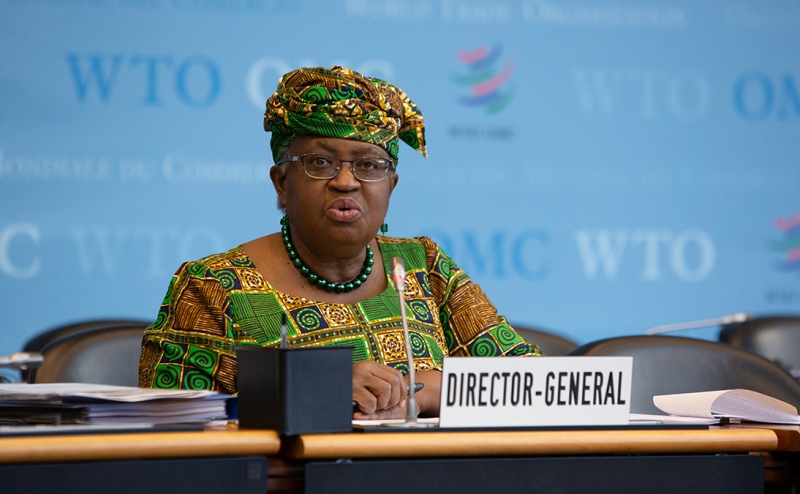
Ngozi Okonjo-Iweala, director-general of the World Trade Organisation (WTO)

The WTO chief, who noted that only 12 members have imposed export restrictions on food to date, emphasised that coordinated government action is needed to avoid a repeat of the cascading export restrictions that exacerbated the rise of food prices in the crisis of 2008-2010.

She urged countries with buffer stocks that can afford to share to coordinate the release of wheat, barley, other cereals and grains, and oils into international markets, thereby alleviating the supply squeeze.

“Countries such as the United States, Canada, Australia, Argentina, and France could increase wheat cultivation while others such as China, Germany, Morocco, Saudi Arabia, Egypt, and Nigeria could increase the global supply of fertiliser,” she said.

Okonjo-Iweala stated further that Africa, with plentiful land and other resources, can take steps to produce more food by utilising more adaptable varieties of wheat, maize and other crops.

The renowned economist suggested that trade facilitation measures could also be brought into play to ease the free flow of goods, while efforts should be made to allow the United Nations World Food Programme full access to humanitarian purchases.

“Prompt notification and information sharing regarding food supplies and stockpiles can help the international community better manage the situation and keep markets functioning more smoothly,” she added.

Responding to calls in some quarters to relocate production and sourcing locally to ensure stable supplies of critical goods and staples, she argued that concentrating on sourcing and production locally could create new vulnerabilities and may not be the best risk management strategy. She, instead, recommended deeper and more diverse international markets to ensure supply resilience.

Okonjo-Iweala maintained that multilateral trade has been and would remain a critical means of adaptation to the mounting global shocks that the world is currently experiencing, noting that this is not the time for countries to retreat inward, but the time to stress the importance of multilateralism, global solidarity and cooperation.

On how the WTO is working towards finding solutions to the food crisis, she explained that the WTO secretariat staff have carried out analysis on food security issues, while also considering a solid basis to foster workable solutions to the present crisis.

She added that Gloria Abraham Peralta, the chair of the WTO’s agriculture negotiations, was planning a food security conference that would take place at the end of April.

The WTO director-general also disclosed that the UN secretary general has set up a three-tiered steering committee involving heads of government, heads of international organisations and technical experts to deal with the issue of surging energy and food prices.


Admin
Admin
Previous Post

Climate change, environmental degradation threat to humanity, says Iwuayanwu

Next Post

New Russia-Ukraine peace talks see gold trade lower

Next Post

New Russia-Ukraine peace talks see gold trade lower

  • Trending
  • Comments
  • Latest

How UNESCO got it wrong in Africa

May 30, 2017

CBN to issue N1.5bn loan for youth led agric expansion in Plateau

July 29, 2025
MMA2 enters new commercial era after 20-year concession dispute

MMA2 enters new commercial era after 20-year concession dispute

August 28, 2026
NGX taps tech advancements to drive N4.63tr capital growth in H1

Insurance-fuelled rally pushes NGX to record high

August 8, 2025

6 MLB teams that could use upgrades at the trade deadline

Top NFL Draft picks react to their Madden NFL 16 ratings

Paul Pierce said there was ‘no way’ he could play for Lakers

Arian Foster agrees to buy books for a fan after he asked on Twitter

Rivers, China's CNCECC sign deal for $3.5bn methanol, fertiliser plant

Rivers, China’s CNCECC sign deal for $3.5bn methanol, fertiliser plant

October 17, 2026
Methane rules spread across 67% of global production as Nigeria faces compliance test 

Methane rules spread across 67% of global production as Nigeria faces compliance test 

October 17, 2026
Onafriq, a pan-African payments company, is set to discontinue its Baxi agent banking business in Nigeria after five years, citing naira depreciation, rising operating costs and intensifying competition that have weakened the segment’s profitability. The planned shutdown will affect the agent banking operations conducted through Baxi under Onafriq Nigeria Payments Limited. However, the decision does not signal the company’s withdrawal from Nigeria, as it intends to retain its cross-border payments network and card issuing services in the country. In a statement, Onafriq said changes in Nigeria’s operating environment since 2024 had significantly altered the economics of its offline agent banking business, making the existing model unsustainable. The move marks a strategic shift for the company, which entered Nigeria’s agent banking market to expand access to financial services through a network of agents providing transaction services outside traditional bank branches. Onafriq attributed the decision to a combination of macroeconomic pressures and structural changes in the country’s payments industry. According to the company, naira depreciation and inflation have affected transaction volumes, increased operating expenses and undermined the sustainability of its agent banking operations. The growing adoption of instant account-to-account transfers has also changed the mix of transactions handled by agents, while heightened competition among payment service providers has put further pressure on margins. These developments have made it increasingly difficult for the business to remain viable under its existing operating structure, prompting the company to reassess its long-term strategy. Dare Okoudjou, founder and chief executive officer of Onafriq, said the decision to close the business was difficult, particularly given the efforts of employees, agents and business partners who helped build the Baxi network. “We entered Nigeria with conviction and commitment, but did not achieve the outcome we set out for. Closing this business was a difficult decision to arrive at, one that affects colleagues, agents, and business partners across Nigeria who poured their hearts and soul into building out the Baxi network,” Okoudjou said. Despite the closure, he reaffirmed the company’s commitment to the Nigerian market, noting that the group would continue to serve customers through its payments network and card issuing operations. Onafriq entered Nigeria’s agent banking market in 2021 through the acquisition of Baxi, also known as Capricorn Digital Limited. The company said it continued investing in the business through 2023, with efforts focused on expanding and strengthening its agent network. However, a subsequent review of the business’s long-term prospects and financial sustainability led to the decision to wind down the operation. As part of the transition, Onafriq said agents onboarded through the Baxi platform had been moved to another principal bank, a step intended to facilitate continuity for the affected agents. The company has also directed agents to transfer their funds to their preferred principal bank within 30 days, adding that its teams would provide support throughout the transition process. Employees whose roles are linked to the agent banking business will also be consulted and supported during the wind-down, with Onafriq pledging to treat affected workers fairly.

Onafriq winds down Baxi as Nigeria’s agent banking economics worsen

October 17, 2026
LCFE links petroleum trading to capital market in pricing transparency drive

LCFE links petroleum trading to capital market in pricing transparency drive

October 17, 2026

Popular News

  • How UNESCO got it wrong in Africa

    0 shares
    Share 0 Tweet 0
  • CBN to issue N1.5bn loan for youth led agric expansion in Plateau

    0 shares
    Share 0 Tweet 0
  • MMA2 enters new commercial era after 20-year concession dispute

    0 shares
    Share 0 Tweet 0
  • Insurance-fuelled rally pushes NGX to record high

    0 shares
    Share 0 Tweet 0
  • Glo, Dangote, Airtel, 7 others prequalified to bid for 9Mobile acquisition

    0 shares
    Share 0 Tweet 0
Currently Playing

CNN on Nigeria Aviation

CNN on Nigeria Aviation

Business AM TV

Edeme Kelikume Interview With Business AM TV

Business AM TV

Business A M 2021 Mutual Funds Outlook And Award Promo Video

Business AM TV

Recent News

Rivers, China's CNCECC sign deal for $3.5bn methanol, fertiliser plant

Rivers, China’s CNCECC sign deal for $3.5bn methanol, fertiliser plant

October 17, 2026
Methane rules spread across 67% of global production as Nigeria faces compliance test 

Methane rules spread across 67% of global production as Nigeria faces compliance test 

October 17, 2026

Categories

  • Frontpage
  • Analyst Insight
  • Business AM TV
  • Comments
  • Commodities
  • Finance
  • Markets
  • Technology
  • The Business Traveller & Hospitality
  • World Business & Economy

Site Navigation

  • Home
  • About Us
  • Contact Us
  • Privacy & Policy
Business A.M

BusinessAMLive (businessamlive.com) is a leading online business news and information platform focused on providing timely, insightful and comprehensive coverage of economic, financial, and business developments in Nigeria, Africa and around the world.

© 2026 Business A.M

Welcome Back!

Login to your account below

Forgotten Password?

Retrieve your password

Please enter your username or email address to reset your password.

Log In
No Result
View All Result
  • Technology
  • Finance
  • Comments
  • Companies
  • Commodities
  • ONLINE & DIGITAL CONTENT PACKAGE

© 2026 Business A.M




