
A 13-year-old girl’s future could have been permanently defined by sexual abuse, teenage pregnancy and the failure of institutions meant to protect her. Instead, timely intervention helped change the course of her life, turning a painful real-life experience into a story of survival that is now finding a wider audience through Nigeria’s creative industry.
That transformation is centered around A Tray of Locust Beans, a short film by Lufodo Productions in collaboration with Kinsman Studios, which premiered in Lagos on November 5. Beyond its cinematic appeal, the production offers an example of how creative enterprises can deploy storytelling to address social challenges, influence public attitudes and bring government, development organisations and advocacy groups into conversations about institutional accountability.
The film’s premiere at Film House, Landmark, Lagos, attracted stakeholders from government, the development sector, gender advocacy and the Nigerian entertainment industry. An Official Selection at the African International Film Festival (AFRIFF) 2026, the production places the protection of vulnerable children at the centre of a wider discussion about the capacity of cinema to advance social change.
Based on a short story by Bisi Fayemi, renowned writer and gender advocate, A Tray of Locust Beans follows Mabel, a 13-year-old girl who experiences sexual abuse and an ensuing pregnancy, as she confronts a system that often fails children in vulnerable circumstances. The narrative draws from a real case handled in Ekiti State, highlighting the importance of timely intervention and the role of individuals and institutions in preventing abuse from determining a child’s future.
The production was directed by Orobosa Ikponmwen, with a screenplay by Ololade Okedare and Ayobola Eniola. It features Somachi Chilaka, veteran actress Joke Silva and Korede Lawal, while Silva, Soji Jacobs and Fayemi served as executive producers.
The premiere, which featured a red-carpet reception, exclusive screening and post-film panel discussion, moved beyond the conventional celebration of a film release to examine the institutional conditions that allow sexual violence against children to persist.
Fayemi, whose work in gender and development spans more than 35 years, said the story reflects a recurring cycle of neglect, violence and limited opportunities that can shape the lives of girls and their children when intervention comes too late.
She argued that breaking this cycle requires more than government policies or the interventions of public office holders, insisting that individuals must recognise their own capacity to influence social outcomes.
“Not all of us will be a first lady. But there’s something that you can do to ensure that we break that cycle of violence and oppression,” she said.
Her position reinforces the importance of collective responsibility in addressing gender-based violence, particularly in societies where institutional capacity, public awareness and access to support services remain uneven.
For Joke Silva, bringing the story to the screen was driven by the possibility of demonstrating how intervention can alter the trajectory of a vulnerable child’s life.
Drawing attention to Mabel’s eventual academic achievement as the best graduating student, she said the outcome illustrated what could be achieved when people refused to ignore the circumstances confronting a child.
“She was the best graduating student. Imagine if nothing had been done,” Silva said.
Director Ikponmwen said the film was deliberately structured around Mabel’s experience, with the camera remaining closely aligned with the central character to help audiences understand her journey from her perspective.
She said the objective was to produce a story that would move viewers beyond sympathy towards practical action.
“I like stories that when you watch them, it drives action. It drives change,” she added.
While the film’s narrative centres on one girl’s experience, the post-screening discussion exposed broader weaknesses in the institutional architecture for responding to sexual violence and protecting survivors.
The panel, hosted by Adesuwa Onyenokwe, veteran broadcast journalist and publisher of TW Magazine, brought together Fayemi, Silva, Ikponmwen, Rita Ilevbare, lawyer and gender-based violence advocate who coordinates the Ekiti State Sexual Assault Referral Centre, and Titilola (Lola) Vivour-Adeniyi, executive secretary of the Lagos State Domestic and Sexual Violence Agency.
Ilevbare traced the real-life case behind the film to a petition in 2011 and the subsequent intervention of the then First Lady of Ekiti State. She explained that the case contributed to policy developments and the establishment of the Sexual Assault Referral Centre, which she said has since served more than 630 women.
“Policy itself does not translate to justice, but it provides a foundation that gives us the basis to work,” she said.
She called on the government to prioritise adequate budgetary provisions for survivor support services, stressing that institutional effectiveness depends on functional facilities, sustained resources and access to justice.
Vivour-Adeniyi brought a Lagos State perspective to the discussion, highlighting the existing child protection framework, including relevant laws, policies, Family Support Units and family courts.
However, she identified institutional fragmentation and weak coordination as continuing obstacles to effective responses to abuse.
“We have the laws, we have policies, and we have institutions. But I think what is lacking is we need to strengthen those institutions,” she said.
She also urged members of the public to develop a stronger culture of reporting suspected abuse, noting that child protection cannot be left exclusively to government agencies or advocacy organisations.
Cases of domestic and sexual violence in Lagos can be reported through the Lagos State Domestic and Sexual Violence Agency’s toll-free line, 08000-333-333.
The premiere also brought together political and cultural stakeholders, reinforcing the relationship between creative expression and public-interest advocacy.
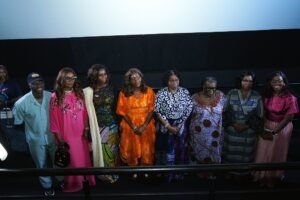
Among the guests was former Ekiti State Governor, Kayode Fayemi. Representing Governor Biodun Oyebanji, Rasaki Ojo Bakare, who recently served as commissioner for arts, culture and creative economy, led a state delegation and conveyed goodwill from the government and people of Ekiti State.
Bakare described the production as an example of how creative expression could advance social advocacy, noting that Fayemi had demonstrated that “advocacy can become art, and art can indeed become advocacy.”
Fayemi acknowledged the support of the Ford Foundation and called for sustained investment in creative projects capable of advancing meaningful social change.
Such collaboration is particularly important for productions whose objectives extend beyond conventional entertainment to include public awareness, advocacy and social development. Partnerships with foundations, development organisations and private-sector institutions can provide opportunities for creative enterprises to address issues that may not be adequately served by purely commercial production models.
Fayemi said her expectation was that the film would encourage audiences to examine their individual responsibilities and consider how their positions, professional roles and social platforms could be used to challenge violence and oppression.
“I want it to spark conversation. And I wanted to get people thinking about the roles they play based on where they are. We all occupy a space. We all have a platform,” she said.
Co-founded by veteran actors Joke Silva and Olu Jacobs, Lufodo Productions is a Nigerian creative production company focused on film, stage and television content that reflects cultural realities while maintaining international artistic standards.
Through its collaboration with Kinsman Studios, the company has brought a real-life account of abuse, intervention and survival into the public domain, demonstrating how Nigeria’s creative industry can contribute to conversations that extend well beyond the screen.