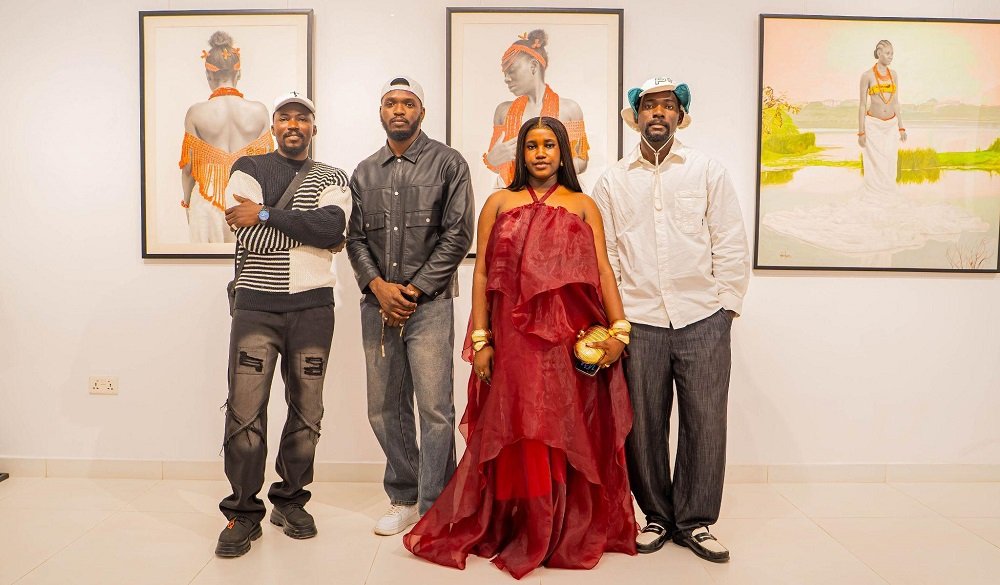
The Nigerian contemporary art market is continuing to create platforms for artists to interrogate identity, memory and social realities, with Fragments of Existence, a new group exhibition at Alexis Galleries, Lagos, bringing four contemporary artists into a shared conversation around the experiences that shape individuals and communities.
The exhibition features Ebuka Anyiam, Celesta Jonah, Idris Olabode Opeyemi and Okediji Femi, whose practices span painting, sculpture, mixed media and abstraction.
Rather than presenting fragmentation solely as a symbol of loss or incompleteness, the exhibition positions it as part of the process of becoming, using artworks to examine identity, belonging, transformation, memory and experiences that often remain unspoken.
Idris Olabode Opeyemi, a multidisciplinary artist and ceramic sculptor, uses clay as a medium for preserving stories in his Spiraled Vessels series.
Inspired by conversations with individuals with facial scarifications, Opeyemi translates elements of their experiences into ceramic vessels, incorporating markings drawn from their stories into the surfaces of the works.
The resulting pieces move beyond the physical representation of scars to explore the identities, memories and lived experiences attached to them, turning the vessels into records of personal histories.
Okediji Femi, meanwhile, employs sculpture and mixed media to examine the relationship between people and the environments they inhabit.
His works engage social realities, memory and human relationships, while reflecting on how changing environments can influence individual experiences.
His Burden of a Nation, an angular sculpture, responds to difficult realities within Nigerian society while retaining an underlying message of hope.
In Anika, Femi examines the experience of achieving something once desired and learning to appreciate it, while When We Become Strangers reflects on memories of community and connection and the changes associated with modern civilisation.
Ebuka Anyiam approaches similar questions through pencil, charcoal and acrylic, using the human figure to explore resilience, determination, identity and cultural heritage.
His work Amara, which depicts a woman standing on water, uses the image as a metaphor for determination in the face of adversity, highlighting the struggles and experiences that become part of an individual’s story.
Celesta Jonah takes a more introspective approach, working primarily in oil painting and hyper-realistic drawing to explore emotion, vulnerability and experiences that are frequently left unspoken.
Her works She Knows and Fragility examine awareness, vulnerability and the instinctive human impulse for protection, adding an intimate dimension to the exhibition’s exploration of existence.
Although their mediums and artistic approaches differ, the four artists converge on the idea that human existence is rarely a single, uncomplicated narrative.
Instead, identity is assembled over time from memories, relationships, wounds, environments, emotions and transformations; fragments that collectively form an individual’s story.
The exhibition also highlights the growing role of corporate and premium-brand partnerships in supporting Nigeria’s creative ecosystem.
The Macallan’s continued engagement with Alexis Galleries forms part of this unique relationship between premium consumer brands and the country’s creative sector.
The whisky brand previously supported the gallery’s Recycling Matters programme, including an artist residency that brought Nigerian creatives together around the use of discarded materials. The residency culminated in an exhibition examining sustainability, material transformation and craftsmanship.
With Fragments of Existence, the partnership takes a different creative direction, moving from the transformation of discarded materials to the experiences and stories that shape people.
Fragments of Existence ultimately reinforces the role of contemporary art as both a cultural and economic component of Nigeria’s creative industries.
By bringing together four distinct practices, the exhibition invites audiences to reconsider the visible and invisible experiences that constitute a life from celebrated achievements to concealed vulnerabilities, memories and personal transformations.