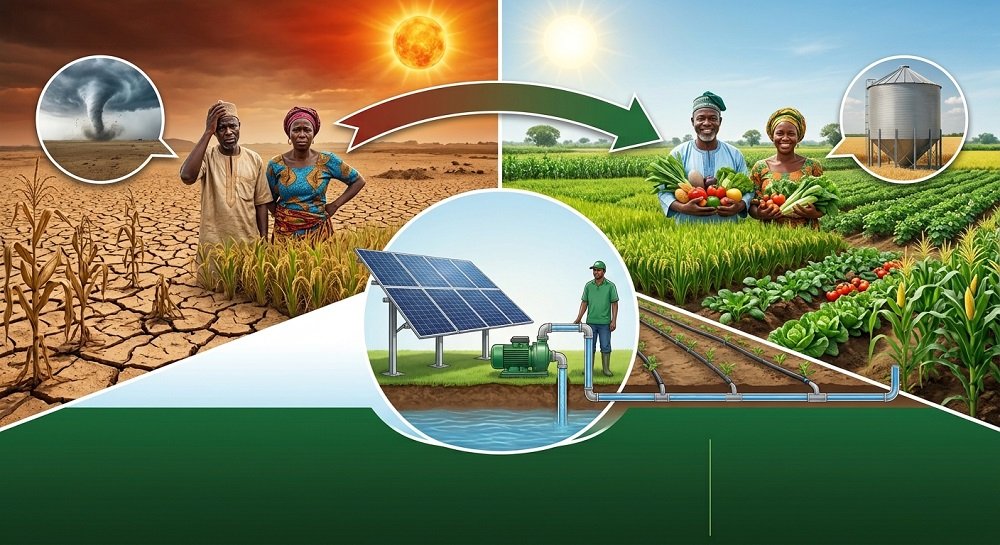
Unpredictable rainfall and rising dry-season production costs are pushing solar-powered irrigation higher on the agenda as farmers seek ways to increase food output, stabilise agricultural prices and strengthen export potential.
Solar irrigation, which uses solar energy to power pumps and distribute water to farms, is gaining global recognition as an alternative to conventional irrigation systems, particularly in developing economies where unreliable electricity supply and high energy costs limit agricultural production.
Higher productivity provides a strong economic argument for expanding irrigation. The World Bank estimates that irrigated farmland can achieve twice the productivity of non-irrigated land and three times that of rain-fed agriculture.
But the economics of adoption remain challenging. High capital requirements, limited financing, unstable policies and fragmented institutional responsibilities continue to constrain investment in irrigation and year-round farming.
The Food and Agriculture Organisation (FAO), in its assessment of solar-powered irrigation, said the technology can provide a reliable and affordable energy source and potentially reduce energy costs associated with irrigation.
The technology could also help address recurring energy shortages that disrupt the supply of water required for agricultural production, particularly in developing countries.
Climate uncertainty raises irrigation stakes
The growing interest in irrigation comes as Nigerian farmers face increasingly uncertain weather patterns.
Rainfall has traditionally determined planting and harvesting schedules for millions of smallholder farmers. But changing climate conditions are making those schedules more difficult to predict, increasing the risk of production losses and limiting the ability of farmers to cultivate crops throughout the year.
Limited rainfall and inadequate access to water have also contributed to the high cost of agricultural production during the dry season, when farmers often require additional capital to secure water for their crops.
The result is a production cycle that leaves many crops vulnerable to seasonal supply shortages and price increases.
For a country seeking to improve food security and expand agricultural exports, industry stakeholders say greater investment in irrigation could reduce dependence on rainfall and support more stable production. But large-scale adoption of solar-powered irrigation has been slow.
A World Bank assessment identified inconsistent and unstable policies, as well as an inappropriate legal framework, among the challenges affecting large-scale solar-powered irrigation development in Nigeria.
The report also pointed to institutional fragmentation in the management of irrigation development.
The Federal Ministry of Water Resources and Sanitation, the Federal Ministry of Agriculture and Food Security, state irrigation departments and River Basin Development Authorities all have responsibilities connected to irrigation development.
However, rather than operating through a coordinated framework, the involvement of multiple institutions has, according to the World Bank assessment, contributed to competing interests and a fragmented approach to irrigation development.
Cost remains a major barrier
The International Fund for Agricultural Development (IFAD) has also identified overestimation of construction costs, high overhead and management expenses, inaccurate irrigation cost-benefit analysis, as well as technical and management challenges, as factors affecting the development of irrigation facilities.
The biggest challenge for smallholder farmers remains the ability to pay. Agronomists have argued that rapid expansion of more affordable solar-powered irrigation could create opportunities for farmers, particularly those operating in drought-prone areas with limited energy infrastructure.
Kenneth Okonkwo, chief executive officer of Irritech Nigeria Limited, said solar-powered irrigation could provide farmers with more consistent access to water, helping them increase productivity, reduce production costs and cultivate crops throughout the year.
According to him, the technology could reduce farmers’ dependence on rainfall while increasing the possibility of multiple cropping and reducing instability in agricultural output.
“The solar irrigation solution provides constant access to water for farmers to help them increase their productivity, reduce cost of production and ensure all-round production of crops throughout the year,” Okonkwo said.
Adekunle Oluwasegun, a professor of Agricultural Extension and Rural Development at the University of Ilorin, called for greater investment and improved access to solar-powered irrigation facilities by both government and private organisations.
Oluwasegun said farmers also require continuous technical knowledge and awareness to improve their understanding and adoption of irrigation technologies.
He described solar-powered irrigation as technically mature, highly reliable and economically competitive.
“The solar-powered irrigation system is the new face of smart agriculture practice made possible by innovation. It allows the farmer to do more with less and the effect is threefold as it enables them to save water, save money and save energy,” he said.
Farmers demand specialised financing
The All Farmers Association of Nigeria (AFAN), Lagos State chapter, has also called for increased financing for irrigation to enable farmers to cultivate crops throughout the year and increase food production.
Sakin Agbayewa, chairman of AFAN in Lagos State, said Nigeria’s heavy dependence on rain-fed agriculture was leaving farmers vulnerable to increasingly unpredictable weather conditions.
“We have a rain-fed agriculture system and most farmers have no capital to adopt irrigation solutions or technology.
“There is nothing our farmers can do to ensure all-year-round farming without proper irrigation systems. Farmers have to wait for the rain before they commence cultivation.
“However, with current climate change realities, planting is no longer predictable,” Agbayewa said.
According to Agbayewa, the ongoing August break has further disrupted the traditional farming calendar, making it increasingly difficult for farmers to determine planting and harvesting periods.
He said prolonged changes in rainfall patterns could force farmers to rethink traditional production schedules.
Nigeria’s dependence on rainfall has also contributed to the perception that certain crops can only be cultivated during specific seasons, he noted.
But with access to reliable irrigation, farmers could potentially cultivate a wider range of crops outside traditional planting periods.
“Who told us that these crops are seasonal? There is no research that says some crops are seasonal.
“However, because most local farmers practise rain-fed agriculture due to a lack of finance, technological know-how or technological advantage, we have decided that there are seasonal crops,” ,” Agbayewa remarked.
Agbayewa called on the government to provide financial support that would enable farmers to establish irrigation systems and adopt technologies required for year-round cultivation.
“I would advise that we should begin to think out of the box and do all-year-round planting once we have the capacity to do it.
“We can create our own water irrigation system if the government comes to the aid of local farmers financially,” he noted further.
Smallholders hold the key
The financing challenge is particularly significant because of the structure of Nigeria’s farming population.
Agbayewa said about 70 percent of Nigerian farmers are subsistence farmers, while the remaining 30 percent operate commercially.
He added that women account for about 80 percent of subsistence farmers, highlighting the importance of designing financing models that can reach small-scale producers.
“So, how many farmers have the financial capacity to go for irrigation?” he asked.
“The government should come into it and talk to the banks, or have specialised institutions that will handle irrigation financing for farmers,” he added.
He suggested that farmland could be used as collateral to enable farmers to access loans for irrigation equipment and other agricultural technologies.
A potential new growth frontier
According to analysts, the economic case for expanding solar-powered irrigation extends beyond farm output.
More reliable water access could enable multiple cropping, reduce seasonal supply shortages and support more stable prices for agricultural products.
It could also strengthen the agricultural value chain by providing processors, transporters, exporters and retailers with a more consistent supply of farm produce.
For Nigeria’s food economy, however, the potential of solar irrigation will depend on whether policymakers can address the structural constraints that have slowed investment.
Analysts contend that coordinated institutional framework, clearer policies, lower equipment costs and specialised financing could determine whether the technology remains limited to a relatively small number of commercial farms or becomes accessible to millions of smallholder producers.
As climate patterns become less predictable, the economic risks of relying almost entirely on rainfall are becoming more difficult for farmers and policymakers to ignore.
Solar-powered irrigation offers the prospect of greater control over production and could support higher food output and more stable supplies. Yet innovation alone will not transform agriculture.
The real test is whether financing can make the technology accessible. Without affordable funding and coordinated investment, solar irrigation risks becoming a solution with proven potential but limited reach, leaving millions of farmers dependent on the uncertainties of the next rainy season.