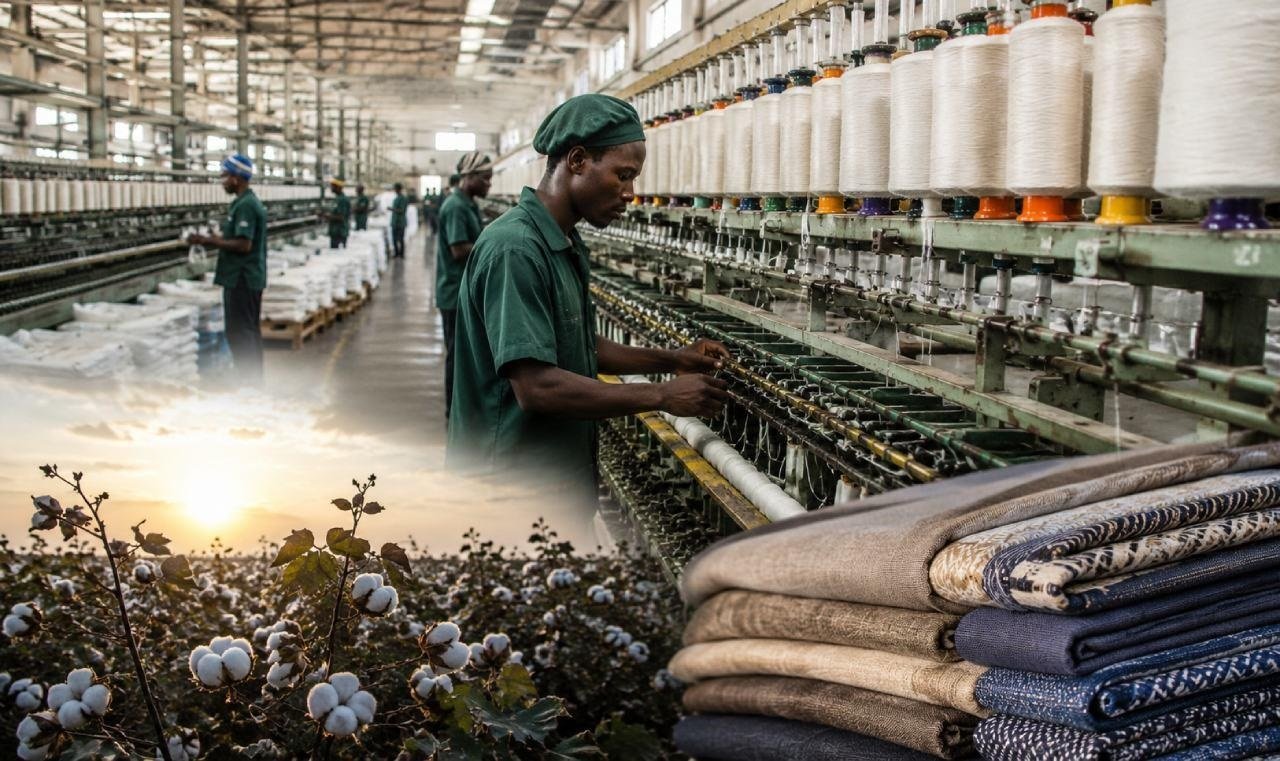
Nigeria is spending more than N1 trillion a year importing fabrics while the cotton farms and textile factories that could supply much of that demand struggle to survive. The growing dependence on foreign textiles is exposing the cost of decades of industrial decline, squeezing domestic manufacturers, weakening the market for local cotton and leaving the country’s large consumer base increasingly reliant on overseas production.
The situation is underscored by the latest trade figures. Nigeria imported textile products and textile articles worth N1.061 trillion in 2025, up from N726.18 billion in 2024, according to data from the National Bureau of Statistics (NBS). Imports reached another N578.51 billion in the first half of 2026, extending the country’s dependence on foreign fabrics and textile-related goods.
Against this backdrop, the Cotton, Textile and Garment Development Forum (CTGDF) has urged the federal government to preserve viable textile and cotton-processing factories facing receivership, while recovering legitimate public loans. Its proposed 12-month industrial asset preservation and recovery protocol would begin with a 90-day national audit of distressed facilities to determine which can be rehabilitated, restructured, transferred to credible operators or closed in an orderly manner.
The forum’s call coincides with renewed government efforts to establish the Cotton, Textile and Garment Development Board, an institution intended to coordinate the sector’s revival from cotton farming through ginning, textile manufacturing and garment production. The National Economic Council endorsed the board’s establishment at its 149th meeting on April 24, 2025. The Federal Government inaugurated a steering committee on March 5, 2026, to develop its framework, mandate, composition, powers and funding arrangements.
The forum says the committee completed its work on April 7 and is urging the government to move from policy approval to implementation. It wants President Bola Ahmed Tinubu to approve the board’s take-off, endorse the committee’s recommendations and authorise transmission of an Executive Bill to the National Assembly.
The proposed board is expected to be funded principally through a Textile Import Levy collected by the Nigeria Customs Service. The forum has called for the levy to be reconciled and for a transparent, auditable mechanism to be established for financing the board and approved programmes.
Manufacturers and investors will be watching whether the proposed institutional arrangement can address problems that have undermined previous efforts to revive Nigeria’s textile industry. Past interventions include a N100 billion Cotton, Textile and Garment Fund launched in 2009 and managed by the Bank of Industry. Despite such measures, the industry has continued to shrink, with many factories still closed and domestic cotton production remaining well below historical levels.
The latest trade data showcase the widening imbalance between domestic production and foreign supply. Textile imports rose from N377.47 billion in 2023 to N726.18 billion in 2024 before exceeding N1 trillion in 2025. In the same period, textile export earnings fell in 2025, declining to N16.55 billion from N36.98 billion in 2024, according to NBS figures.
The consequences extend beyond the manufacturers themselves. A weak domestic textile industry limits the market available to cotton farmers, reduces demand for ginning and other processing services, and constrains employment across production, distribution and garment-making. It also means a larger share of spending on textile products flows to overseas producers rather than circulating through Nigerian farms and factories.
The sector’s output has also weakened. Data from the NBS show that the value attributed to the cotton, textile and garment industry fell from N4.548 trillion in 2023 to N4.476 trillion in 2024 and N4.384 trillion in 2025, a decline of about N164 billion over two years.
The figures reflect a prolonged loss of industrial capacity. Nigeria once had around 180 textile mills, supported by large numbers of workers and cotton farmers. Industry reports now put the number of operational mills at fewer than 20, with capacity utilisation at low levels. The CTGDF estimates that about 180 textile factories have shut down and that imports account for approximately 90 per cent of domestic textile demand.
The sector’s decline is particularly visible in traditional textile centres such as Kaduna and Kano. In Kaduna, industry figures indicate that 11 textile mills once employed more than 50,000 workers. Today, only a small remnant of the former industrial base remains. Several once-prominent mills in Kano have also disappeared after years of pressure from high operating costs, cheap imports and shortages of locally produced cotton.
The loss of factories has had consequences for communities that depended on textile wages and related businesses. Former workers have described how industrial employment supported local commerce, household spending and small enterprises. As factories closed, those economic links weakened, while workers who lost their jobs faced prolonged financial hardship.
Cotton shortages undermine the entire value chain
The textile revival depends on more than reopening mills. It also requires restoring the agricultural base that supplies their principal raw material.
Nigeria’s cotton output, estimated at about 300,000 tonnes in the 1980s, has fallen to roughly 13,000 to 15,000 tonnes in current industry estimates. The CTGDF cites output of approximately 13,000 metric tonnes, while other figures supplied by industry stakeholders put production at around 15,000 tonnes. The estimates vary, but both show a steep contraction from historical levels.
The number of cotton farmers has also reportedly declined from about 620,000 to roughly 100,000. Poor-quality or contaminated seeds, low yields, inadequate access to modern farm equipment and insecurity have made cotton cultivation less attractive in several producing areas.
Average yields are reported to have fallen to between 500 and 600 kilogrammes per hectare, compared with historical productivity estimates of 1.5 to two tonnes. Lower yields reduce the volume of cotton available to ginneries and mills, while uncertain demand discourages farmers from investing in improved seeds and farm inputs.
Insecurity has compounded the problem in parts of the North-West, where farmers have abandoned cotton fields or switched to crops they consider less risky or more commercially attractive. Ibrahim Mu’azu of Funtua Textiles has described the change in farming patterns, saying: “Travelling from Funtua to Zamfara, you won’t find a single cotton farm. They’ve all turned to soybeans.”
Energy costs and price competition squeeze manufacturers
Even where raw materials are available, Nigerian textile producers face a challenging cost structure. Unreliable electricity supply forces many manufacturers to rely on diesel generators and other alternative sources of power. Industry estimates energy can account for around 35 per cent of local manufacturing costs, leaving producers exposed to fuel prices and the cost of maintaining their own power systems.
That burden affects every stage of production, from spinning and weaving to dyeing, finishing and garment assembly. Textile manufacturing is energy-intensive, and inconsistent electricity can also disrupt production schedules, raise maintenance costs and reduce capacity utilisation.
Manufacturers must then compete against imported fabrics that can enter the market at prices local producers struggle to match. Industry stakeholders have complained about smuggling, counterfeit goods and synthetic fabrics sold at low prices, arguing that weak enforcement of trade rules puts compliant domestic operators at a disadvantage.
The price comparison cited by stakeholders show that some imported fabrics are reportedly sold at around N1,000 for five yards, while local production costs for a comparable quantity can exceed N5,000. The figures are industry claims rather than a verified like-for-like market comparison, but they indicate the scale of the cost challenge facing domestic manufacturers.
Adamawa and Gombe offer potential for cotton recovery
Despite the nationwide decline, some states retain the agricultural conditions or processing infrastructure needed to support a recovery.
Adamawa is regarded by industry stakeholders as having fertile soils and potential for high-quality cotton production. Farmers, however, need greater access to tractors, improved seedlings and sustained public and private investment to expand output.
Gombe also offers potential. Farmers there have reportedly shown renewed interest following input support through partnerships involving Chad and Cameroon. Cotton prices cited by stakeholders have risen to around N750,000 per tonne, encouraging some farmers to reconsider the crop.
These opportunities point to the importance of a geographically targeted strategy. Rather than applying identical interventions across the country, policymakers could focus on areas where suitable land, farming expertise, ginneries, transport links and industrial facilities already exist. Such an approach would help direct limited resources towards value chains with a clearer path to commercial viability.
Isma’il Anchau of Kaduna Polytechnic has advocated public-private partnerships to attract investment and rebuild cotton farming. Anibe Achimugu, president of the National Cotton Association of Nigeria and coordinator of the CTGDF, has also stressed the importance of private-sector-driven reforms to meet the industry’s challenges.
Global growth offers an opening, not a guarantee
The potential opportunity extends beyond Nigeria’s domestic market. Mordor Intelligence estimates the global cotton market at $44.30 billion in 2026 and projects it will reach $53.50 billion by 2031, representing compound annual growth of 3.85 per cent over the forecast period. Asia-Pacific is the largest market, while Africa is identified as the fastest-growing region.
The global outlook offers a possible opening for African producers, but regional growth will not automatically translate into gains for Nigeria. Capturing a larger share of the market requires consistent quality, efficient processing, competitive costs and dependable logistics. Producers must also meet the specifications of domestic and international buyers, including requirements related to product durability, colour consistency and delivery schedules.
Nigeria’s challenge is therefore to convert its agricultural potential and large consumer market into a competitive manufacturing system. This requires investment across the chain rather than isolated support for one factory, one farming season or one category of input.
The government has signalled renewed interest in the sector. Vice President Kashim Shettima has argued that cotton can thrive in 34 states, describing the gap between that potential and current production as a call for action. Minister of State for Industry John Enoh has also visited textile hubs as part of the renewed policy focus.
The proposed CTG Development Board is expected to coordinate these efforts, with the Textile Import Levy providing a potential funding mechanism. Its effectiveness, however, will depend on clear accountability, timely disbursement, private-sector participation and measurable targets for cotton output, factory utilisation, employment and export performance.