The US Federal Aviation Administration (FAA) is moving to deploy artificial intelligence in the management of the country’s airspace, introducing a system designed to identify congestion, capacity constraints and potential flight conflicts before they disrupt airline operations.
The technology, known as Strategic Management of Airspace, Routes and Trajectories (SMART), is scheduled for initial operations in the Washington area this fall, marking the first operational deployment of the system as the FAA seeks to move from reacting to air traffic bottlenecks to anticipating them.
SMART analyses airline schedules, weather, airport capacity, airspace conditions and other operational constraints to predict traffic flows and identify potential conflicts before flights depart.
The FAA says the system will not replace air traffic controllers. Instead, it will operate as a planning layer alongside existing air traffic management systems, giving controllers, airlines and other operators a shared real-time picture of conditions across the network.
The move forms part of a major technology programme being developed with Air Space Intelligence (ASI). The FAA awarded ASI a contract covering SMART and the related Flow Management Data and Services (FMDS) platform, with the programme running for 12 years. The contract has been reported at about $875 million.
The commercial proposition behind SMART is straightforward: identify an airspace problem while there is still time to prevent it from becoming a wider disruption.
Today, traffic managers must constantly balance scheduled demand against available airport and airspace capacity. Weather, runway closures, equipment problems and other unexpected events can quickly upset that balance, forcing aircraft to be rerouted, held on the ground or delayed.
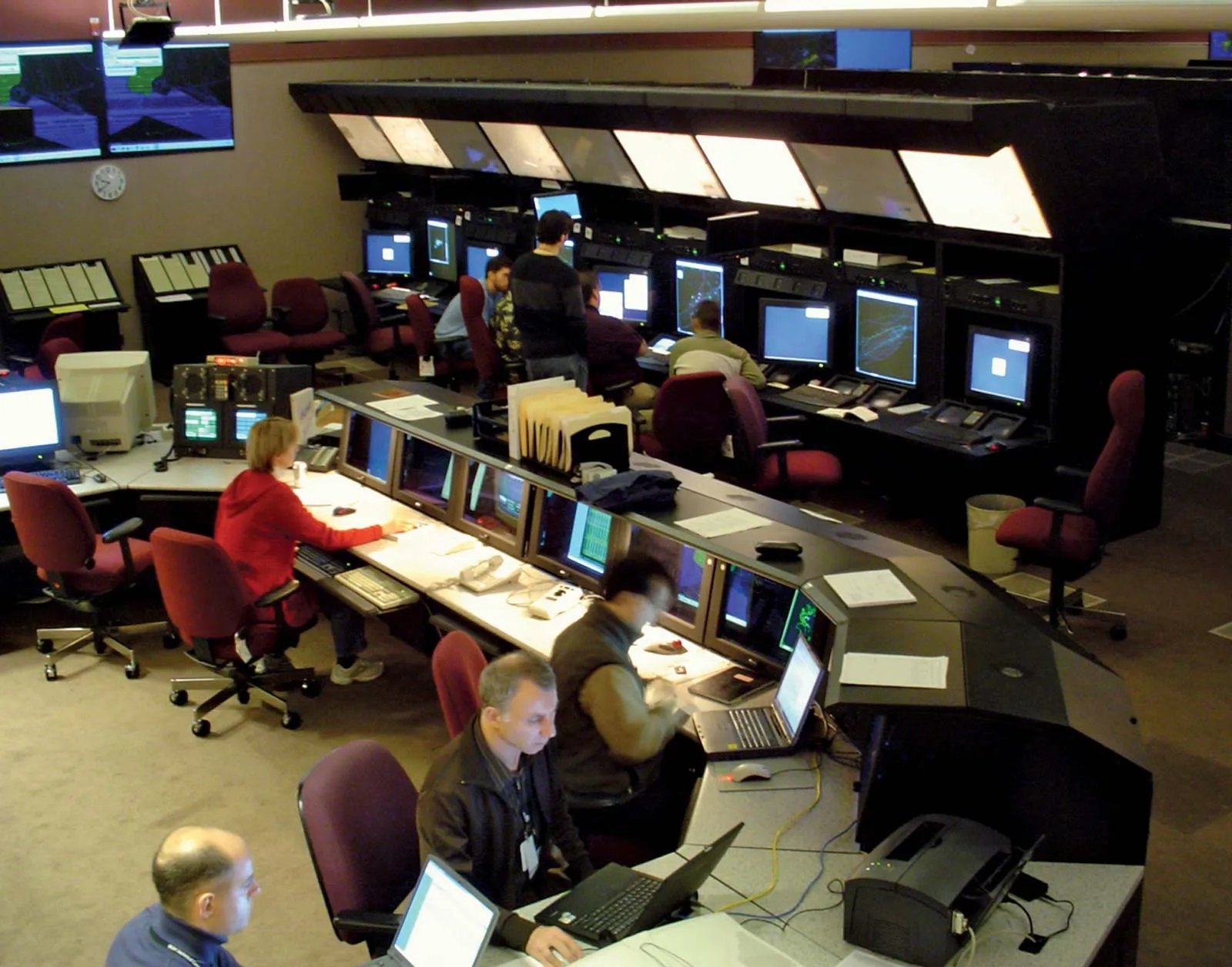
The FAA’s existing Air Traffic Control System Command Center already manages these disruptions through measures including rerouting, ground-delay programmes and other traffic-management initiatives.
SMART is intended to give managers greater visibility before those interventions become necessary.
The system will use information on planned flights, weather and capacity to identify constraints and conflicts earlier, allowing traffic managers to consider changes to routes, departure times and other flight trajectories before congestion spreads.
The FAA says the objective is to improve efficiency and predictability, reduce fuel burn and improve on-time performance. These are projected benefits of the technology rather than results already demonstrated from the Washington deployment.
$875m bet on aviation software
The FAA’s partnership with ASI represents a significant investment in the software infrastructure underpinning US air traffic management.
The programme combines two related systems.
FMDS is designed to serve as a technological backbone for the FAA’s Air Traffic Control System Command Center, bringing together flight plans, airline schedules and real-time aircraft-position information to estimate current and future traffic flows and capacity limitations.
SMART, operating within that environment, will use the data to provide predictive insights into demand, capacity, weather impacts and potential conflicts.
The FAA says FMDS will also support the exchange of live information between the agency and airspace users, enabling more collaborative decisions over routing and traffic management.
The architecture is therefore intended to do more than add an AI tool to an existing control system. It is designed to create a common operational picture from which the FAA and airlines can make decisions before flights take off.
Airlines stand to gain from earlier intervention
For airlines, the potential economic benefit lies in preventing small disruptions from becoming network-wide problems.
A weather event at one airport can affect aircraft rotations, crew schedules and passenger connections at several others. A runway closure or airspace restriction can create knock-on delays that persist long after the original problem has cleared.
Earlier intervention could give airlines and traffic managers more options to adjust schedules and routes before aircraft are committed to congested parts of the network.
The FAA says SMART is intended to help operators select more efficient routes and departure and arrival times while improving system-wide predictability.
Fuel efficiency is another potential benefit. Holding aircraft on the ground or in the air, diverting around congested airspace and flying less efficient routes can increase fuel consumption. The FAA’s SMART fact sheet identifies reduced fuel burn among the expected benefits of the system.
Washington provides the first operational test
The Washington deployment is significant because it will move SMART beyond development and into live aviation operations.
The FAA plans to begin initial operations in autumn 2026 and subsequently extend the technology to other parts of the US airspace.
The Washington region presents a demanding environment for such a system. The FAA’s Potomac Terminal Radar Approach Control manages aircraft operating around Ronald Reagan Washington National Airport, Washington Dulles International Airport, Baltimore/Washington International Airport and Joint Base Andrews.
The FAA’s national Air Traffic Control System Command Center, meanwhile, is responsible for balancing demand with available capacity across the wider network.
That means the initial deployment will provide an important test of whether predictive software can turn large quantities of operational data into decisions that traffic managers can act on quickly enough to make a difference.
Controllers remain in charge
Despite the emphasis on artificial intelligence, the FAA is positioning SMART as a decision-support system rather than an autonomous replacement for human air traffic control.
Controllers remain responsible for maintaining safe separation between aircraft. SMART is intended to help them identify constraints and conflicts earlier and make better-informed planning decisions.
That distinction is important because the technology will be introduced into an environment where safety, reliability and operational continuity take precedence over automation for its own sake.
The FAA describes SMART as a planning layer that enhances existing air traffic management systems rather than replacing them.
Preparing for a more crowded sky
The FAA also sees predictive technology as a way to accommodate growth in aviation without relying entirely on new physical infrastructure.
The agency says SMART can help create capacity for new airlines, cargo operators and advanced air-mobility aircraft by making more efficient use of existing airspace.
That could become increasingly important as the aviation ecosystem expands beyond conventional passenger airlines to include drones, commercial space operations and other emerging users.
The challenge is that these users will compete for the same finite airspace, creating a need for increasingly sophisticated coordination.
The Washington launch puts the FAA’s AI strategy into its first real operational test.
The technology will need to process large amounts of constantly changing information, identify meaningful constraints and deliver useful predictions early enough for traffic managers and airlines to act.
The FAA’s existing command centre already manages thousands of daily flights and responds to weather, runway closures, equipment outages and other disruptions.
SMART’s proposition is to move some of that work further upstream.
Rather than waiting for congestion to materialise and then deploying measures to contain it, the FAA wants to identify the pressure points while there is still time to alter flight schedules and trajectories